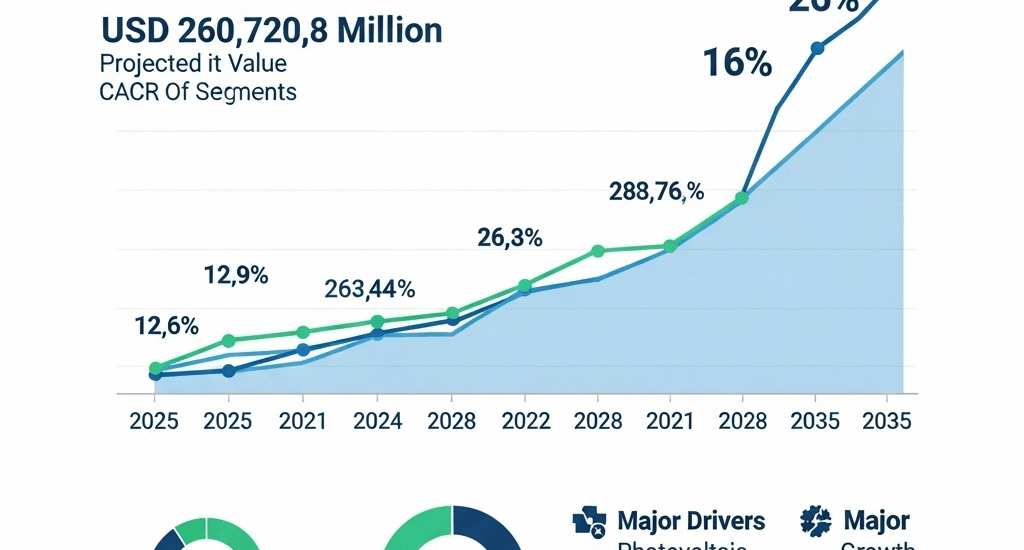
The European photovoltaic (PV) mounting system market is poised for exponential growth, driven by the continent’s aggressive pursuit of renewable energy targets and robust supportive government policies. As the foundational element of solar installations, advanced mounting systems are critical for enhancing energy generation, optimizing installation efficiency, and ensuring long-term system durability. Projections indicate a remarkable surge from USD 58,794.5 million in 2025 to an impressive USD 260,720.8 million by 2035, demonstrating a compelling Compound Annual Growth Rate (CAGR) of 16% over the forecast period.
Full Market Report available for delivery. For purchase or customization, please request here: https://www.futuremarketinsights.com/reports/sample/rep-gb-17286
Driving Europe’s Green Energy Transition
Europe’s steadfast regulatory framework, aimed at drastically reducing carbon emissions and lessening reliance on fossil fuels, has firmly established solar PV as a cornerstone of the EU’s energy strategy. This commitment is accelerating the deployment of photovoltaic mounting systems across residential, commercial, industrial, and utility-scale sectors, with both rooftop and ground-mounted arrays gaining significant traction. Germany and Spain are at the forefront of this expansion, closely followed by Italy and France, benefiting from supportive mechanisms such as feed-in tariffs, green financing initiatives, and net metering schemes that bolster solar photovoltaic projects.
Innovation and Technological Advancements
Manufacturers are actively innovating to meet diverse terrain requirements, focusing on lightweight, corrosion-resistant materials like aluminum alloys and galvanized steel. The market is witnessing a strong demand for quick-install systems, adjustable tilt designs, and structures compatible with bifacial modules. For large-scale utility projects, solar trackers are increasingly vital for maximizing energy yield, while fixed-angle and ballasting systems remain dominant in urban residential and commercial segments. Emerging technologies, including AI-assisted solar tracking, automated installation processes, and modular frame systems, are paving the way for faster deployment speeds and reduced labor costs. The region’s ongoing transition towards climate neutrality is expected to further fuel demand for sophisticated mounting solutions, large-scale solar parks, building-integrated PV (BIPV), and floating PV installations.
Regional Market Dynamics and Competitive Edge
Across Europe, distinct regional trends are shaping the competitive landscape. Northern Europe, encompassing Sweden, Finland, and Denmark, is seeing high demand for snow-stopping and bifacial-friendly rooftop and ground-based systems, prioritizing corrosion resistance for weathered climates. Elevated mounting systems are also gaining prominence in dense urban areas where space is limited.
Western Europe, led by Germany, France, and the Benelux region, dominates the market due to aggressive solar deployment targets and utility-scale investments. Manufacturers here are focusing on recyclable materials and automation-ready systems, with strong demand for aluminum and steel frames featuring quick-install capabilities for large modules.
Southern Europe, including Italy, Spain, and Portugal, leverages high solar irradiance for widespread on-site PV deployment. The region is expanding rooftop solar and agrivoltaic systems, increasingly utilizing tilt and tracking structures. Mounting systems with dust-resistant coatings and low-maintenance designs are preferred in these sun-intense locales.
Eastern Europe, a burgeoning growth market, benefits from EU energy transition and solar infrastructure funding. Countries like Poland, Romania, and Bulgaria are integrating PV solutions into municipal and rural energy programs, showing a preference for low-cost fixed-mount systems while gradually adopting modular, tracker-based platforms for larger utility-scale projects.
Challenges and Opportunities Ahead
The market faces challenges such as land constraints, particularly in urban and heritage environments, and lengthy permitting processes across EU jurisdictions. Variable climatic conditions necessitate region-specific engineering, adding to cost and complexity. However, significant opportunities arise from the demand for agile installation solutions, especially for temporary or mobile systems. Europe’s drive towards carbon-neutral infrastructure is creating a strong market for recyclable, low-embodied-carbon mounting materials. Technological advancements in dual-axis trackers, rooftop elevation structures, and AI-enhanced alignment systems are set to redefine market performance and design expectations.
Market Evolution: Past Trends and Future Projections
Between 2020 and 2024, the market was significantly boosted by pandemic recovery stimuli, escalating electricity prices, and a renewed commitment to the EU Green Deal. This period saw a rapid proliferation of rooftop PV in residential and commercial & industrial (C&I) segments, with urban rollouts standardizing lightweight frames and preassembled kits.
Looking ahead from 2025 to 2035, the industry is poised to transition towards next-generation mounting platforms designed to accommodate ultra-large solar modules, enable smart integration with energy storage, and facilitate co-location alongside agriculture or transportation infrastructure. Custom anchoring and wind-resistant frames will be crucial for floating and vertical PV systems. The era of digital twins and embedded monitoring for structural health assessment will emerge as premium offerings, while policy harmonization and recycling mandates will push suppliers towards eco-efficient designs and end-of-life management protocols.
Segmentation Outlook: Rooftop and B2B Lead
Rooftop mounting systems are projected to dominate the European market, accounting for 48.9% in 2025, driven by surging urban solar demand in residential and commercial sectors, streamlined permitting, and tax incentives. Innovations like low-profile frames, tilt-in rails, and dual-function solar shingles are facilitating this adoption.
The Business-to-Business (B2B) sales channel will continue to lead, commanding 61.3% of sales by 2025. Engineering, Procurement, and Construction (EPC) firms are major buyers, favoring preassembled and scalable mounting kits to minimize installation time and labor costs. Strategic supply contracts with solar farm developers and public housing authorities will further amplify B2B volume purchases.
Request a Draft Report Here: https://www.futuremarketinsights.com/reports/brochure/rep-gb-17286
Competitive Landscape
The European photovoltaic mounting system market is highly competitive, characterized by rapid innovation in materials that enhance durability and accelerate assembly. Major players are focusing on lightweight aluminum alloys, corrosion-resistant coatings, and tilt-adjustable mechanisms. Companies are also offering additional value through comprehensive installation services and structural engineering support. Strategic partnerships with utility-scale developers and urban planners are driving growth in ground-mounted and carport systems.
Leading the market are Schletter Group, holding an estimated 16-19% market share, renowned for its engineering-focused solutions like the ProLine series, ideal for challenging climates. Mounting Systems GmbH, with 13-16% market share, focuses on fast deployment and structural safety, with its Sigma II line gaining traction in large utility-scale projects. K2 Systems, holding 12-15% market share, is a pioneer in carport and rooftop installations, particularly for residential and EV charging infrastructure, offering innovative drainage and corrosion protection. Renusol Europe GmbH, with 10-13% market share, provides compact, rail-less systems popular among European contractors for their speed and versatility. The remaining 37-42% of the market is shared by other key players such as Van der Valk Solar Systems, Clenergy, Esdec, Antaisolar, and S-Flex GmbH, each offering specialized solutions tailored to regional demands.
About Future Market Insights (FMI)
Future Market Insights, Inc. (ESOMAR certified, recipient of the Stevie Award, and a member of the Greater New York Chamber of Commerce) offers profound insights into the driving factors that are boosting demand in the market. FMI stands as the leading global provider of market intelligence, advisory services, consulting, and events for the Packaging, Food and Beverage, Consumer Technology, Healthcare, Industrial, and Chemicals markets. With a vast team of over 400 analysts worldwide, FMI provides global, regional, and local expertise on diverse domains and industry trends across more than 110 countries.
Join us as we commemorate 10 years of delivering trusted market insights. Reflecting on a decade of achievements, we continue to lead with integrity, innovation, and expertise.
Contact Us:
Future Market Insights Inc.
Christiana Corporate, 200 Continental Drive,
Suite 401, Newark, Delaware – 19713, USA
T: +1-347-918-3531
For Sales Enquiries: sales@futuremarketinsights.com
Website: https://www.futuremarketinsights.com
LinkedIn| Twitter| Blogs | YouTube