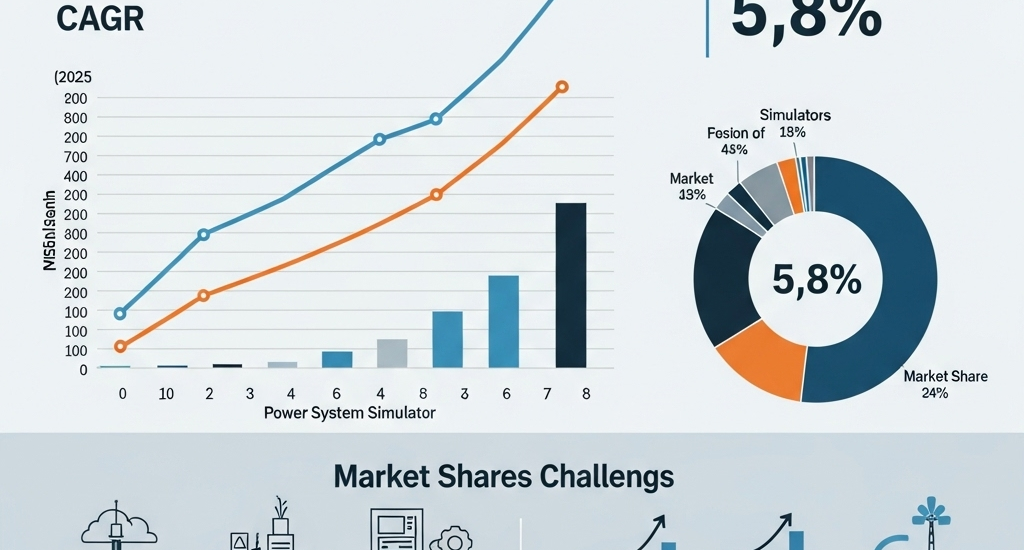
The global Power System Simulator market is poised for significant expansion, with a new industry outlook projecting its value to reach USD 2,369.4 Million by 2035, up from USD 1,438.2 Million in 2025. This robust growth, anticipated at a Compound Annual Growth Rate (CAGR) of 5.8% over the decade, underscores the critical role of advanced simulation tools in enhancing grid reliability, stability, and efficiency worldwide. The increasing integration of cutting-edge technologies like the Internet of Things (IoT) and Artificial Intelligence (AI) in power systems is a key accelerator for this market, alongside a relentless global focus on cost reduction and energy efficiency.
Full Market Report available for delivery. For purchase or customization, please request here: https://www.futuremarketinsights.com/reports/sample/rep-gb-17321
Revolutionizing Grid Management: Drivers and Opportunities
The power system simulator market is experiencing unprecedented momentum, driven by a confluence of factors. The escalating complexity of modern electrical grids, coupled with the rapid integration of diverse renewable energy sources and the ongoing digital transformation of utility operations, necessitates sophisticated simulation capabilities. These tools empower grid operators, engineers, and planners to accurately model real electrical conditions, enabling informed decision-making and proactive maintenance strategies.
A significant opportunity lies in the global transition towards renewable energy sources, the proliferation of microgrids, and the broader grid modernization efforts. Power system simulators are indispensable for stakeholders to visualize grid behavior, predict energy loads, optimize generation scheduling, and evaluate emergency scenarios in a risk-free virtual environment. As solar, wind, battery storage, and electric vehicle (EV) charging networks expand, simulators become vital for maintaining grid stability, reliability, and resilience. Emerging opportunities include real-time digital twin simulation, AI-enhanced grid modeling, and cyber-physical system testing, further solidifying the market’s upward trajectory.
Regional Dynamics: A Global Shift Towards Smarter Grids
Geographically, North America continues to be a dominant force in the power system simulator market. The region’s substantial investments in renewable energy integration, energy storage solutions, and grid reliability testing are propelling demand. In the United States, simulators are extensively utilized for cybersecurity assessments, interconnection studies, and smart grid pilot projects, aligning with NERC compliance and digital twin energy modeling initiatives, with the US alone projected to see a CAGR of 5.9%.
Europe is demonstrating steady growth, fueled by its strong commitment to renewable energy integration and stringent environmental regulations. Countries such as Germany, France, and the UK are heavily investing in smart grid technologies and energy storage, thereby driving demand for advanced simulation tools. The European Union, with a projected CAGR of 5.8%, is actively leveraging simulators for cross-border grid coordination, particularly for offshore wind integration and real-time congestion management, within frameworks like the Clean Energy for All Europeans package.
The Asia-Pacific region is set to emerge as the fastest-growing market, propelled by rapid industrialization, urbanization, and burgeoning energy demand. Nations like China and India are significantly augmenting their power generating capacities and investing in modern grid projects. Simulation technologies are playing a critical role in facilitating the integration of renewable energy, the development of smart cities, and ensuring efficient power distribution across the region. South Korea, with a strong emphasis on its smart grid master plan and a projected CAGR of 5.9%, and Japan, at 5.7%, are also contributing significantly to this growth by deploying simulators for distributed resource planning, EV grid impact modeling, and virtual power plant management. The UK is also showcasing a healthy growth rate of 5.6%.
Market Segmentation Highlights: Software and Load Flow Lead the Way
Within the power system simulator market, software-based offerings and load flow modules are commanding the largest market shares. Software solutions, accounting for 69.3% of offerings in 2025, are preferred due to their inherent flexibility, cost-effectiveness, and ease of integration with existing digital infrastructures. These platforms facilitate complex electrical modeling, automated simulation runs, and cloud-based scenario planning, making them indispensable for planning, training, and real-time control. The urgent need for scalable and customizable software tools is particularly evident with the increasing demand for decentralized energy and EV charging networks.
Load flow modules, holding 54.7% of the module market share in 2025, are fundamental for simulating voltage levels, real and reactive power flow, and losses within an electrical network. These modules are critical for grid stability studies, network planning, and fault analysis, providing essential operational visibility and control accuracy. Advances in real-time data inputs, automated control model updates, and AI-based optimization are further enhancing the speed and accuracy of load flow simulations, especially in smart grid and microgrid applications.
Competitive Landscape: Innovation Driving Market Leadership
The Power System Simulator market is characterized by intense competition, with key players continuously innovating to enhance their product offerings. Siemens AG, with an estimated market share of 14-18%, leads the charge, integrating AI-driven grid forecasting and multi-domain simulation for transmission & distribution convergence. General Electric (GE Digital), holding 12-16% market share, has enhanced its GridOS™ suite with real-time hybrid simulation for renewables and launched a cloud-based power system sandbox. OPAL-RT Technologies (10-14%) is a frontrunner in real-time simulation and Hardware-in-the-Loop (HIL) solutions, emphasizing cyber-physical modeling. RTDS Technologies Inc. (8-12%) remains a trusted provider of real-time electromagnetic transient (EMT) simulators, while ETAP (Operation Technology Inc.) (6-9%) delivers industry-standard digital twins and offline-to-online transition tools.
Beyond these market leaders, a vibrant ecosystem of academic institutions, engineering firms, and automation-focused companies, collectively holding 30-40% of the market share, are driving further innovation. These include Typhoon HIL for ultra-fast HIL platforms, DIgSILENT GmbH for comprehensive power factory software, and MathWorks for MATLAB/Simulink-based toolsets. The competitive landscape is also seeing the entry of cloud-native simulation platforms, digital twin developers, and energy AI providers, indicating a dynamic shift towards more adaptive, high-fidelity, and interconnected simulation ecosystems.
Request a Draft Report Here: https://www.futuremarketinsights.com/reports/brochure/rep-gb-17321
Outlook for 2025-2035: A Digitally Resilient Future
The period from 2025 to 2035 will witness a significant evolution in the power system simulator market, moving towards cloud-based, AI-enabled simulation platforms offering real-time, decentralized, and scalable power system analysis. The development of interconnected regional energy markets, smart substations, and grid-edge technologies will further fuel demand for adaptive, high-fidelity simulators. Use cases are expanding beyond traditional applications, incorporating predictive outage simulation, carbon optimization, and autonomous grid control testing. As the world accelerates towards electrification of transport and decentralized energy systems, power system simulators will be a core tool for planning carbon neutrality, designing low-loss grid architectures, and ensuring digital resilience in an increasingly complex and interconnected energy future.
About Future Market Insights (FMI)
Future Market Insights, Inc. (ESOMAR certified, recipient of the Stevie Award, and a member of the Greater New York Chamber of Commerce) offers profound insights into the driving factors that are boosting demand in the market. FMI stands as the leading global provider of market intelligence, advisory services, consulting, and events for the Packaging, Food and Beverage, Consumer Technology, Healthcare, Industrial, and Chemicals markets. With a vast team of over 400 analysts worldwide, FMI provides global, regional, and local expertise on diverse domains and industry trends across more than 110 countries.
Join us as we commemorate 10 years of delivering trusted market insights. Reflecting on a decade of achievements, we continue to lead with integrity, innovation, and expertise.
Contact Us:
Future Market Insights Inc.
Christiana Corporate, 200 Continental Drive,
Suite 401, Newark, Delaware – 19713, USA
T: +1-347-918-3531
For Sales Enquiries: sales@futuremarketinsights.com
Website: https://www.futuremarketinsights.com
LinkedIn| Twitter| Blogs | YouTube