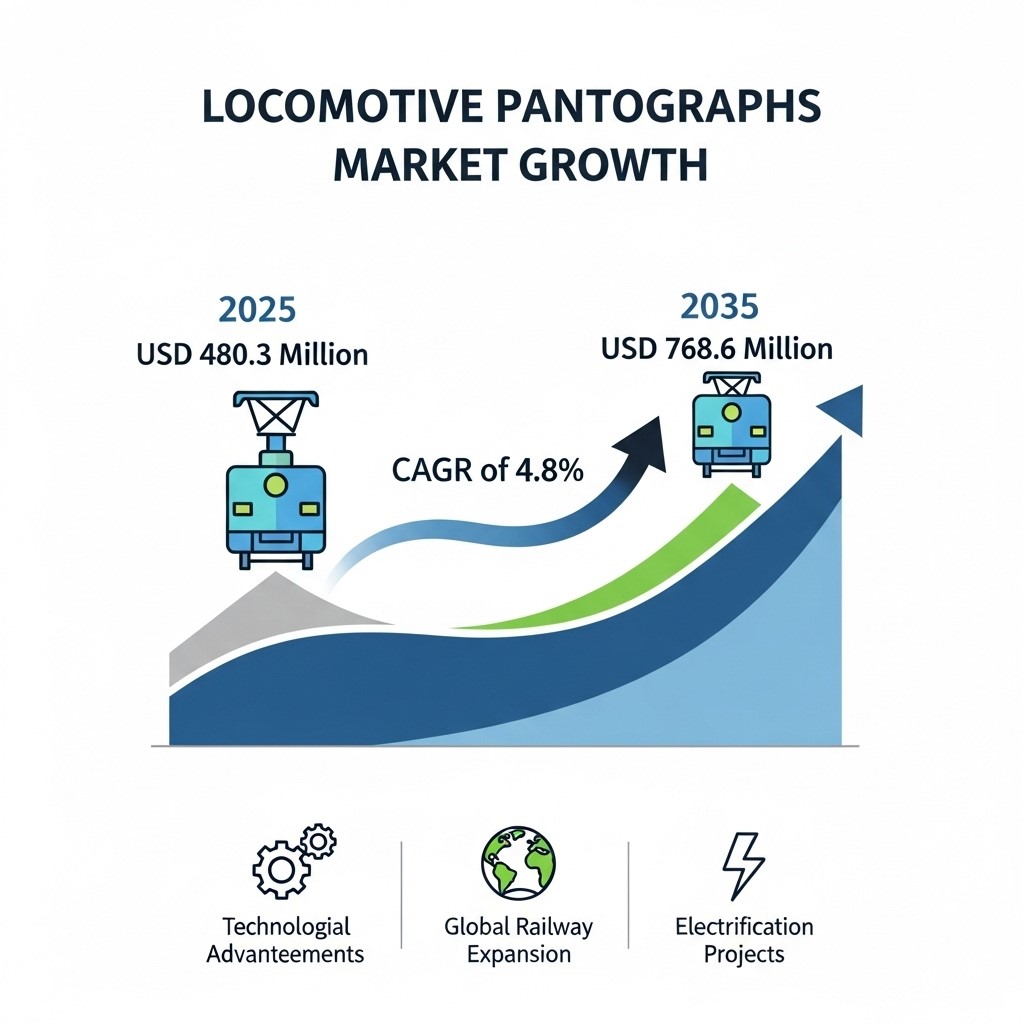
The global locomotive pantographs market is witnessing steady growth, with an estimated valuation of USD 462.3 million in 2024. Projected to reach USD 480.3 million in 2025, the market is expected to expand at a CAGR of 4.8% from 2025 to 2035, achieving USD 768.6 million by 2035. Rising railway electrification, high-speed rail development, and technological innovations in pantograph design are the primary factors driving this growth.
Single-arm pantographs are becoming increasingly preferred due to their aerodynamic efficiency, lightweight design, and lower maintenance costs. Modern smart pantographs with real-time monitoring and predictive maintenance features are expected to see rapid adoption. Expansion in high-speed and urban rail networks globally continues to fuel demand for advanced pantograph systems.
Full Market Insights Available. Inquire for Customization or Purchase https://www.futuremarketinsights.com/reports/sample/rep-gb-16119
Report Coverage & Deliverables:
- Detailed analysis of global locomotive pantograph market trends from 2025 to 2035.
- Insights into market size, projected growth, and CAGR trends.
- Segmentation by pantograph arm type (single vs. double) and train type (high-speed, conventional).
- Regional market outlook covering Asia, Europe, North America, and key emerging economies.
- Competitive landscape, including Tier 1, Tier 2, and Tier 3 players, and strategic initiatives.
- Analysis of technological advancements, sustainability initiatives, and infrastructure expansion influencing market dynamics.
- Semi-annual update on market growth and performance trends.
Key Factors Shaping Market Dynamics:
- Railway Electrification: Governments worldwide are expanding electrified rail networks to reduce carbon emissions and improve energy efficiency. Over 40% of the global rail network is electrified, with India aiming for 100% electrification by 2030. Countries like China and Germany are investing heavily in electrified rail infrastructure.
- High-Speed Rail Expansion: Rapid growth in high-speed rail networks across China, Japan, France, and Spain is increasing demand for advanced pantographs capable of operating at speeds exceeding 300 km/h. Lightweight, aerodynamic designs and active damping mechanisms are critical for performance and efficiency.
- Technological Advancements: Modern pantographs incorporate carbon fiber components, smart sensors, real-time monitoring, and automated height adjustment systems. These innovations enhance durability, operational efficiency, and reliability, particularly for high-speed rail applications.
- Government Sustainability Initiatives: Policies such as the EU Green Deal and China’s carbon neutrality goals are driving the adoption of electric locomotives, boosting demand for pantographs as key components for power collection and transmission.
- Infrastructure Modernization: Investments in high-speed, metro, and freight rail systems are fueling demand for next-generation pantographs that reduce energy loss, maintenance costs, and operational downtime.
Key Takeaways:
- The locomotive pantographs market is set to grow from USD 480.3 million in 2025 to USD 768.6 million by 2035.
- Single-arm pantographs dominate with a projected 74.7% market share by 2035 due to superior aerodynamic efficiency, lightweight design, and cost-effectiveness.
- High-speed trains are expected to hold 42.2% of the market share, driven by growing adoption and government investment in sustainable transport.
- China, India, and Germany are projected to record CAGRs of 6.1%, 5.7%, and 5.4%, respectively, between 2025 and 2035.
- Technological innovations such as smart monitoring systems, carbon-fiber components, and automated height adjustment are key enablers of market growth.
- Tier 1 companies, including Wabtec Corporation, The+together Group, Schneider Electric, and HeidelbergCement, dominate 50-55% of the global market share, while Tier 2 and Tier 3 players cater to regional and niche demands.
Regional Analysis:
- Asia: China leads the global locomotive pantographs market with a CAGR of 6.1%, driven by extensive high-speed rail expansion and the Belt and Road Initiative. India follows closely with a 5.7% CAGR, fueled by ambitious electrification goals and urban rail network growth. Japan is also witnessing strong demand for pantographs in its Shinkansen high-speed rail network.
- Europe: Germany’s market is set to grow at 5.4% CAGR, supported by sustainable transport initiatives, the EU Green Deal, and high-speed rail development. France and Spain continue to expand their TGV and AVE networks, increasing pantograph demand.
- North America: The U.S. and Canada are modernizing rail infrastructure, promoting adoption of electric locomotives and advanced pantograph systems, with moderate growth prospects of 4.7% and 4.4% CAGR, respectively.
Key Segments of Market Report:
- By Arm Type: Single-arm (dominant) vs. double-arm pantographs. Single-arm variants are preferred for high-speed rail due to lightweight and aerodynamic advantages.
- By Train Type: High-speed trains (42.2% share) vs. conventional trains. High-speed rail adoption drives the need for advanced pantograph systems capable of stable power transmission at high velocities.
- By Material: Steel and carbon composite pantographs provide durability, conductivity, and low maintenance costs, meeting the operational requirements of electrified networks.
- By Technology: Smart pantograph systems with real-time monitoring, predictive maintenance, and active damping are increasingly adopted by railway operators worldwide.
Competitive Landscape:
- Tier 1 Players: Wabtec Corporation, The+together Group, Schneider Electric, HeidelbergCement (50–55% market share).
- Tier 2 Players: New Flyer Industries, CRRC Corporation, Knorr Bremse, Bombardier (20–25% share).
- Tier 3 Players: Hitachi Rail, Mitsubishi Electric, and other regional manufacturers (15–20% share).
- Key strategies include acquisitions, partnerships, R&D investments, and geographic expansion.
Industry Updates:
- September 2024: Wabtec Corporation launched a new single-arm pantograph with carbon-fiber materials and advanced damping systems for high-speed operations.
- November 2023: Wabtec acquired relay and pantograph component businesses to expand its high-speed and freight rail product portfolio.
- August 2022: Hitachi Rail acquired Thales’ Ground Transportation Systems division, enhancing its global rail automation and signaling capabilities.
Stay Ahead – Grab the Report: https://www.futuremarketinsights.com/reports/brochure/rep-gb-16119
About Future Market Insights (FMI)
Future Market Insights, Inc. (ESOMAR certified, recipient of the Stevie Award, and a member of the Greater New York Chamber of Commerce) offers profound insights into the driving factors that are boosting demand in the market. FMI stands as the leading global provider of market intelligence, advisory services, consulting, and events for the Packaging, Food and Beverage, Consumer Technology, Healthcare, Industrial, and Chemicals markets. With a vast team of over 400 analysts worldwide, FMI provides global, regional, and local expertise on diverse domains and industry trends across more than 110 countries.
Contact Us:
Future Market Insights Inc.
Christiana Corporate, 200 Continental Drive,
Suite 401, Newark, Delaware – 19713, USA
T: +1-347-918-3531
For Sales Enquiries: sales@futuremarketinsights.com
Website: https://www.futuremarketinsights.com
LinkedIn| Twitter| Blogs | YouTube