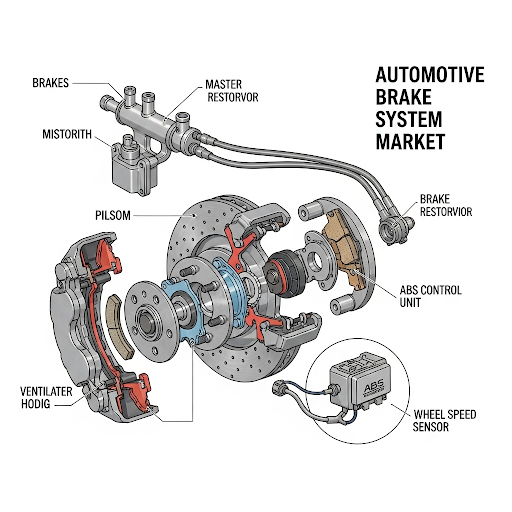
The global automotive brake system market is entering a decade of transformation, projected to grow from USD 7,556.4 million in 2025 to USD 20,140.4 million by 2035, registering a CAGR of 10.3%. The market’s rapid expansion is being fueled by stricter safety regulations, rising electric vehicle (EV) adoption, and next-generation technologies such as brake-by-wire systems, regenerative braking, and AI-enabled safety integration.
Uncover Essential Data – Get A Sample Copy https://www.futuremarketinsights.com/reports/sample/rep-gb-503
Breakthroughs Reshaping the Industry
Recent announcements from industry leaders underline how innovation is accelerating. In 2024, ZF Friedrichshafen AG unveiled a brake-by-wire platform designed for electric and automated vehicles. The system operates entirely on electronic signals, eliminating hydraulic components while ensuring compatibility with Level 4 automation and regenerative braking.
Similarly, Bosch advanced its brake control platform, emphasizing over-the-air updates and customizable braking profiles. This modular architecture allows automakers to tailor performance to regional regulations and vehicle use cases, while seamlessly integrating with advanced driver assistance systems (ADAS).
On the commercial side, Accelera (a Cummins brand) introduced its Endurance Braking System for electric trucks and buses. Specifically engineered for heavy loads and long-haul applications, it combines regenerative braking with thermal control to deliver consistent braking efficiency and durability.
Market Growth Anchored by EV and ADAS Adoption
The global shift toward electric mobility and automation is the market’s strongest growth driver. Braking solutions are no longer only about stopping vehicles—they are about energy efficiency, predictive diagnostics, and redundancy for autonomous driving safety.
Disc brake systems remain the dominant technology, accounting for 71% of the global market in 2025. Their ability to dissipate heat effectively, provide consistent braking power, and integrate seamlessly with ADAS has made them the preferred choice for passenger cars, EVs, and commercial fleets. Lightweight caliper designs, corrosion-resistant coatings, and noise-dampening innovations are further enhancing adoption.
By vehicle type, mid-sized passenger cars represent 36% of the market in 2025, expected to maintain strong growth through 2035. This segment balances affordability and performance, particularly in Asia-Pacific and Europe, where urban mobility and intercity travel demand efficient braking solutions.
Challenges Facing the Industry
Despite optimism, the market is not without hurdles. High costs of advanced braking systems—such as brake-by-wire, AEB, and ESC—pose adoption challenges in price-sensitive markets. In addition, compatibility and integration complexities with existing vehicle architectures extend development cycles and add costs for OEMs.
Retrofitting electronic braking systems into older vehicles remains particularly difficult, highlighting the need for global standardization and R&D investments to ensure wider adoption.
Opportunities for Innovators and New Entrants
While established manufacturers like Bosch, ZF, Continental, and Brembo dominate the market, emerging companies and suppliers are finding opportunities in:
- Electric & Autonomous Vehicles – Growth of EVs and self-driving cars creates demand for ultra-responsive, fail-safe braking technologies.
- Lightweight & Smart Systems – Carbon-ceramic and aluminum brake systems are being developed to reduce vehicle weight and improve performance.
- Connected Braking – IoT and AI integration enable predictive maintenance, adaptive braking profiles, and real-time diagnostics.
New players investing in these technologies can carve a niche, especially in regions transitioning rapidly to EVs and autonomous fleets.
Country-Wise Market Highlights
- United States (CAGR 4.8%): Growth is supported by NHTSA mandates requiring safety features such as AEB and ESC. EV adoption is accelerating demand for regenerative braking, while lightweight carbon-ceramic systems are increasingly adopted in performance vehicles.
- United Kingdom (CAGR 4.5%): Strict emission norms and government EV incentives are fueling demand for regenerative and copper-free brake systems. Luxury automakers such as Jaguar Land Rover are driving demand for high-performance ceramic brakes.
- European Union (CAGR 4.9%): Germany and France lead in R&D for electro-hydraulic and AI-driven braking systems, supported by strict EU safety regulations. Sustainability initiatives are pushing adoption of recyclable brake pads.
- Japan (CAGR 4.7%): A technology leader, Japan is focusing on brake-by-wire and AI-driven braking assist systems. Strong EV adoption by Toyota, Nissan, and Honda supports regenerative braking demand.
- South Korea (CAGR 4.6%): Home to Hyundai and Kia, South Korea is investing in AI-based predictive braking and eco-friendly friction materials. Collaborations with global tech firms strengthen its smart mobility strategy.
Competitive Landscape
The market remains highly competitive, with global leaders and new entrants racing to define the next era of braking technology. Key players include:
- Robert Bosch GmbH
- Continental AG
- ZF Friedrichshafen AG
- Aisin Seiki Co., Ltd.
- Brembo S.p.A.
- Hitachi Astemo Ltd.
- Akebono Brake Industry Co., Ltd.
- Nissin Kogyo Co., Ltd.
- Mando Corporation
- Tenneco Inc.
These companies are investing heavily in sustainability, digital integration, and autonomous-ready braking systems. Mergers, acquisitions, and technology partnerships are expected to further reshape the competitive environment through 2035.
Key Takeaways
- Global market to reach USD 20.14 billion by 2035, growing at 10.3% CAGR.
- Disc brake systems will remain the market leader, driven by ADAS compatibility and EV adoption.
- Mid-sized passenger cars are the largest demand segment, particularly in Asia-Pacific and Europe.
- Opportunities exist in smart braking, lightweight materials, and EV-integrated solutions.
- New players leveraging AI, IoT, and regenerative technologies can compete alongside established leaders.
Key Segments
By System Type:
In terms of System Type, the industry is divided into Disc Brake, Drum Brake.
By Vehicle Type:
In terms of Vehicle Type, the industry is divided into Mid-Sized Passenger Cars, Compact Passenger Cars, Luxury Passenger Cars, Light Commercial Vehicles, Heavy Commercial Vehicles, Premium Passenger Cars.
By Region:
The report covers key regions, including North America, Latin America, Western Europe, Eastern Europe, East Asia, South Asia, and the Middle East and Africa (MEA).
Stay Ahead – Grab the Report: https://www.futuremarketinsights.com/checkout/503
About Future Market Insights (FMI)
Future Market Insights, Inc. (ESOMAR certified, recipient of the Stevie Award, and a member of the Greater New York Chamber of Commerce) offers profound insights into the driving factors that are boosting demand in the market. FMI stands as the leading global provider of market intelligence, advisory services, consulting, and events for the Packaging, Food and Beverage, Consumer Technology, Healthcare, Industrial, and Chemicals markets. With a vast team of over 400 analysts worldwide, FMI provides global, regional, and local expertise on diverse domains and industry trends across more than 110 countries.
Contact Us:
Future Market Insights Inc.
Christiana Corporate, 200 Continental Drive,
Suite 401, Newark, Delaware – 19713, USA
T: +1-347-918-3531
For Sales Enquiries: sales@futuremarketinsights.com
Website: https://www.futuremarketinsights.com
LinkedIn| Twitter| Blogs | YouTube