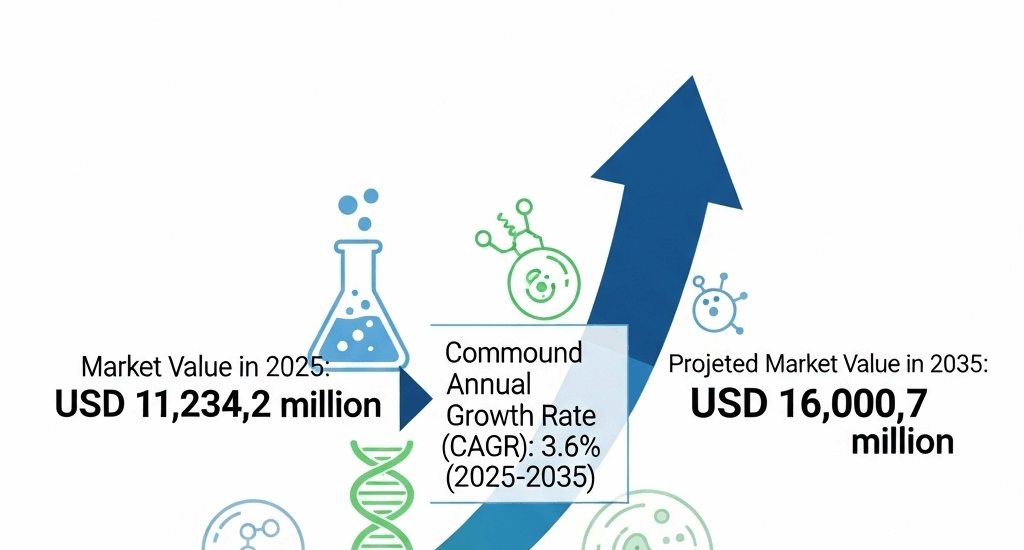
The global Bioprocessing Supplies Market is set to expand from USD 11,234.2 million in 2025 to USD 16,000.7 million by 2035, reflecting a steady 3.6% CAGR and a 1.42X increase in value over the next decade. Growth will be powered by large-scale adoption of single-use bioprocess containers, modular facilities, and the rising demand for cell and gene therapies.
Market Outlook and Growth Drivers
Between 2025 and 2030, the sector will generate an additional USD 2,173.1 million, representing nearly 46% of total decade-long growth. From 2030 to 2035, an even larger increment of USD 2,593.4 million is projected, driven by accelerated uptake of single-use systems, expanded vaccine manufacturing, and wider deployment of filling and freezing supplies.
Key growth factors include:
- Regulatory compliance: Adoption of validated consumables aligned with USP <665>/<1665> and EMA standards.
- Operational efficiency: Modular, disposable-based facilities enabling faster changeovers and contamination control.
- Therapeutic expansion: Increased biologics, vaccines, and personalized medicine pipelines requiring high-volume consumables.
- Regional momentum: Asia Pacific, particularly India (5.4% CAGR) and China (4.9% CAGR), is emerging as the fastest-growing region.
Click Here for More Information:- https://www.futuremarketinsights.com/reports/bioprocessing-supplies-market
Competitive Landscape
The market remains moderately consolidated, with leaders such as Cytiva, Sartorius AG, Thermo Fisher Scientific, and Merck KGaA collectively holding a dominant share.
- Cytiva continues to lead with a broad portfolio of bioprocess containers, chromatography solutions, and filtration devices. Its USD 1.6 billion investment (2025–2028) to expand resin and filtration capacity underscores its long-term commitment.
- Sartorius AG is strengthening its innovation pipeline with its new Center for Bioprocess Innovation in Massachusetts, advancing clinical production and next-generation therapeutics.
- Merck KGaA, Lonza, and Thermo Fisher are securing competitive positioning through modular system integration, hybrid stainless-steel/single-use offerings, and automation platforms.
- Specialized players like Repligen, Asahi Kasei Medical, and Fujifilm Healthcare are capitalizing on niche segments such as perfusion systems, custom filtration media, and cell therapy consumables.
This competitive shift is moving away from standalone component sales toward bundled, facility-integrated solutions—a strategy that ensures long-term client retention and recurring revenues.
Key Market Segments
- By Product: Single-use bioprocess containers will maintain leadership with a 22.6% market share in 2025, remaining the backbone of upstream and downstream workflows. Filtration devices (15.0%) and chromatography components (14.3%) follow closely.
- By Application: Upstream processing dominates at 48.1% share, fueled by intensive biologics pipelines and perfusion-based manufacturing.
- By End User: Biopharma and biotech companies account for 41.2% share in 2025, while CDMOs (28.5%) continue to expand rapidly, reflecting their critical role in global outsourcing models.
Regional Insights
- North America: A mature but innovation-led market, projected to expand at 3.6% CAGR, driven by advanced therapy adoption and modular plant construction.
- Europe: Steady growth at 2.3% CAGR, with Germany (1.9%) and France (2.6%) investing in automation and public biomanufacturing projects.
- Asia Pacific: The fastest-growing region, led by India (5.4% CAGR) and China (4.9% CAGR), supported by government-backed biotech hubs and CDMO expansions.
- South Korea: Expected to post 4.7% CAGR, strengthened by its Bioeconomy 2025 strategy and leadership in biosimilar exports.
Get Sample Report: – https://www.futuremarketinsights.com/reports/sample/rep-gb-23214
Market Positioning
The global bioprocessing supplies market is transitioning from component-level adoption toward end-to-end disposable workflows. This reflects the industry’s broader goals:
- Flexibility: Enabling rapid scale-up for vaccines and biologics.
- Compliance: Meeting stricter contamination and material traceability standards.
- Cost efficiency: Reducing cleanroom redesign, cleaning validation, and downtime.
Vendors who can offer integrated platforms combining consumables, automation, and process validation support will gain a competitive edge as biopharma players seek reliable, compliant, and scalable partners.
About Future Market Insights (FMI)
Future Market Insights, Inc. (ESOMAR certified, recipient of the Stevie Award, and a member of the Greater New York Chamber of Commerce) offers profound insights into the driving factors that are boosting demand in the market. FMI stands as the leading global provider of market intelligence, advisory services, consulting, and events for the Packaging, Food and Beverage, Consumer Technology, Healthcare, Industrial, and Chemicals markets. With a vast team of over 400 analysts worldwide, FMI provides global, regional, and local expertise on diverse domains and industry trends across more than 110 countries.
Contact Us:
Future Market Insights Inc.
Christiana Corporate, 200 Continental Drive,
Suite 401, Newark, Delaware – 19713, USA
T: +1-347-918-3531
For Sales Enquiries: sales@futuremarketinsights.com
Website: https://www.futuremarketinsights.com
LinkedIn| Twitter| Blogs | YouTube