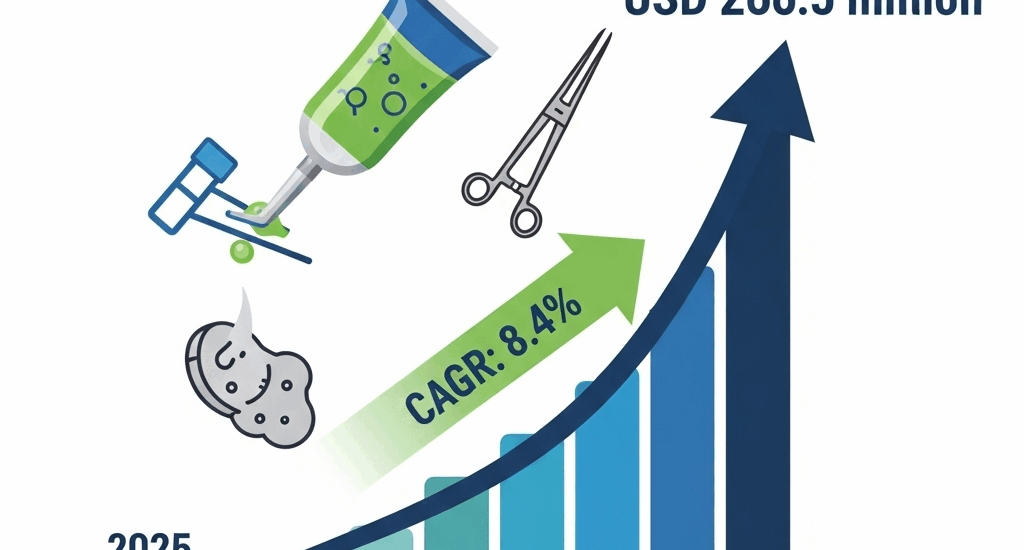
The global Anti-Adhesion Barrier Gels Market is set for accelerated expansion, projected to rise from an estimated USD 119.0 million in 2025 to USD 266.5 million by 2035, reflecting a robust compound annual growth rate (CAGR) of 8.4% during the forecast period. Increasing surgical interventions, clinical emphasis on reducing post-operative complications, and the adoption of biocompatible formulations are fueling strong industry momentum.
Market Drivers and Growth Outlook
Adhesion formation remains one of the most common and costly post-surgical complications. Anti-adhesion barrier gels are increasingly being integrated into clinical workflows to minimize tissue adhesion, reduce hospital readmissions, and improve patient outcomes. The global market now represents approximately 8.7% of the broader adhesion barriers segment, valued at around USD 1.0 billion.
Rising incidences of sports-related injuries, workplace trauma, orthopedic disorders, and chronic illnesses such as cardiovascular disease and cancer are expanding the target pool of patients requiring surgical adhesion prevention. In the U.S. alone, more than 900,000 cardiac surgeries are performed annually, positioning the country as a high-demand market for adhesion prevention solutions.
Regulatory approvals for biodegradable polymers and innovative hyaluronic acid-based gels are further boosting adoption, especially in minimally invasive and laparoscopic surgeries.
Click Here for More Information:- https://www.futuremarketinsights.com/reports/anti-adhesion-barrier-gels-market
Segmental Highlights
- Product Type: Hyaluronic acid-based gels are projected to account for 48.0% of total market revenue in 2025, driven by excellent biocompatibility, regenerative potential, and proven safety across abdominal, gynecological, and orthopedic surgeries.
- Application: Surgical applications will dominate with 82.0% revenue share in 2025, underscoring the high demand in abdominal and pelvic interventions.
- End User: Hospitals remain the leading end-user segment, expected to hold 67.0% of market share in 2025, due to centralized purchasing power and high surgical case volumes.
Regional Insights
- North America leads with the U.S. capturing 90.5% of regional share in 2024, supported by advanced surgical infrastructure and a high incidence of sports injuries.
- Asia-Pacific emerges as the fastest-growing region, with India expected to dominate South Asia at 50.2% share, fueled by its expanding healthcare sector and growing surgical volumes.
- Europe is led by Germany, forecast to grow at a CAGR of 9.5%, with strong demand from gynecological and orthopedic procedures.
Competitive Landscape
The market is characterized by active innovation, strategic acquisitions, and regional expansions. Key players include Anika Therapeutics, Kyeron, FzioMed, Normedi Nordic, Betatech, Bioscompass, Klas, Terumo, BioRegen Biomedical, CGBIO, Shing Poong Pharma Co. LTD, Hangzhou Singclean Medical Products, Genewel, LG Chem Life Sciences, Hanohai Biological, and PlantTec Medical GmbH.
Recent developments shaping the competitive space include:
- Baxter’s acquisition of Sanofi’s Seprafilm adhesion barrier, strengthening its surgical sealants and hemostats portfolio.
- FzioMed’s launch of Oxiplex/IU intrauterine adhesion barrier gel, expanding the range of application-specific products.
Manufacturers are also investing in biodegradable formulations and hybrid gels, aiming to enhance efficacy while improving patient compliance. Strategic collaborations between device makers and biotechnology firms are expected to accelerate the next generation of indication-specific adhesion prevention products.
Challenges and Restraints
Despite the promising outlook, adoption barriers persist. High surgical costs, inconsistent reimbursement policies in emerging economies, and limited long-term clinical evidence of efficacy have slowed market penetration. Regulatory hurdles and product recalls linked to safety concerns have also impacted industry growth.
Nevertheless, growing awareness among surgeons, coupled with a steady rise in hospital-based protocols for adhesion prevention, is expected to mitigate these challenges.
Get Sample Report: – https://www.futuremarketinsights.com/reports/sample/rep-gb-15678
Future Opportunities
The need for effective adhesion management is pressing. Studies indicate that 95% of abdominal surgeries eventually lead to adhesion-related complications, with 65–75% of small bowel obstruction cases directly associated with postoperative adhesions. Hospitals and surgical centers are prioritizing technologies that lower complication rates, positioning anti-adhesion barrier gels as an essential component of modern surgical practice.
As laparoscopic and robotic surgeries expand globally, demand for localized, minimally invasive anti-adhesion solutions will surge. This, combined with favorable clinical economics in reducing reoperations, underscores the significant market potential through 2035.
About Future Market Insights (FMI)
Future Market Insights, Inc. (ESOMAR certified, recipient of the Stevie Award, and a member of the Greater New York Chamber of Commerce) offers profound insights into the driving factors that are boosting demand in the market. FMI stands as the leading global provider of market intelligence, advisory services, consulting, and events for the Packaging, Food and Beverage, Consumer Technology, Healthcare, Industrial, and Chemicals markets. With a vast team of over 400 analysts worldwide, FMI provides global, regional, and local expertise on diverse domains and industry trends across more than 110 countries.
Contact Us:
Future Market Insights Inc.
Christiana Corporate, 200 Continental Drive,
Suite 401, Newark, Delaware – 19713, USA
T: +1-347-918-3531
For Sales Enquiries: sales@futuremarketinsights.com
Website: https://www.futuremarketinsights.com
LinkedIn| Twitter| Blogs | YouTube