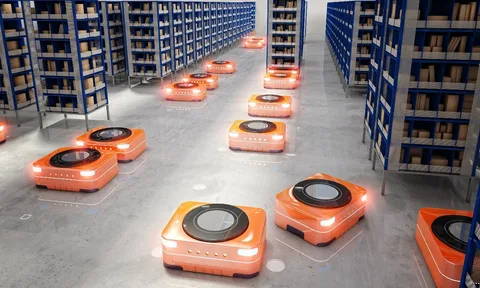
The Autonomous Mobile Robots for Logistics and Warehousing Market is estimated to be valued at USD 4.5 billion in 2025 and is projected to reach USD 34.5 billion by 2035, registering a compound annual growth rate (CAGR) of 22.7% over the forecast period.
The autonomous mobile robots (AMRs) for logistics and warehousing market is gaining rapid momentum as industries seek intelligent, flexible, and cost-efficient automation solutions. Known for their ability to navigate dynamic environments independently, AMRs are transforming supply chains by streamlining material handling, reducing operational costs, and enhancing productivity. Their adaptability across diverse warehouse settings positions them as a cornerstone of modern logistics infrastructure.
Market Overview
Autonomous mobile robots are advanced robotic systems designed to transport goods within warehouses, distribution centers, and manufacturing facilities without human intervention. Equipped with sensors, cameras, and AI-driven navigation, AMRs provide a scalable solution to meet growing demands in e-commerce, retail, and industrial sectors. Unlike traditional automated guided vehicles (AGVs), AMRs do not require fixed paths, offering greater flexibility and efficiency in managing inventory and fulfilling orders. From small parcel handling to large-scale pallet movement, AMRs are becoming integral to next-generation logistics systems.
Get Ahead with Our Report: Request Your Sample Now!
Key Market Drivers
The rise of e-commerce and the increasing need for faster order fulfillment are key drivers for the adoption of AMRs. Warehouses are under pressure to manage higher volumes with shorter lead times, making intelligent automation a necessity. Labor shortages and rising labor costs are further accelerating the shift toward autonomous solutions. AMRs are also gaining traction for their ability to operate in hybrid human-robot environments, ensuring safety and efficiency. The growing focus on reducing operational costs and improving supply chain resilience is propelling adoption across industries.
Emerging Trends
The integration of AMRs with advanced technologies such as artificial intelligence, machine learning, and computer vision is enabling smarter navigation and decision-making. The development of fleet management systems allows coordination among multiple AMRs, optimizing warehouse operations. Emerging use cases include collaborative robots (cobots) that work alongside human workers to improve efficiency. Battery innovations and wireless charging are extending operational uptime, while modular designs are making AMRs adaptable to a wide range of applications. Additionally, the combination of AMRs with IoT and cloud-based platforms is expanding their role in connected, data-driven logistics ecosystems.
Regional Insights
North America is leading in the adoption of AMRs, driven by strong e-commerce penetration, advanced logistics infrastructure, and early adoption of automation. Europe is experiencing steady growth, supported by investments in smart warehouses and Industry 4.0 initiatives. The Asia-Pacific region is emerging as a major hub, fueled by large-scale manufacturing, expanding retail markets, and the need for efficient supply chain operations. Latin America and the Middle East are also adopting AMR technologies as businesses in these regions modernize their logistics networks and embrace digital transformation.
Competitive Landscape
The competitive landscape of the AMR market includes robotics manufacturers, automation solution providers, and technology innovators. Companies are focusing on developing intelligent AMRs with enhanced navigation, load capacity, and safety features. Partnerships with logistics service providers, retailers, and e-commerce companies are expanding adoption. Vendors are differentiating by offering scalable, interoperable, and cost-efficient solutions that can integrate seamlessly with existing warehouse management systems. Innovations in AI-driven autonomy, fleet management software, and energy-efficient designs are shaping the competitive dynamics.
Exhaustive Market Report: A Complete Study
Future Outlook
The future of the autonomous mobile robots market for logistics and warehousing will be defined by continued advancements in AI, robotics, and connectivity. As supply chains become increasingly complex and customer expectations for speed and accuracy grow, AMRs will play a central role in enabling intelligent, automated logistics networks. Emerging applications in cold storage, last-mile delivery, and omni-channel retail will further expand their relevance. With their ability to deliver scalability, flexibility, and efficiency, AMRs will remain a cornerstone in driving the future of smart, resilient, and highly automated supply chains.
About Future Market Insights (FMI)
Future Market Insights, Inc. (ESOMAR certified, recipient of the Stevie Award, and a member of the Greater New York Chamber of Commerce) offers profound insights into the driving factors that are boosting demand in the market. FMI stands as the leading global provider of market intelligence, advisory services, consulting, and events for the Packaging, Food and Beverage, Consumer Technology, Healthcare, Industrial, and Chemicals markets. With a vast team of 400 analysts worldwide, FMI provides global, regional, and local expertise on diverse domains and industry trends across more than 110 countries.
Contact Us:
Future Market Insights Inc.
Christiana Corporate, 200 Continental Drive,
Suite 401, Newark, Delaware – 19713, USA
T: +1-845-579-5705
For Sales Enquiries: sales@futuremarketinsights.com
Website: https://www.futuremarketinsights.com
LinkedIn| Twitter| Blogs | YouTube