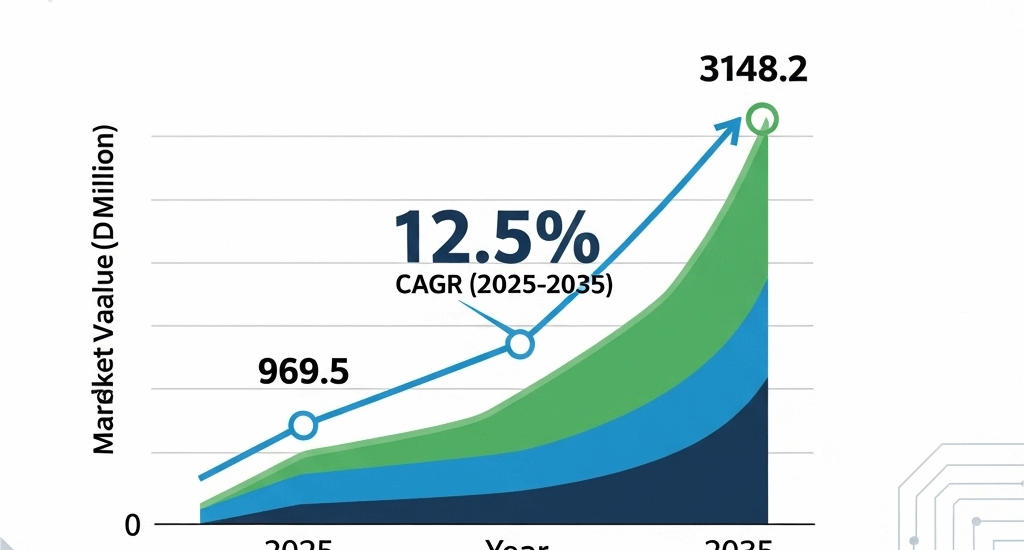
The global 3D printed medical implants market is on track for transformative growth, projected to surge from USD 969.5 million in 2025 to USD 3,148.2 million by 2035, according to the latest industry outlook. The forecast reflects a strong 12.5% compound annual growth rate (CAGR) driven by advancements in additive manufacturing, rising adoption of patient-specific implants, and increasing demand for minimally invasive procedures.
Industry Growth Drivers
3D printing technology, also known as additive manufacturing, is reshaping modern healthcare by enabling the production of customized, anatomically precise implants with shorter lead times and superior fit. Medical professionals are increasingly leveraging these solutions across orthopaedics, dentistry, cranial reconstruction, and hearing aids, addressing growing patient demand for personalized treatment.
Recent regulatory approvals and breakthroughs in biocompatible materials have accelerated clinical adoption. Titanium and cobalt-chrome alloys, for instance, are gaining traction due to their mechanical strength and corrosion resistance, particularly in orthopaedic and craniofacial applications.
Digital integration—from medical imaging to AI-driven modeling software—is further optimizing implant design, surgical planning, and patient recovery, ensuring faster adoption across global healthcare systems.
Click Here for More Information:- https://www.futuremarketinsights.com/reports/3d-medical-implants-market
Competitive Landscape
The market remains highly competitive, with companies such as Stratasys Ltd., Straumann Group, EOS GmbH, MedShape, Inc., Oxford Performance Materials Inc., BioArchitects, and Renovis Surgical Technologies spearheading innovation.
- In March 2024, Stratasys introduced the J5 DentaJet 3D PolyJet printer, strengthening its foothold in dental applications.
- Oxford Performance Materials expanded in Asia through OPM Asia, partnering with JSR Corp. to boost supply of PEKK implants.
- In July 2025, OPM announced a strategic collaboration with Fuse Medical, Inc., aimed at developing premium-quality spinal and extremity implants using its proprietary OsteoFab® PEKK technology.
These strategic partnerships and product launches highlight a broader trend: increased industry collaboration and M&A activity to expand product portfolios and regional reach.
Regional Market Outlook
- North America is set to retain the largest market share, backed by advanced healthcare infrastructure, strong regulatory support, and high adoption of medical 3D printing technologies. The region is projected to grow at a 14.3% CAGR through 2035.
- Asia-Pacific is anticipated to be the fastest-growing market, expanding at 15.3% CAGR. Countries such as China, India, and Japan are becoming hotbeds for medical device manufacturing, with rising investments in healthcare digitization and local partnerships.
- Europe continues to play a pivotal role, driven by strong R&D activity, government-funded research, and growing demand for precision implants across dental and orthopaedic segments.
Segmental Insights
- By Material Type: Metals will dominate with a 48% market share in 2025, favored for their strength, durability, and biocompatibility.
- By Application: Orthopaedics will lead with 53% market share, reflecting the rising burden of musculoskeletal disorders and the demand for tailored joint replacement solutions.
Market Trends and Challenges
Key Growth Trends
- Surge in public and private funding to accelerate innovation. For example, in 2024, U.S.-based Topology raised USD 861.8 million to advance additive manufacturing platforms.
- Expansion of direct digital manufacturing in clinical workflows, cutting costs and reducing design-to-production timelines.
- Integration of nanomaterials and virtual surgical simulations, allowing clinicians to create precise anatomical models for preoperative planning.
Key Challenges
- Shortage of skilled professionals trained in additive manufacturing is a restraint, limiting scalability. Bridging the talent gap remains critical for widespread adoption.
Get Sample Report: – https://www.futuremarketinsights.com/reports/sample/rep-gb-6004
Outlook and Future Potential
The 3D printed medical implants industry is positioned at the crossroads of precision medicine, advanced materials science, and digital healthcare transformation. Demand is expected to accelerate as populations age, musculoskeletal conditions increase, and healthcare systems pursue cost-efficient, outcome-driven solutions.
By 2035, the sector is expected to achieve a 1.3-fold increase in demand compared to 2024 levels, cementing its role as one of the fastest-growing verticals in the global medical device industry.
About Future Market Insights (FMI)
Future Market Insights, Inc. (ESOMAR certified, recipient of the Stevie Award, and a member of the Greater New York Chamber of Commerce) offers profound insights into the driving factors that are boosting demand in the market. FMI stands as the leading global provider of market intelligence, advisory services, consulting, and events for the Packaging, Food and Beverage, Consumer Technology, Healthcare, Industrial, and Chemicals markets. With a vast team of over 400 analysts worldwide, FMI provides global, regional, and local expertise on diverse domains and industry trends across more than 110 countries.
Contact Us:
Future Market Insights Inc.
Christiana Corporate, 200 Continental Drive,
Suite 401, Newark, Delaware – 19713, USA
T: +1-347-918-3531
For Sales Enquiries: sales@futuremarketinsights.com
Website: https://www.futuremarketinsights.com
LinkedIn| Twitter| Blogs | YouTube