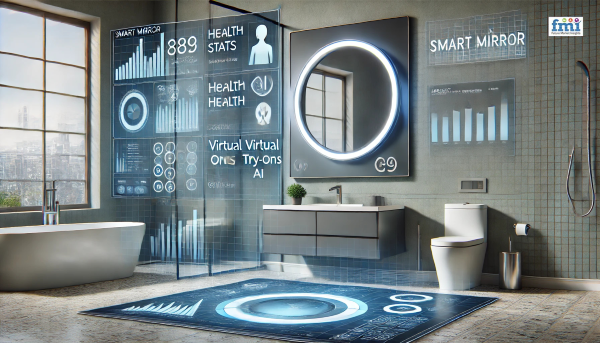
The global smart mirror market is experiencing impressive growth, with its estimated value reaching USD 639.4 million by 2025 and forecasted to soar to USD 1380.4 million by 2035, at a CAGR of 8.0%. Once a novelty, smart mirrors are rapidly becoming essential devices, blending the traditional function of a mirror with smart technology to provide enhanced user experiences across a wide range of industries.
Unlock exclusive insights – Request your sample report! https://www.futuremarketinsights.com/reports/sample/rep-gb-15896
What Is a Smart Mirror?
A smart mirror is a reflective surface with integrated digital features. It combines traditional reflection with real-time data, such as weather updates, health tracking, and news. Through built-in displays and sensors, smart mirrors can sync with devices like smartphones or voice assistants. Some even offer augmented reality (AR) for virtual try-ons or interactive touchscreens, enhancing their functionality in spaces like bathrooms, retail stores, and healthcare facilities.
Key Drivers of Market Growth
- Technological Innovation: The continuous evolution of AI, IoT, and AR has empowered smart mirrors to evolve beyond mere reflections. These mirrors now offer interactive displays, health tracking, virtual try-ons, and integration with other smart devices, offering a personalized experience to users. As technology advances, we can expect these mirrors to become even more sophisticated, incorporating features like facial recognition and predictive AI.
- Healthcare Integration: In healthcare, smart mirrors are emerging as valuable tools for health monitoring, offering capabilities like skin analysis, posture correction, and even tracking vital signs. These mirrors are particularly beneficial in telemedicine and physiotherapy, where real-time feedback and remote monitoring can greatly enhance care delivery.
- Retail Innovation: In retail and fashion, augmented reality (AR) smart mirrors are transforming shopping experiences. Customers can try on clothes, makeup, and accessories virtually, reducing fitting room times and enhancing the in-store experience. This use of smart mirrors also helps retailers reduce inventory and improve customer engagement.
- Smart Home Integration: Smart mirrors are becoming key elements in connected homes. By integrating with smart home ecosystems, these mirrors act as multifunctional hubs, offering users control over lighting, temperature, and security systems. Voice assistants embedded in mirrors allow for hands-free control of other smart devices, making daily routines more seamless.
- Commercial & Hospitality Growth: The commercial and hospitality sectors are driving demand for smart mirrors, which are used in high-end hotels, luxury spas, and retail environments to offer personalized greetings, concierge services, and entertainment. These mirrors provide customers with an interactive and futuristic experience, elevating service offerings.
Regional Insights
- North America is expected to dominate the market, with the U.S. leading the way due to strong demand in healthcare and automotive sectors. The region’s well-established tech infrastructure and consumer readiness for innovative products make it a key player.
- Europe is witnessing increasing adoption in the luxury hospitality and wellness industries, with smart mirrors enhancing customer experience and service personalization.
- Asia Pacific is seeing rapid growth due to the rising demand for smart home technologies and the burgeoning middle class in countries like China and India. The region’s strong technological landscape is fueling innovation and adoption.
Challenges Facing the Market
Despite its rapid growth, the smart mirror market faces challenges such as:
- High Initial Costs: Advanced features like AR, sensors, and integration with smart devices make smart mirrors relatively expensive, limiting their adoption in some segments.
- Privacy and Security: As these devices often involve cameras and sensors that collect data, ensuring user privacy and data security remains a key concern for consumers.
- Complexity in Integration: The integration of various technologies (IoT, AR, AI) can be technically challenging, requiring seamless interoperability to ensure a smooth user experience.
Top Segments Studied in the Smart Mirror Market
By Installation Type:
- Wall-Mounted
- Free-Standing
By Application:
- Residential
- Commercial
By Distribution Channel:
- Online
- Offline
By Region:
- North America
- Latin America
- Europe
- East Asia
- South Asia
- Oceania
- Middle East & Africa
Purchase the in-depth market report now! https://www.futuremarketinsights.com/checkout/15896
About Future Market Insights (FMI)
Future Market Insights, Inc. (ESOMAR certified, recipient of the Stevie Award, and a member of the Greater New York Chamber of Commerce) offers profound insights into the driving factors that are boosting demand in the market. FMI stands as the leading global provider of market intelligence, advisory services, consulting, and events for the Packaging, Food and Beverage, Consumer Technology, Healthcare, Industrial, and Chemicals markets. With a vast team of over 400 analysts worldwide, FMI provides global, regional, and local expertise on diverse domains and industry trends across more than 110 countries.
Contact Us:
Future Market Insights Inc.
Christiana Corporate, 200 Continental Drive,
Suite 401, Newark, Delaware – 19713, USA
T: +1-347-918-3531
For Sales Enquiries: sales@futuremarketinsights.com
Website: https://www.futuremarketinsights.com
LinkedIn| Twitter| Blogs | YouTube