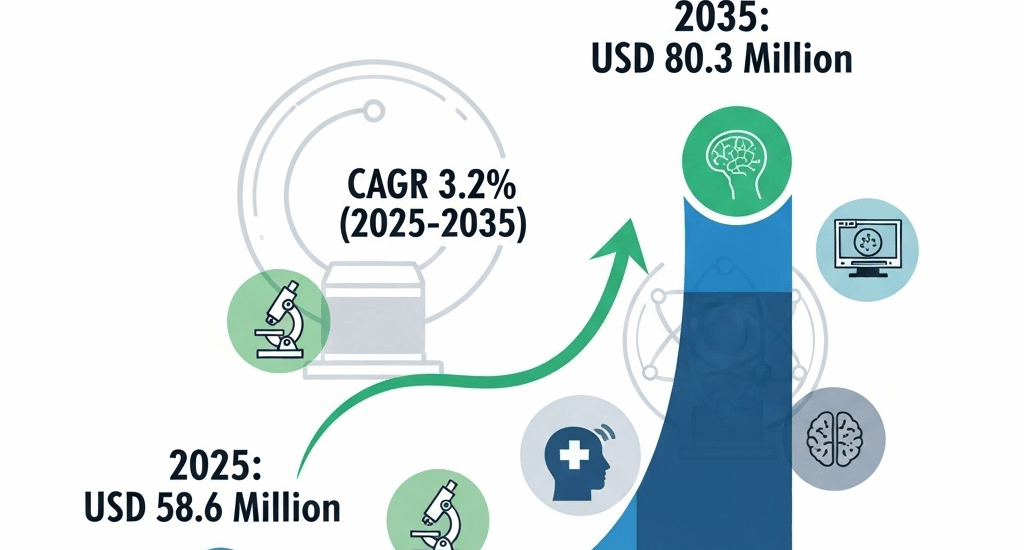
The global In Vivo Imaging Systems Market is poised for steady growth, with market value expected to increase from USD 58.6 million in 2025 to USD 80.3 million by 2035, reflecting a compound annual growth rate (CAGR) of 3.2%. This expansion underscores the increasing role of imaging technologies in advancing personalized medicine, preclinical research, and precision diagnostics.
Market Overview
The in vivo imaging systems industry is experiencing a transformation fueled by the demand for real-time visualization of biological processes and disease progression in living organisms. These technologies enable researchers and clinicians to conduct non-invasive, high-resolution analysis, which is pivotal for drug development, biomarker validation, and personalized treatment planning.
Key factors contributing to this growth include:
- Technological advancements in image fusion, contrast agents, and functional imaging modalities.
- Rising adoption in preclinical and translational research supported by increased funding and regulatory support.
- Shift toward evidence-based medicine, necessitating accurate longitudinal imaging for therapeutic evaluation.
Click Here for More Information:- https://www.futuremarketinsights.com/reports/in-vivo-imaging-systems-market
Industry Trends and Growth Drivers
The market’s upward trajectory aligns with several emerging trends:
- Integration of Multi-Modality Imaging Systems
Combining modalities such as PET-MRI and SPECT-CT offers deeper anatomical and functional insights, improving diagnosis and treatment monitoring. - Focus on Precision Medicine
As healthcare systems prioritize individualized therapy, imaging systems play a critical role in evaluating drug efficacy and disease progression at the molecular level. - Miniaturization and Automation
Manufacturers are innovating with compact imaging platforms and automated analysis software, improving workflow efficiency in research and clinical settings. - Growing Research Funding and Academia-Industry Collaboration
Increased government and private sector investments, particularly in Asia-Pacific and North America, are fostering innovation and adoption.
Segment Analysis
- By Application: The Monitoring Drug Treatment Response segment is projected to dominate, capturing 33.5% of the market share in 2025. Its growth is driven by the need for dynamic assessment of therapeutic efficacy, which is critical for clinical trials and drug development.
- By Technology: Magnetic Resonance Imaging (MRI) will account for 26.7% of revenue by 2025, maintaining a stronghold due to its ability to provide high-resolution images without ionizing radiation, making it ideal for repeated imaging.
- By End Use: Hospitals are anticipated to lead the end-user segment with 41.2% market share, as these facilities integrate advanced imaging systems for diagnosis, treatment planning, and clinical research.
Regional Insights
- North America dominates the market, supported by robust research infrastructure, technological innovation, and strong pharmaceutical pipelines.
- Asia-Pacific is the fastest-growing region, driven by expanding research institutes, government funding, and industry-academia collaborations.
- Europe remains a key market, leveraging advanced healthcare systems and increasing investments in oncology and neurology research.
Competitive Landscape
The market is moderately consolidated with key players including:
Bruker Corporation, Life Technologies Corporation, Miltenyi Biotech GmbH, PerkinElmer Inc., FUJIFILM Holdings Corporation, and Siemens AG. These companies are focused on:
- Product innovation to improve imaging accuracy and throughput.
- Strategic partnerships with research institutes for preclinical studies.
- Expanding footprints in emerging markets through acquisitions and collaborations.
Challenges and Opportunities
While the market outlook is positive, challenges such as high equipment costs, maintenance expenses, and short accessory life cycles remain. However, these are counterbalanced by:
- Increasing demand for early disease detection.
- Growing preclinical imaging applications in drug discovery.
- Opportunities in developing economies, where research activities are accelerating.
Get Sample Report: – https://www.futuremarketinsights.com/reports/sample/rep-gb-1742
Future Outlook
The future of in vivo imaging lies in multi-modality systems, AI-driven image analysis, and integration with molecular diagnostics. These advancements are expected to enhance diagnostic precision, accelerate drug development, and support next-generation healthcare models.
About Future Market Insights (FMI)
Future Market Insights, Inc. (ESOMAR certified, recipient of the Stevie Award, and a member of the Greater New York Chamber of Commerce) offers profound insights into the driving factors that are boosting demand in the market. FMI stands as the leading global provider of market intelligence, advisory services, consulting, and events for the Packaging, Food and Beverage, Consumer Technology, Healthcare, Industrial, and Chemicals markets. With a vast team of over 400 analysts worldwide, FMI provides global, regional, and local expertise on diverse domains and industry trends across more than 110 countries.
Contact Us:
Future Market Insights Inc.
Christiana Corporate, 200 Continental Drive,
Suite 401, Newark, Delaware – 19713, USA
T: +1-347-918-3531
For Sales Enquiries: sales@futuremarketinsights.com
Website: https://www.futuremarketinsights.com
LinkedIn| Twitter| Blogs | YouTube