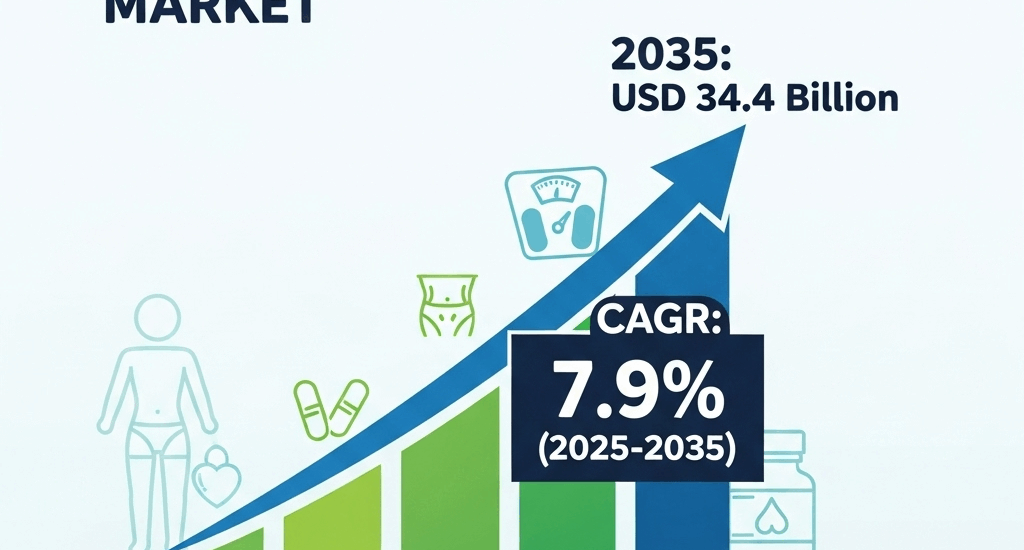
The global OTC appetite suppressant market is poised for robust growth, projected to rise from USD 16.1 billion in 2025 to USD 34.4 billion by 2035, at a compound annual growth rate (CAGR) of 7.9%, according to recent industry insights. This expansion is driven by increasing obesity rates, heightened interest in self-managed weight solutions, and growing consumer preference for stimulant-free, plant-based supplements.
Rising Obesity Rates and Shift Toward Non-Prescription Solutions
With nearly 40% of the global population classified as obese in 2024, consumers are actively seeking effective and convenient options for weight management. Over-the-counter appetite suppressants have emerged as an accessible alternative to prescription drugs like GLP-1 agonists, offering consumers affordable solutions without the need for medical supervision.
According to the report, 63% of OTC appetite suppressant volume in 2025 will come from capsules and gummies featuring botanical extracts, fiber bulking agents, and carb-blocking blends. This reflects a growing demand for clean-label, stimulant-free solutions that align with wellness-oriented lifestyles.
Click Here for More Information:- https://www.futuremarketinsights.com/reports/otc-appetite-suppressant-market
Industry Trends: Plant-Based Dominance and Digital-First Distribution
Plant-based extracts, including glucomannan, garcinia cambogia, and green tea, are expected to command 20% of the market share in 2025, as consumers increasingly prioritize natural ingredients with minimal side effects. These products are widely adopted among individuals practicing intermittent fasting, which represents an estimated 11% of application demand in 2025.
The e-commerce channel is projected to account for 32% of industry sales in 2025, driven by direct-to-consumer (DTC) subscription models, influencer-led campaigns, and algorithm-driven personalization. Leading brands such as Hydroxycut and Transparent Labs have scaled digital promotions, leveraging platforms like Amazon Prime to strengthen their market reach.
Competitive Landscape and Benchmark Analysis
The competitive environment remains dynamic, with leading companies including Haleon Group, GNC Holdings, LLC, NOW Foods, NatureWise, Nestlé USA, and Bayer AG vying for market leadership. Haleon currently commands an estimated 9.8% market share, supported by a robust portfolio of non-stimulant appetite control solutions.
Recent innovation milestones include Nestlé USA’s launch of BOOST® Pre-Meal Hunger Support, a whey-protein-based shot designed to trigger natural GLP-1 release. Similarly, UK-based Elcella introduced a twice-daily capsule leveraging hormonal pathways to reduce appetite without synthetic interventions, marking a breakthrough in the “natural Ozempic” category.
Private-label strategies are gaining traction, particularly among retail pharmacies seeking margin control through in-house product lines. However, success depends heavily on clinical claim validation and transparent ingredient sourcing, as consumers demand higher levels of trust and efficacy.
Regional Growth Highlights: BRICS Outpace OECD Nations
Geographically, South Asia & Pacific leads the growth trajectory, with India projected to record a CAGR of 13.5%, fueled by herbal appetite control products and rising digital health adoption. China follows closely at 12.2% CAGR, with appetite suppressants positioned as part of beauty and metabolic wellness routines, primarily sold via online platforms.
In contrast, mature markets such as the United States (6.7% CAGR) and Germany (5.9% CAGR) exhibit slower but steady growth. U.S. demand is largely concentrated in plant-based and intermittent fasting-compatible formats, while Germany’s market reflects consumer reliance on pharmacist-recommended and clinically validated SKUs.
Get Sample Report: – https://www.futuremarketinsights.com/reports/sample/rep-gb-22453
Industry Challenges: Efficacy and Regulatory Oversight
Despite growth potential, the market faces hurdles in product efficacy and safety assurance. Clinical studies indicate 30% of users report inconsistent appetite suppression results, and 22% of consumers remain skeptical about OTC supplement safety due to limited regulatory oversight compared to prescription medications.
To sustain growth, manufacturers must prioritize science-backed formulations, regulatory compliance, and consumer education to address concerns and strengthen brand trust.
Future Outlook: From Lifestyle Nutrition to Functional Health
The OTC appetite suppressant sector is positioned at the intersection of nutraceutical innovation, digital retailing, and preventive health care. As consumer behaviors shift toward proactive health management, brands offering clean-label, clinically validated, and lifestyle-integrated solutions are likely to dominate future market share.
About Future Market Insights (FMI)
Future Market Insights, Inc. (ESOMAR certified, recipient of the Stevie Award, and a member of the Greater New York Chamber of Commerce) offers profound insights into the driving factors that are boosting demand in the market. FMI stands as the leading global provider of market intelligence, advisory services, consulting, and events for the Packaging, Food and Beverage, Consumer Technology, Healthcare, Industrial, and Chemicals markets. With a vast team of over 400 analysts worldwide, FMI provides global, regional, and local expertise on diverse domains and industry trends across more than 110 countries.
Contact Us:
Future Market Insights Inc.
Christiana Corporate, 200 Continental Drive,
Suite 401, Newark, Delaware – 19713, USA
T: +1-347-918-3531
For Sales Enquiries: sales@futuremarketinsights.com
Website: https://www.futuremarketinsights.com
LinkedIn| Twitter| Blogs | YouTube