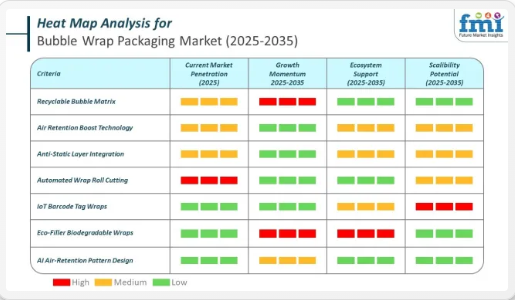
The bubble wrap packaging market is on a steady upward trajectory, offering a clear and compelling opportunity for manufacturers to innovate and capture new value. The market’s projected growth from USD 3.1 billion in 2025 to USD 4.3 billion by 2035, at a 3.1% CAGR, is being fueled by an unprecedented surge in global e-commerce and a shifting landscape of consumer and regulatory demands. For manufacturers, success will hinge on a solution-focused approach that addresses the core challenges of modern logistics: speed, precision, sustainability, and efficiency.
The rise of online shopping and direct-to-consumer (D2C) models across electronics, apparel, and personal care has made reliable protective packaging a non-negotiable. Bubble wrap, with its lightweight structure and superior cushioning, is an essential tool for preventing damage during last-mile delivery. This demand is not limited to large corporations; it extends to small and medium-sized enterprises (SMEs) and fulfillment centers globally, reinforcing the material’s critical role in modern supply chains.
Request Bubble Wrap Packaging Market Draft Report: https://www.futuremarketinsights.com/reports/sample/rep-gb-5612
AI and Robotics are Redefining Production Efficiency
To meet this escalating demand, manufacturers must move beyond traditional production methods. The most significant competitive advantage is being built on the factory floor, where robotics and IoT are re-engineering bubble wrap packaging lines for unprecedented speed and precision. This isn’t just about automation; it’s about intelligent, data-driven manufacturing.
AI-powered vision algorithms now inspect the air-cell matrix in real time, dynamically adjusting bubble size and inflation volume to eliminate defects. Machine learning models predict maintenance schedules based on wear patterns, minimizing downtime and optimizing uptime. Robotic arms handle every stage of production—from extrusion and cutting to rolling and labeling—with adaptive precision. End-of-line systems, powered by autonomous guided vehicles (AGVs), prepare shipments without human intervention. This level of technological integration drives not only efficiency and scale but also a new standard of quality that reduces waste and boosts profitability.
Sustainability and Strategic Segmentation are Key Growth Drivers
While technology optimizes the manufacturing process, strategic product innovation and market focus will drive revenue growth. Manufacturers are increasingly developing eco-friendly alternatives made from recycled or biodegradable materials to align with corporate sustainability goals and consumer preferences. This includes materials like Linear Low-Density Polyethylene (LLDPE), which offers superior flexibility and puncture resistance and is projected to be the fastest-growing material segment with a 3.7% CAGR.
The market is also segmenting into high-growth areas that demand specialized solutions. Bubble bags and mailers are the fastest-growing product type, projected to achieve a 3.6% CAGR. Their ready-to-use, lightweight, and tamper-evident design makes them perfect for the small-parcel shipping that dominates e-commerce. This accelerated growth in the e-commerce sector—expected to account for over 32% of the market share by 2035—reinforces the need for manufacturers to develop and promote these ready-to-use formats.
For more on their methodology and market coverage, visit! https://www.futuremarketinsights.com/about-us
The market also faces challenges, including competition from alternative packaging and environmental regulations that are pushing for sustainable materials. Manufacturers who can leverage these constraints as opportunities—by investing in recyclable materials and automation—will lead the market. The competitive landscape is already shifting, with market leaders like Sealed Air Corporation and Veritiv Corporation dominating with extensive product portfolios, while emerging players like Flexi-Hex disrupt the space with paper-based, eco-conscious alternatives.
For bubble wrap manufacturers, the next decade is about embracing a dual strategy: investing in intelligent, automated production to maximize efficiency and offering innovative, sustainable products tailored to the needs of a rapidly expanding e-commerce world. By doing so, they can turn market demands into a blueprint for future growth.
Related Reports:
Foldable And Collapsible Pallets Market: https://www.futuremarketinsights.com/reports/foldable-and-collapsible-pallets-market
Bile Collection Bags Market: https://www.futuremarketinsights.com/reports/bile-collection-bags-market
Fiberboard Packaging Market: https://www.futuremarketinsights.com/reports/fiberboard-packaging-market
Editor’s Note:
This release is based exclusively on verified and factual market content derived from industry analysis by Future Market Insights. No AI-generated statistics or speculative data have been introduced. This press release highlights significant shifts in the Bubble Wrap Packaging Market, which is experiencing a pivotal change driven by consumer demand for healthier, more transparent products.
About Future Market Insights (FMI)
Future Market Insights, Inc. (ESOMAR certified, recipient of the Stevie Award, and a member of the Greater New York Chamber of Commerce) offers profound insights into the driving factors that are boosting demand in the market. FMI stands as the leading global provider of market intelligence, advisory services, consulting, and events for the Packaging, Food and Beverage, Consumer Technology, Healthcare, Industrial, and Chemicals markets. With a vast team of over 400 analysts worldwide, FMI provides global, regional, and local expertise on diverse domains and industry trends across more than 110 countries.
Contact Us:
Future Market Insights Inc.
Christiana Corporate, 200 Continental Drive,
Suite 401, Newark, Delaware – 19713, USA
T: +1-347-918-3531
For Sales Enquiries: sales@futuremarketinsights.com
Website: https://www.futuremarketinsights.com
LinkedIn| Twitter| Blogs | YouTube