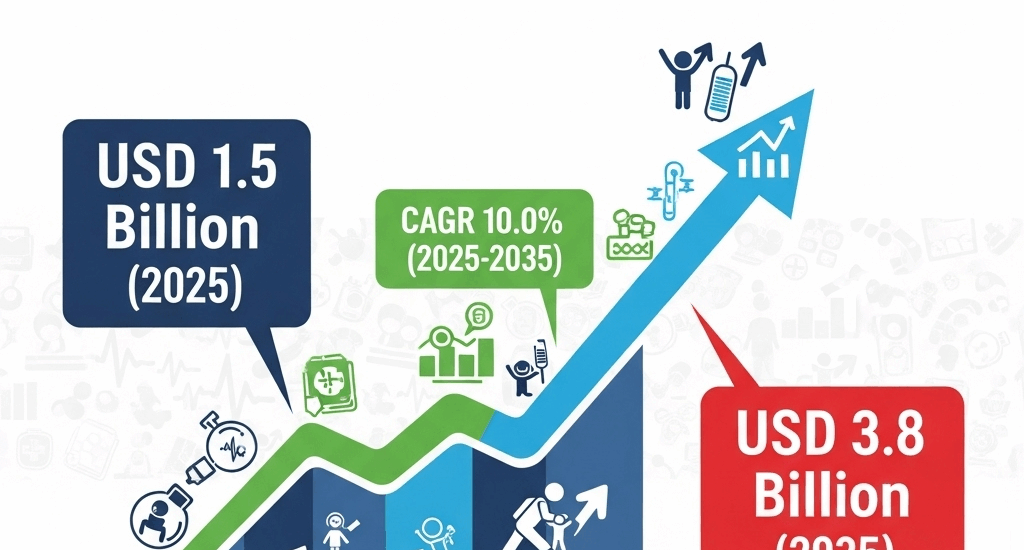
The global Paediatric Spasticity Treatment Market is on track for substantial growth, projected to expand from USD 1.5 billion in 2025 to USD 3.8 billion by 2035, representing a strong compound annual growth rate (CAGR) of 10.0%, according to the latest industry analysis. This growth is being driven by increased awareness, advancements in therapeutic protocols, and broader adoption of multidisciplinary care models for managing childhood neuromuscular disorders.
Industry Outlook and Market Drivers
Paediatric spasticity, most commonly associated with cerebral palsy and other neurological disorders, has long been a clinical challenge. The condition significantly impacts quality of life, mobility, and long-term musculoskeletal health. Growing clinical evidence supports early intervention and targeted therapies to improve outcomes, fueling demand for effective treatment options.
Key factors shaping the market include:
- Rising research and development (R&D): Leading pharmaceutical companies are developing safer and more effective formulations tailored for paediatric use.
- Healthcare infrastructure improvements: Expansion of specialized rehabilitation and neurology services has improved treatment accessibility.
- Regulatory advancements: Recent approvals, including the FDA’s expanded indication for Ipsen’s Dysport (July 2024) and acceptance of XEOMIN’s sBLA (August 2024), have broadened therapeutic options.
While high treatment costs and limited awareness in underdeveloped markets remain challenges, the industry is poised to benefit from emerging-market growth in Asia-Pacific and Latin America, particularly China and Brazil, where patient pools are large and healthcare spending is increasing.
Click Here for More Information:- https://www.futuremarketinsights.com/reports/paediatric-spasticity-treatment-market
Segmental Highlights
- By Drug Type: Botox is expected to dominate the market in 2025 with a 38.6% share, supported by strong clinical data and widespread adoption as a first-line intervention. Botulinum toxin’s ability to reduce muscle tone without systemic side effects has made it the gold standard in paediatric care.
- By Route of Administration: Injectables are set to hold 52.4% of market revenue in 2025, reflecting the preference for localized, predictable drug delivery. Advances in injection techniques have further improved patient outcomes and acceptance.
- By Distribution Channel: Hospital Pharmacies will capture 45.3% share in 2025, underscoring their role as the primary point of access for specialized therapies administered under multidisciplinary care settings.
Regional Trends
- North America leads the market due to well-developed healthcare facilities, a strong clinical trial pipeline, and government funding for drug development.
- Europe follows with high adoption rates for innovative treatments and a mature healthcare infrastructure.
- Asia-Pacific is forecast to be the fastest-growing region, led by China and India, where rising awareness and increasing prevalence of paediatric spasticity drive demand.
- Latin America and Middle East & Africa will see moderate growth, constrained by infrastructure gaps and lower awareness.
Competitive Landscape
The market is moderately consolidated with major players such as Allergan plc, Ipsen Biopharmaceuticals, Almirall, Piramal Critical Care, Genentech, Sanofi, Saol Therapeutics, and USA WorldMeds actively pursuing organic and inorganic growth strategies. Recent FDA approvals and pipeline innovations are intensifying competition, with companies racing to address unmet needs in paediatric spasticity care.
Notably, the competitive benchmark shows Allergan’s Botox continuing to dominate the market, while Ipsen’s Dysport and Merz’s Xeomin are strengthening their positions through expanded indications. Partnerships and collaborations for research funding are expected to accelerate innovation and broaden global access to novel therapies.
Get Sample Report: – https://www.futuremarketinsights.com/reports/sample/rep-gb-9408
Market Outlook
The global paediatric spasticity treatment market is expected to continue its upward trajectory through 2035, shaped by:
- Expanding treatment guidelines recommending early intervention.
- Integration of physiotherapy, pharmacological, and surgical options within multidisciplinary care frameworks.
- Growing investment in paediatric-specific clinical trials.
About Future Market Insights (FMI)
Future Market Insights, Inc. (ESOMAR certified, recipient of the Stevie Award, and a member of the Greater New York Chamber of Commerce) offers profound insights into the driving factors that are boosting demand in the market. FMI stands as the leading global provider of market intelligence, advisory services, consulting, and events for the Packaging, Food and Beverage, Consumer Technology, Healthcare, Industrial, and Chemicals markets. With a vast team of over 400 analysts worldwide, FMI provides global, regional, and local expertise on diverse domains and industry trends across more than 110 countries.
Contact Us:
Future Market Insights Inc.
Christiana Corporate, 200 Continental Drive,
Suite 401, Newark, Delaware – 19713, USA
T: +1-347-918-3531
For Sales Enquiries: sales@futuremarketinsights.com
Website: https://www.futuremarketinsights.com
LinkedIn| Twitter| Blogs | YouTube