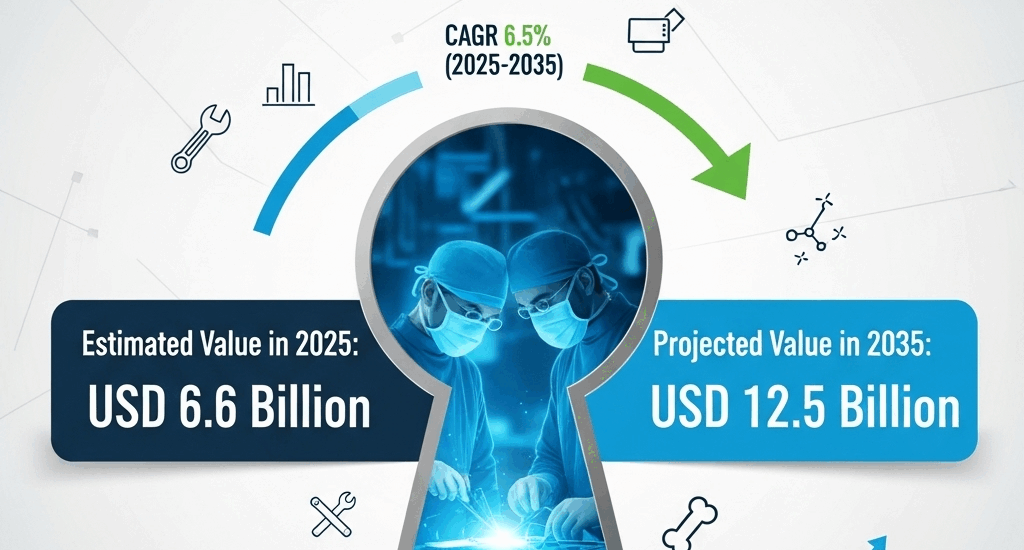
The global Keyhole Orthopaedic Surgery Market is projected to experience robust expansion, rising from an estimated USD 6.6 billion in 2025 to USD 12.5 billion by 2035, at a steady compound annual growth rate (CAGR) of 6.5%, according to industry forecasts. This growth reflects increasing adoption of minimally invasive surgical techniques, technological advancements, and a rising burden of musculoskeletal disorders across both developed and emerging markets.
Market Growth Drivers
Keyhole orthopaedic surgery, also known as minimally invasive orthopaedic surgery, has become a preferred option for patients and healthcare providers alike. Its advantages—reduced blood loss, shorter hospital stays, faster recovery times, and fewer visible scars—are fueling widespread adoption.
The growing prevalence of sports injuries, osteoarthritis, and ligament damage is further contributing to market expansion. Additionally, the global shift toward outpatient procedures and enhanced recovery protocols is boosting the demand for advanced arthroscopic systems.
Technological breakthroughs, particularly in arthroscopes and arthroscopic systems—which are expected to account for 39.7% of market revenue in 2025—have improved surgical precision, visualization, and ergonomics. These advancements enable surgeons to conduct complex joint procedures with greater accuracy and efficiency, reinforcing their position as the leading product category.
Click Here for More Information:- https://www.futuremarketinsights.com/reports/keyhole-orthopaedic-surgery-marketCompetitive Landscape and Benchmarking
The competitive environment remains intense, with global medical technology leaders such as Smith & Nephew Plc, KARL STORZ SE & Co KG, Arthrex Inc, Johnson & Johnson, Zimmer Biomet Holdings Inc, ConMed Corp, and Stryker Corp spearheading innovation.
Stryker, for instance, has introduced cutting-edge visualization platforms such as the 1688 AIM 4K and HipCheck, setting new industry benchmarks for intraoperative efficiency and clinical outcomes. Competitors like Arthrex and Smith & Nephew continue to invest heavily in next-generation arthroscopic tools, while Zimmer Biomet and DePuy Synthes are strengthening their portfolios through mergers, acquisitions, and R&D investments.
The high degree of competition is pushing companies to differentiate through ergonomic device design, imaging integration, and digital health solutions that improve surgical navigation and patient monitoring.
End User and Regional Insights
Hospitals are projected to remain the dominant end user, contributing 53.4% of the market’s revenue by 2025. Their advantage lies in established infrastructure, access to skilled surgeons, and the ability to provide perioperative and postoperative care. Favorable reimbursement frameworks and clinical guidelines have further entrenched hospitals as the primary setting for orthopaedic keyhole procedures.
Regionally, North America is expected to maintain market leadership, supported by rapid technological adoption, high healthcare spending, and strong presence of industry leaders. Asia-Pacific, particularly South Asia, is emerging as a high-growth region due to an alarming rise in road accidents and sports injuries. For example, India alone reported over 354,000 road accidents in 2024, intensifying demand for orthopaedic interventions.
Restraints and Challenges
Despite its strong outlook, the market faces challenges. The high cost of equipment, limited access in underdeveloped regions, and a shortage of highly trained surgeons remain key barriers. Postoperative complications, though relatively rare, also limit acceptance in some markets.
Nonetheless, industry players are actively addressing these barriers through training programs, cost optimization, and the development of portable, user-friendly systems designed for outpatient and ambulatory surgical centers.
Future Outlook
Looking ahead, the keyhole orthopaedic surgery market is set to benefit from:
- Continuous R&D investments in imaging and robotic-assisted surgical technologies.
- Expansion into ambulatory surgical centers offering cost-effective treatment alternatives.
- Rising patient awareness and preference for minimally invasive procedures across emerging economies.
As demand continues to surge, companies that integrate AI-driven imaging, advanced robotics, and next-gen implants into their product lines are expected to capture significant market share and set new standards for surgical care.
Get Sample Report: – https://www.futuremarketinsights.com/reports/sample/rep-gb-9300
About Future Market Insights (FMI)
Future Market Insights, Inc. (ESOMAR certified, recipient of the Stevie Award, and a member of the Greater New York Chamber of Commerce) offers profound insights into the driving factors that are boosting demand in the market. FMI stands as the leading global provider of market intelligence, advisory services, consulting, and events for the Packaging, Food and Beverage, Consumer Technology, Healthcare, Industrial, and Chemicals markets. With a vast team of over 400 analysts worldwide, FMI provides global, regional, and local expertise on diverse domains and industry trends across more than 110 countries.
Contact Us:
Future Market Insights Inc.
Christiana Corporate, 200 Continental Drive,
Suite 401, Newark, Delaware – 19713, USA
T: +1-347-918-3531
For Sales Enquiries: sales@futuremarketinsights.com
Website: https://www.futuremarketinsights.com
LinkedIn| Twitter| Blogs | YouTube