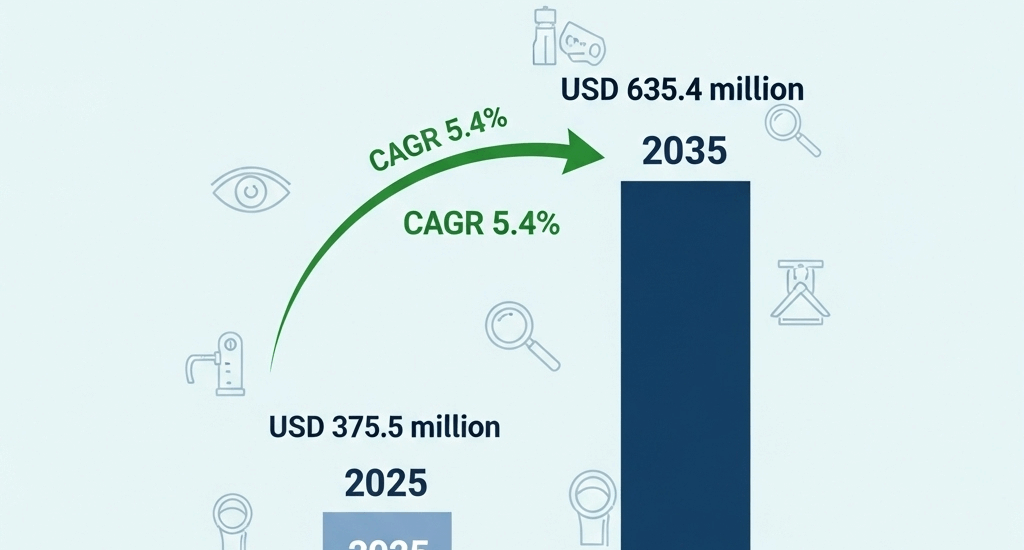
The global Next Generation Optical Biometry Devices Market is set for steady growth, rising from USD 375.5 million in 2025 to USD 635.4 million by 2035, at a compound annual growth rate (CAGR) of 5.4%, according to the latest industry analysis. The expansion is being driven by advanced imaging technologies, increasing demand for precision in cataract and refractive surgeries, and the growing prevalence of eye disorders worldwide.
Rising Demand for Precision in Eye Care
The growing need for non-invasive, highly accurate diagnostic devices has transformed ophthalmology practices. Optical biometry devices, particularly Swept-Source Optical Coherence Tomography (OCT) based biometers, are gaining prominence for their superior imaging capabilities, deeper tissue penetration, and faster scan times. These devices accounted for 53.6% of the market share in 2025, underscoring their dominance in clinical adoption.
Clinics and specialized eye care centers are increasingly investing in next-generation biometers to improve diagnostic accuracy, enhance preoperative planning, and deliver personalized treatment outcomes. The integration of advanced imaging tools with surgical systems is further boosting adoption across hospitals and ambulatory surgical centers.
Click Here for More Information:- https://www.futuremarketinsights.com/reports/next-generation-optical-biometry-devices-market
Industry Trends and Competitive Benchmarks
The market landscape is shaped by a mix of global leaders and innovative entrants. Carl Zeiss AG, Nidek Co Ltd, Haag-Streit AG, Topcon Corporation, Ziemer Ophthalmic Systems, and Optovue, Incorporated remain frontrunners with robust product portfolios. Zeiss, for instance, continues to set benchmarks with its IOLMaster series, leveraging partial coherence interferometry and swept-source OCT technology to deliver high-precision ocular measurements.
Competitors are differentiating through pricing strategies, patient-friendly device features, and automation capabilities. For example, TOMEY GmbH and Movu Inc. are focusing on compact, high-speed biometers designed for outpatient facilities, while Bausch & Lomb and Leica Microsystems are expanding regional penetration through strategic partnerships.
The competitive emphasis has shifted toward workflow efficiency and patient comfort, aligning with the rising demand for outpatient eye care services and the global increase in cataract procedures.
Regional Market Outlook
- North America is expected to account for 26.8% of the market share in 2025, supported by rising cataract prevalence, advanced eye care infrastructure, and healthcare reimbursement policies such as Medicare and Medicaid. The U.S. alone reports over 25 million cataract patients annually, making it a key market for next generation biometers.
- Europe is witnessing strong adoption in the UK, Germany, and France, driven by government investments in ophthalmic healthcare and the growing number of cataract surgeries.
- Asia-Pacific is set to emerge as a high-growth region due to a rapidly aging population, expanding access to healthcare, and investments in specialized ophthalmic centers in China, India, and Japan.
Key Growth Segments
- Product Type: Swept-Source OCT-based biometers remain the leading product category, expected to sustain dominance through 2035, driven by their ability to overcome ocular opacities and deliver multi-dimensional measurements.
- End User: Ophthalmology clinics and specialized eye care centers are projected to represent 47.8% of market revenues in 2025, as they continue to be early adopters of advanced diagnostic tools. Hospitals also represent a significant growth avenue, accounting for 41.8% revenue share, supported by government and private sector expansion.
Driving Factors Behind Market Growth
- Increasing cataract and refractive surgeries globally.
- Rising awareness about vision health and outpatient eye care.
- Technological advances including automation, AI-driven data analysis, and cloud-based reporting.
- Government support for healthcare infrastructure and reimbursement of cataract surgeries.
Future Outlook
With aging populations, lifestyle-related eye disorders, and growing surgical volumes, the next decade is poised to witness accelerated adoption of optical biometry devices. Industry experts predict that innovations in AI-powered ocular imaging, teleophthalmology integration, and smart surgical planning tools will further expand the market.
Manufacturers are expected to focus on cost optimization, digital integration, and emerging markets penetration to remain competitive. Strategic collaborations, mergers, and continuous R&D investments will define the industry’s growth trajectory.
Get Sample Report: – https://www.futuremarketinsights.com/reports/sample/rep-gb-7556
About Future Market Insights (FMI)
Future Market Insights, Inc. (ESOMAR certified, recipient of the Stevie Award, and a member of the Greater New York Chamber of Commerce) offers profound insights into the driving factors that are boosting demand in the market. FMI stands as the leading global provider of market intelligence, advisory services, consulting, and events for the Packaging, Food and Beverage, Consumer Technology, Healthcare, Industrial, and Chemicals markets. With a vast team of over 400 analysts worldwide, FMI provides global, regional, and local expertise on diverse domains and industry trends across more than 110 countries.
Contact Us:
Future Market Insights Inc.
Christiana Corporate, 200 Continental Drive,
Suite 401, Newark, Delaware – 19713, USA
T: +1-347-918-3531
For Sales Enquiries: sales@futuremarketinsights.com
Website: https://www.futuremarketinsights.com
LinkedIn| Twitter| Blogs | YouTube