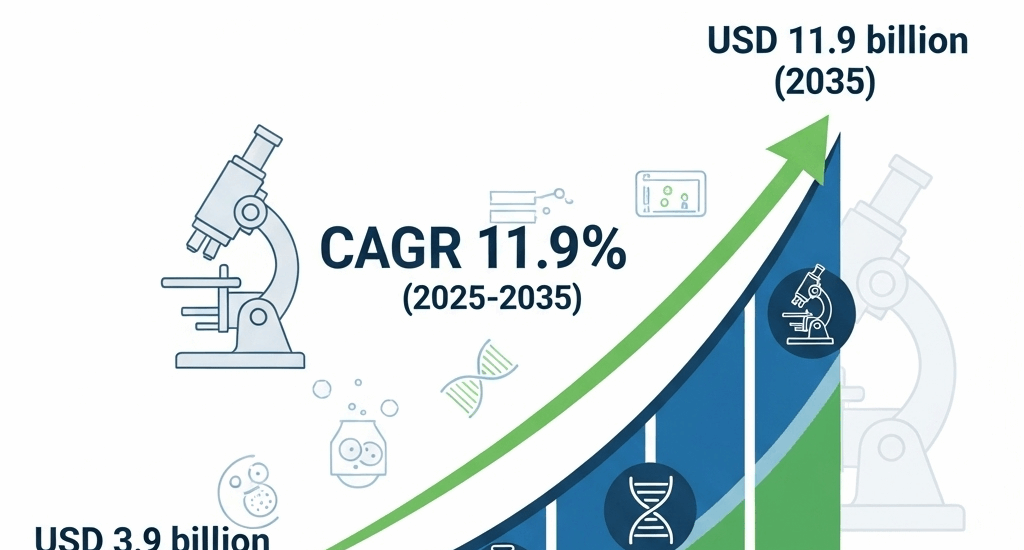
The global Quantitative Pathology Imaging Market is set to witness unprecedented expansion, projected to rise from USD 3.9 billion in 2025 to USD 11.9 billion by 2035, registering a robust CAGR of 11.9%, according to the latest industry analysis. The surge is driven by the rapid integration of artificial intelligence (AI), digital pathology platforms, and precision medicine applications across clinical and research domains.
Market Momentum Fueled by Digital Transformation in Pathology
Quantitative pathology imaging is gaining widespread traction as hospitals, research institutes, and pharmaceutical companies embrace high-resolution imaging, automated workflows, and AI-driven diagnostics. This technology is increasingly indispensable for biomarker validation, oncology research, and whole-slide imaging in both academic and clinical settings.
With the global push toward personalized medicine and value-based healthcare, demand for real-time digital imaging solutions is soaring. Integration with laboratory automation systems, cloud-based data storage, and advanced analytics tools is enabling faster, more accurate diagnoses while supporting collaborative, multi-center research.
Click Here for More Information:- https://www.futuremarketinsights.com/reports/quantitative-pathology-imaging-market
Key Growth Segments
- By Product – Instruments will lead in 2025 with a commanding 41.2% revenue share, underpinned by high adoption of whole-slide scanners, multiplexing platforms, and AI-compatible imaging systems.
- By Application – Drug discovery and development will account for 38.1% of the market, driven by the growing need for high-throughput imaging in preclinical research, therapeutic validation, and translational studies.
- By End-User – Hospitals are expected to hold 36.9% share in 2025, leveraging digital pathology platforms for cancer screening, intraoperative consultations, and remote diagnostics.
Regional Outlook
North America will dominate with 41.6% market share in 2025, buoyed by advanced healthcare infrastructure, strong R&D investments, and early adoption of digital pathology standards. Europe follows with 24.8%, supported by rising chronic disease prevalence, an aging population, and expanding healthcare digitization initiatives. Asia-Pacific is poised for the fastest growth, fueled by large-scale cancer screening programs, expanding healthcare access, and significant investment in clinical informatics.
Industry Trends and Competitive Benchmarking
The competitive landscape features leading players such as Leica Microsystems, PerkinElmer Inc., Hoffmann-La Roche AG, Indica Labs, Paige, and PathAI, each innovating to enhance image resolution, speed, and diagnostic accuracy. These companies are differentiating themselves through advanced AI algorithms, cloud integration, and compliance with regulatory standards for medical device interoperability.
Start-ups are also disrupting the market with specialized software for morphological pattern recognition and multiplex biomarker detection. Notably, diagnostics technology remains one of the most active investment sectors, with USD 99.7 billion raised across 2,700+ companies—over half in the last three years.
Demand Drivers
Several factors underpin this market’s strong trajectory:
- Rising cancer incidence and the need for more accurate and efficient diagnostic tools
- Expansion of precision oncology and immunotherapy research
- Growing adoption of remote pathology services and teleconsultation
- Operational efficiencies enabled by automation and AI integration
- Increased need for regulatory-compliant, digitized pathology workflows
Quantitative pathology imaging systems offer reduced turnaround time, improved visualization, and lower error rates. The technology’s multiplexing capabilities allow simultaneous detection of multiple, weakly expressed biomarkers—critical in complex disease profiling.
Challenges to Address
Despite strong growth prospects, the market faces hurdles including limited global availability of advanced systems, lack of reimbursement pathways for novel imaging technologies, and slower adoption among certain healthcare providers due to infrastructure constraints. Addressing these barriers will be key to unlocking the market’s full potential.
Future Outlook
From 2025 to 2035, the quantitative pathology imaging market is set to triple in size, propelled by innovations in AI, automation, and cloud-based analytics. Industry leaders and emerging players alike are positioned to capitalize on the rising demand for accurate, rapid, and scalable pathology solutions in both clinical diagnostics and research.
Get Sample Report: – https://www.futuremarketinsights.com/reports/sample/rep-gb-5041
About Future Market Insights (FMI)
Future Market Insights, Inc. (ESOMAR certified, recipient of the Stevie Award, and a member of the Greater New York Chamber of Commerce) offers profound insights into the driving factors that are boosting demand in the market. FMI stands as the leading global provider of market intelligence, advisory services, consulting, and events for the Packaging, Food and Beverage, Consumer Technology, Healthcare, Industrial, and Chemicals markets. With a vast team of over 400 analysts worldwide, FMI provides global, regional, and local expertise on diverse domains and industry trends across more than 110 countries.
Contact Us:
Future Market Insights Inc.
Christiana Corporate, 200 Continental Drive,
Suite 401, Newark, Delaware – 19713, USA
T: +1-347-918-3531
For Sales Enquiries: sales@futuremarketinsights.com
Website: https://www.futuremarketinsights.com
LinkedIn| Twitter| Blogs | YouTube