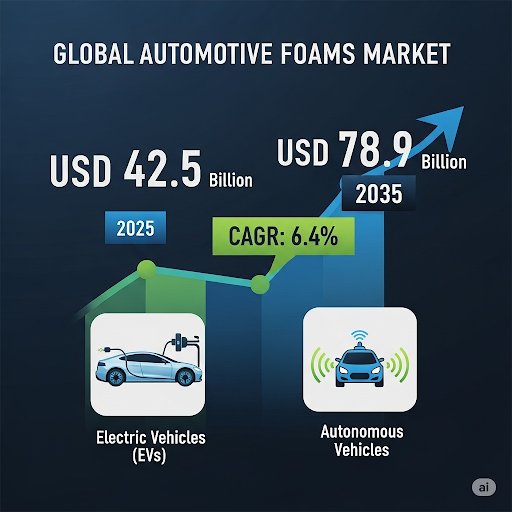
The global automotive foams market is forecast to grow from USD 42.5 billion in 2025 to USD 78.9 billion by 2035, at a 6.4% CAGR, fueled by the rapid adoption of electric vehicles (EVs), autonomous driving technologies, and lightweight materials. Rising demand for thermal insulation, acoustic comfort, and sustainable foam solutions is reshaping the industry landscape. Manufacturers are investing in recyclable, bio-based, and high-performance foams to meet evolving environmental and performance standards.
Innovations such as Huntsman Corporation’s SHOKLESS™ polyurethane systems for EV battery safety and Foam Partner’s low-emission interior foams are setting new benchmarks for performance, comfort, and safety. These advancements are aligned with the automotive sector’s push for materials that are lighter, more durable, and thermally efficient, meeting both regulatory demands and consumer expectations.
Uncover Essential Data – Get A Sample Copy https://www.futuremarketinsights.com/reports/sample/rep-gb-1753
Market Trends Highlighted
- Lightweight & Thermal Efficiency: Increasing use of polyurethane foams in EV interiors, battery insulation, and structural reinforcement to improve efficiency and range.
- Sustainability Shift: Growing adoption of low-VOC, recyclable, and bio-based foams in compliance with EU Green Deal, EPA regulations, and global sustainability targets.
- Smart & Adaptive Foams: Development of self-healing, temperature-sensitive, and AI-engineered foams to enhance passenger comfort, reduce maintenance, and extend lifespan.
- Aftermarket Growth: Rising retrofits for thermal and acoustic insulation in commercial fleets, ride-hailing vehicles, and older cars in emerging markets.
- Collaborative Innovation: Partnerships between OEMs, chemical companies, and Tier-1 suppliers for next-generation seating, NVH reduction, and crash safety applications.
Key Takeaways of the Report
- Market Size & Growth: USD 42.5B (2025) → USD 78.9B (2035) | CAGR 6.4%
- Leading Material: Polyurethane foam to hold 67% market share by 2025, growing at 6.7% CAGR.
- Top Application: Seating to maintain 58% share in 2025, driven by EV comfort innovations.
- Opportunities:
- EV boom driving demand for lightweight, thermally insulating foams.
- Advancements in bio-based and recyclable materials improving sustainability.
- Smart foam technologies opening premium market segments.
- Challenges:
- Raw material price volatility impacting PU, PE, and EPP supply.
- High production and R&D costs for eco-friendly and advanced foams.
- Recycling limitations due to complex material compositions.
Challenges and Opportunities in Automotive Foams
The automotive foams market faces challenges from volatile raw material prices and the high costs of developing sustainable, bio-based alternatives. However, significant opportunities are emerging. The rise of EVs is driving demand for lightweight, thermally efficient foams for battery safety, while the development of new smart foam technologies is set to innovate vehicle interiors and safety features.
Regional Market Outlook
United States:
Projected CAGR 6.5% from 2025–2035. Growth driven by EV adoption, stringent fuel economy standards, and demand for bio-based foams. Premium comfort seating and noise insulation in luxury and autonomous vehicles are key demand drivers.
United Kingdom:
CAGR 5.9%. Market expansion fueled by EV manufacturing growth, circular economy initiatives, and demand for premium interiors in luxury vehicles. Strong focus on crash safety and acoustic insulation materials.
European Union:
CAGR 6.3%. EU Green Deal regulations boosting sustainable foam adoption. Germany, France, and Italy lead innovation in recyclable and biodegradable foams for EVs and hybrids.
Japan:
CAGR 5.8%. High-tech precision engineering and hydrogen/EV production driving demand for lightweight, insulating, and safety foams. Autonomous vehicle R&D accelerates adoption of impact-absorbing materials.
South Korea:
Fastest growth at 6.7% CAGR, supported by EV production, smart manufacturing, and luxury interior upgrades. Sustainability regulations accelerating use of recyclable foams.
Other Key Players
- Armacell International
- FoamPartner
- Johnson Controls (Adient plc)
- Evonik Industries
- Woodbridge Foam Corporation
- Saint-Gobain Performance Plastics
- FXI Holdings Inc.
- Sekisui Chemical Co., Ltd.
- UFP Technologies, Inc.
- Zotefoams plc
Key Segments
By Foam Type:
- Polyurethane
- Polyolefin
- Other
By Application:
- Seating
- Door Panels & Water shields
- Instrument Panels
- Bumper System
- Other Applications
By End Use:
- Passenger Vehicles
- Light Commercial Vehicles (LCV)
- Heavy Commercial Vehicles (HCV)
Stay Ahead Grab the Report: https://www.futuremarketinsights.com/checkout/1753
About Future Market Insights (FMI)
Future Market Insights, Inc. (ESOMAR certified, recipient of the Stevie Award, and a member of the Greater New York Chamber of Commerce) offers profound insights into the driving factors that are boosting demand in the market. FMI stands as the leading global provider of market intelligence, advisory services, consulting, and events for the Packaging, Food and Beverage, Consumer Technology, Healthcare, Industrial, and Chemicals markets. With a vast team of over 400 analysts worldwide, FMI provides global, regional, and local expertise on diverse domains and industry trends across more than 110 countries.
Contact Us:
Future Market Insights Inc.
Christiana Corporate, 200 Continental Drive,
Suite 401, Newark, Delaware – 19713, USA
T: +1-347-918-3531
For Sales Enquiries: sales@futuremarketinsights.com