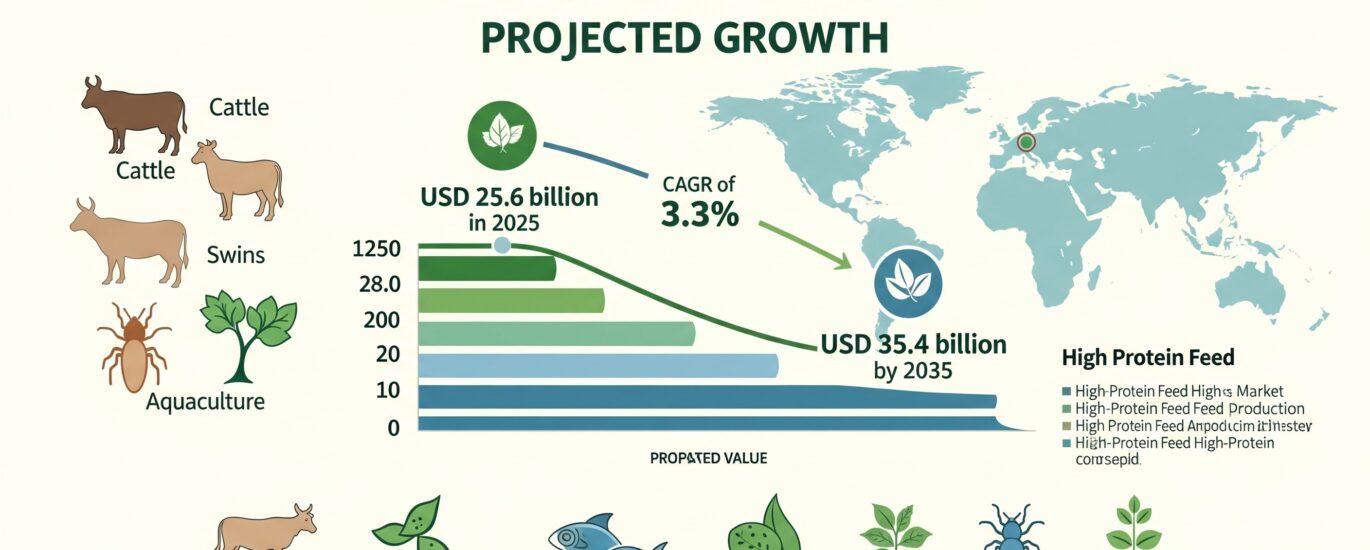
The global high-protein feed market is projected to grow to USD 35.4 billion by 2035, a new market analysis reveals. The sector, valued at USD 25.6 billion in 2025, is expanding at a steady compound annual growth rate (CAGR) of 3.3% as the world’s livestock and aquaculture industries seek to optimize animal nutrition and drive production efficiency. The findings highlight a market in transition, balancing traditional protein sources with a rising demand for innovative, sustainable alternatives.
The analysis, which examines the market landscape from 2025 to 2035, points to a clear market leader: soybean meal. Holding a dominant 39% share of the plant-based feed source segment in 2025, its cost-efficiency and robust amino acid profile make it an essential ingredient for poultry, swine, and dairy diets. The poultry sector itself is the primary consumer, accounting for a 34% share of the market, driven by the need for rapid growth and improved feed conversion ratios in broiler and layer operations.
Preview the Latest Trends – Request a Sample Copy: https://www.futuremarketinsights.com/reports/sample/rep-gb-22464
While traditional sources remain foundational, the market is undergoing a significant strategic shift. “One of the biggest challenges [the cultivated protein industry] faces though is how to feed the protein cells cost-efficiently, sustainably and at very large scale,” said David Blakemore, CEO of Nutreco, during the inauguration of a new cell-feed powder facility.
This statement encapsulates a broader industry movement toward sustainability and cost-effective scaling, which is a key driver for investment in alternative proteins. The report projects that the alternative protein feed segment alone is expected to reach USD 18.1 billion by 2035, with players like Nutreco pioneering solutions in areas like cell-based nutrition.
Competitive analysis of the market reveals a landscape dominated by vertically integrated agribusiness giants. Cargill Inc. and Archer Daniels Midland Company (ADM) lead the market through their vast sourcing and distribution networks for conventional protein sources like soybean and canola meal. Cargill’s recent 2025 Protein Profile highlights consumer trends favoring animal protein, directly correlating to the demand for high-protein animal feed inputs.
In a competitive move, Nutreco, through its brands Skretting and Trouw Nutrition, strategically focuses on value-added, high-protein blends, while Alltech Inc. differentiates itself with yeast-based proteins and fermentation technologies. Ridley Corporation maintains a strong regional presence in the Asia-Pacific market, adapting its formulations to specific local demands.
The market’s growth is not without its challenges. The analysis identifies price volatility in raw materials and a fragmented regulatory environment for novel ingredients as key hurdles. The report notes that soybean and corn protein prices have fluctuated 11-18% annually since 2022, creating procurement difficulties. Furthermore, regulatory approval timelines for new proteins, such as insect meal, can range from 9 to 24 months, delaying market entry and scaling for innovators.
Geographically, the market’s growth is concentrated in key industrial-scale livestock regions. South Asia & Pacific, East Asia, and North America are the leading growth hubs. India, specifically, is projected to see a 3.6% CAGR, propelled by the expanding dairy and poultry sectors and government support for protein-enriched feed.
Australia, at 3.4%, is driven by its ruminant livestock industry, while China’s 3.2% growth is anchored in its massive aquaculture and swine markets. These regional dynamics are a microcosm of the global trend, where local protein sourcing and national agricultural strategies are shaping the future of animal nutrition.
The high-protein feed market is also seeing a shift in product format and application. Pellets, which account for a 31% share, are favored for their convenience in handling and distribution, especially in automated feeding systems. The most sought-after protein concentration range is 30-50%, holding a 45% market share due to its versatility in balancing rations across various species. The primary application remains growth promotion, which holds a 30% share, reflecting the industry’s continuous focus on maximizing feed efficiency and animal performance.
Purchase the Complete Market Report Today: https://www.futuremarketinsights.com/checkout/22464
About the Report:
This market analysis provides a comprehensive overview of the global high-protein feed market, its size, key trends, and future projections. It includes detailed segmentation by protein source, livestock type, form, protein concentration, application, and sales channel. The report analyzes the competitive landscape and provides a deep dive into top-performing countries, offering a strategic outlook for stakeholders, manufacturers, and investors.
About Future Market Insights (FMI)
Future Market Insights, Inc. (ESOMAR certified, recipient of the Stevie Award, and a member of the Greater New York Chamber of Commerce) offers profound insights into the driving factors that are boosting demand in the market. FMI stands as the leading global provider of market intelligence, advisory services, consulting, and events for the Packaging, Food and Beverage, Consumer Technology, Healthcare, Industrial, and Chemicals markets. With a vast team of over 400 analysts worldwide, FMI provides global, regional, and local expertise on diverse domains and industry trends across more than 110 countries.
Contact Us:
Future Market Insights Inc.
Christiana Corporate, 200 Continental Drive,
Suite 401, Newark, Delaware – 19713, USA
T: +1-347-918-3531
For Sales Enquiries: sales@futuremarketinsights.com
Website: https://www.futuremarketinsights.com
LinkedIn| Twitter| Blogs | YouTube