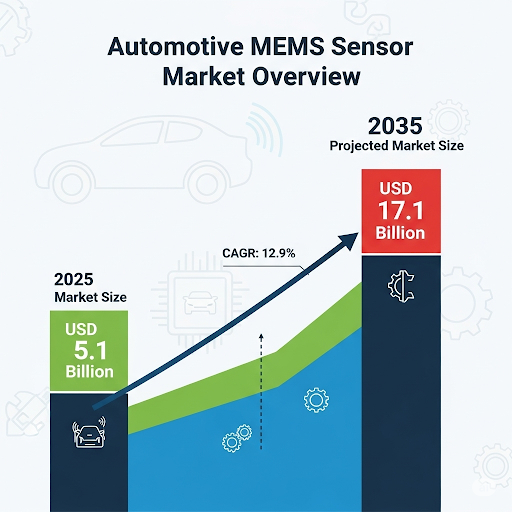
The global Automotive MEMS Sensor Market is set to expand from USD 5.1 billion in 2025 to USD 17.1 billion by 2035, reflecting a robust CAGR of 12.9%. Growth is being fueled by rising adoption of MEMS-based gyroscopes, accelerometers, and pressure sensors in advanced driver assistance systems (ADAS), safety applications, and infotainment platforms. Demand for sensor fusion technologies that enhance vehicle intelligence and automated driving capabilities is also on the rise, supported by rapid innovation from both established industry leaders and agile startups.
In May 2024, TDK Corporation unveiled a next-generation 6-axis MEMS inertial measurement unit (IMU) engineered specifically for automotive safety applications. Designed to maintain exceptional performance across temperature variations, the device helps manufacturers comply with ISO 26262 functional safety standards. According to TDK’s Automotive MEMS division, the innovation addresses the heightened precision and stability requirements of autonomous driving systems, a development highlighted by Telematics Wire as a key milestone in advancing automotive sensor capabilities.
Uncover Essential Data – Get A Sample Copy https://www.futuremarketinsights.com/reports/sample/rep-gb-8450
Key Industry Highlights
- Market Value Projection: USD 5.1 billion in 2025 to USD 17.1 billion by 2035, CAGR 12.9%.
- Strongest Growth Segments: Accelerometers (35% share by 2025) and powertrain applications (31% share).
- Technology Focus: AI-driven sensor fusion, miniaturization, and high-precision MEMS for real-time monitoring.
- Recent Innovations:
- TDK’s 6-axis MEMS IMU for automotive safety (May 2024).
- Omnitron Sensors’ USD 13M funding for SWS-based MEMS manufacturing (Jan 2025).
- Sheba Microsystems’ Sharp-7 MEMS autofocus for automotive cameras (May 2024).
- Primary Drivers: ADAS adoption, EV proliferation, stricter safety regulations, and the shift toward autonomous vehicles.
- Key Challenges: High production costs, stringent ISO 26262 compliance, and harsh operational environments.
Collaboration Between Small Market Players to Strengthen Product Portfolios
Startups are playing a critical role in pushing MEMS innovation forward. Omnitron Sensors’ proprietary Structural Wave Sensing (SWS) process promises “automotive-grade durability” at reduced costs, positioning it for mass-market adoption. Sheba Microsystems’ Sharp-7, the first MEMS autofocus for automotive cameras, is enhancing real-time imaging for ADAS systems. These developments highlight how small but technologically agile players are partnering with Tier 1 suppliers and OEMs to integrate novel MEMS designs into next-gen vehicle platforms.
Market Concentration
The automotive MEMS sensor industry is moderately consolidated, with Robert Bosch GmbH, STMicroelectronics, Infineon Technologies, Texas Instruments, and NXP Semiconductors together controlling over 55% of the market. These leaders are leveraging R&D capabilities, AI integration, and manufacturing scale to meet growing demand for high-performance sensing solutions in safety-critical automotive applications.
Country-Wise Insights
- United States (CAGR 14.2%) – Strong EV adoption and regulatory mandates for ESC and TPMS are boosting demand for MEMS sensors in connected and autonomous vehicles.
- United Kingdom (CAGR 12.8%) – Growth driven by luxury automakers and government-backed investments in smart mobility and self-driving technologies.
- European Union (CAGR 13.6%) – Stringent safety regulations, electrification goals, and leadership from Germany, France, and Italy accelerate sensor integration.
- Japan (CAGR 13.4%) – Automotive electronics innovation, hybrid adoption, and AI-integrated sensing solutions fuel expansion.
- South Korea (CAGR 13.5%) – Leadership in semiconductor manufacturing and EV technology boosts MEMS sensor deployment in autonomous and connected vehicles.
Company Profile
- Robert Bosch GmbH
- STMicroelectronics
- Infineon Technologies AG
- Texas Instruments Inc.
- NXP Semiconductors
- TDK Corporation (InvenSense)
- Murata Manufacturing Co., Ltd.
- Analog Devices, Inc. (ADI)
- Sensata Technologies
- ON Semiconductor (onsemi)
Key Segments
By Sensor Type:
- Accelerometer
- Pressure Sensor
- Gyroscope
- Others
By Distribution Channel:
- OEM
- Aftermarket
By Application:
- Classic & Safety
- Body Electronics
- Powertrain
- Infotainment
- Others
By Region:
- North America
- Latin America
- Europe
- Asia Pacific
- The Middle East and Africa
Stay Ahead – Grab the Report: https://www.futuremarketinsights.com/checkout/8450
About Future Market Insights (FMI)
Future Market Insights, Inc. (ESOMAR certified, recipient of the Stevie Award, and a member of the Greater New York Chamber of Commerce) offers profound insights into the driving factors that are boosting demand in the market. FMI stands as the leading global provider of market intelligence, advisory services, consulting, and events for the Packaging, Food and Beverage, Consumer Technology, Healthcare, Industrial, and Chemicals markets. With a vast team of over 400 analysts worldwide, FMI provides global, regional, and local expertise on diverse domains and industry trends across more than 110 countries.
Contact Us:
Future Market Insights Inc.
Christiana Corporate, 200 Continental Drive,
Suite 401, Newark, Delaware – 19713, USA
T: +1-347-918-3531
For Sales Enquiries: sales@futuremarketinsights.com
Website: https://www.futuremarketinsights.com
LinkedIn| Twitter| Blogs | YouTube