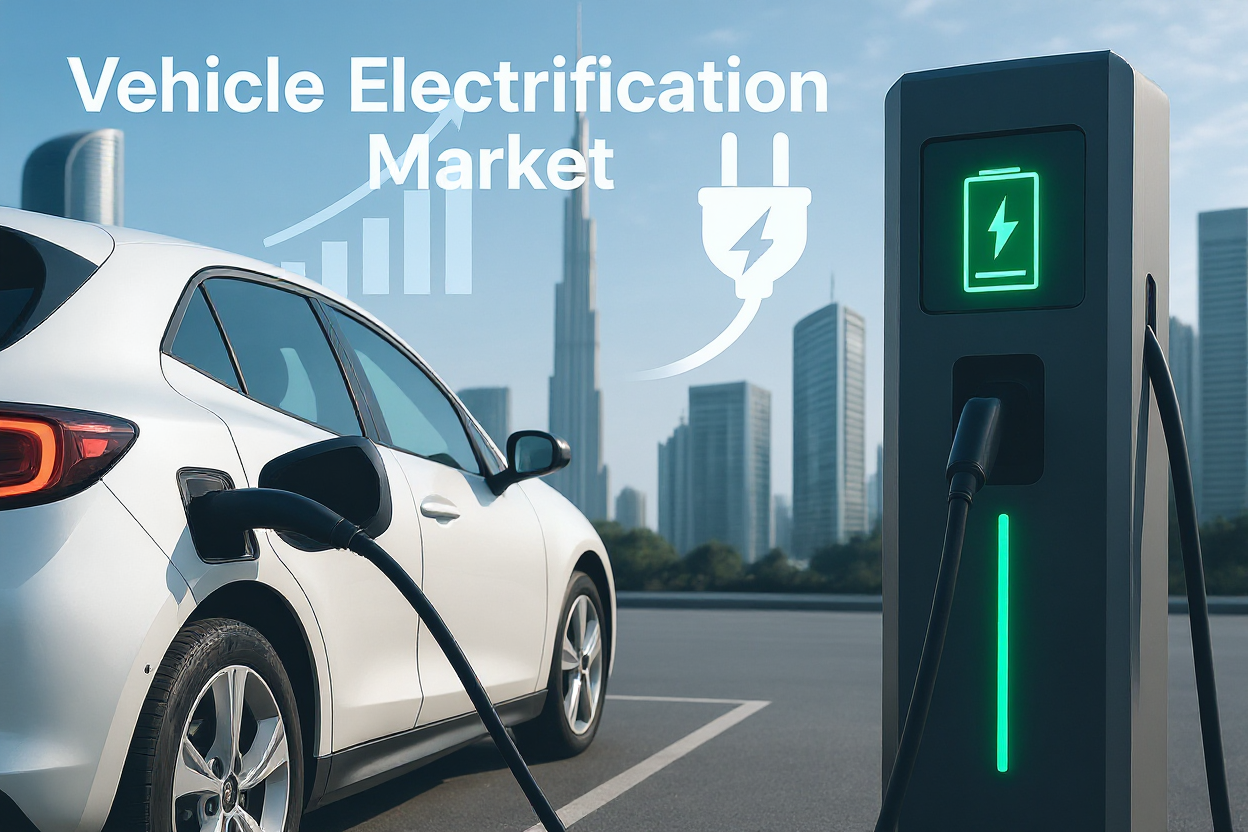
The global vehicle electrification market, valued at USD 66.3 billion in 2020, is projected to reach USD 99.3 billion by 2025 and further expand to USD 222.4 billion by 2035, at a CAGR of 8.3% between 2025 and 2035. Market growth is fueled by advancements in automotive electrical architectures, regulatory support for emissions reduction, and rising adoption of energy-efficient systems across both passenger and commercial vehicles.
Key developments such as Nissan’s affordable vehicle-to-grid technology and STMicroelectronics’ innovative Stellar microcontrollers are poised to accelerate the transition towards electrified mobility. The market’s expansion is fueled by ongoing innovation in automotive electrical architecture, a dynamic regulatory environment, and the growing adoption of energy-efficient systems in both passenger and commercial vehicles. A key example is Nissan’s development of an affordable vehicle-to-grid (V2G) technology, set for a 2026 launch, which will allow electric vehicles to function as bi-directional energy storage units.
Uncover Essential Data – Get A Sample Copy https://www.futuremarketinsights.com/reports/sample/rep-gb-542
Market Trends Highlighted
- Integration of Vehicle-to-Grid (V2G) Solutions
- In 2024, Nissan announced the launch of cost-effective V2G technology for release in 2026, enabling EVs to serve as bi-directional energy storage units.
- This innovation supports grid balancing, enhances energy resilience, and reduces ownership costs for EV users, making electrification more attractive for mass adoption.
- Advances in Automotive Microcontrollers
- STMicroelectronics introduced its Stellar microcontroller platform with extensible xMemory architecture in 2025.
- Designed for zonal control, motor management, and power conversion in electrified vehicles, these microcontrollers offer scalable memory and real-time processing to meet evolving automotive demands.
- Regulatory Momentum and Emission Norms
- Stringent emission standards in major markets such as the EU, China, and the U.S. are accelerating OEM investments in hybrid and electric vehicle platforms.
- Governments are offering subsidies, tax benefits, and charging infrastructure investments, further boosting electrification adoption.
- Shift Towards Modular Electrical Architectures
- Automakers are transitioning to modular, zonal-based electrical architectures to improve efficiency, reduce weight, and simplify maintenance in EVs and hybrids.
Key Takeaways of the Report
- Market Size Projection:
- USD 99.3 billion in 2025 to USD 222.4 billion by 2035, growing at an 8.3% CAGR.
- Primary Growth Drivers:
- Technological innovations like V2G systems and next-gen automotive microcontrollers.
- Supportive government policies and stricter environmental regulations.
- Rising consumer awareness of sustainability and lower operational costs of EVs.
- Dominant End-Use Segments:
- Passenger vehicles lead in adoption rates, but commercial vehicles are gaining traction, particularly in urban logistics and public transportation sectors.
- Technology Outlook:
- Growth in hybrid and battery electric vehicles (BEVs) will dominate the decade ahead.
- Increased integration of advanced driver-assistance systems (ADAS) and smart charging solutions.
Key Highlights of Vehicle Electrification
Vehicle electrification is being driven by several key industry highlights. The shift to electric vacuum pumps is crucial for enhancing the braking performance and energy efficiency of electric vehicles (EVs), with their on-demand operation and precise control. Government policies are also playing a significant role, with incentives and infrastructure investments making EVs more accessible and affordable.
This is further supported by the rise of Electric Power Steering (EPS), which reduces weight and improves fuel efficiency while enabling advanced features like lane-keeping assistance. Finally, Electric Air-Conditioner Compressors (e-ACCs) are boosting EV efficiency by eliminating mechanical belts, reducing energy consumption, and ensuring passenger comfort without compromising vehicle range. These innovations collectively underscore the industry’s focus on efficiency, sustainability, and technological advancement.
Regional Market Outlook
- Asia-Pacific:
Asia-Pacific, particularly China and India, is expected to be the fastest-growing market for vehicle electrification, supported by aggressive EV adoption targets, government subsidies, and local manufacturing capabilities. China is projected to grow at a CAGR of 20% from 2025 to 2035, while India follows with 15%, driven by urban mobility needs and energy security initiatives. - Europe and North America:
Europe, led by Germany and the UK, is benefitting from stringent carbon reduction mandates and strong OEM investments in electric mobility. Germany is expected to post a CAGR of 12%, while the UK will grow at 8%. The U.S. market is projected to grow at a 10% CAGR, supported by federal funding for EV infrastructure and rising consumer demand for sustainable transportation.
Key Players
- Robert Bosch GmbH
- Continental AG
- Denso Corporation
- Hitachi, Ltd.
- JTEKT Corporation
- Aisin Corporation
- Magna International
- Valeo SA
- Marelli Corporation
- Mahle GmbH
Key Segmentation
By Product Type:
The product type is further categorized into electric power steering (EPS), start/stop system, electric air-conditioner compressor, electric vacuum pump, electric oil pump, electric water pump, liquid heater PTC, integrated starter generator (ISG), starter motor, alternator and actuator.
By Degree of Hybridization:
The degree of hybridization is classified into internal combustion engine (ICE) & micro-hybrid vehicle, hybrid electric vehicle (HEV), plug-in hybrid electric vehicle (PHEV), battery electric vehicle (BEV) and mild hybrid system.
By Region:
Regions considered in the study include North America, Latin America, Western Europe, Eastern Europe, East Asia, South Asia & Pacific, and the Middle East and Africa.
Stay Ahead Grab the Report: https://www.futuremarketinsights.com/checkout/542
About Future Market Insights (FMI)
Future Market Insights, Inc. (ESOMAR certified, recipient of the Stevie Award, and a member of the Greater New York Chamber of Commerce) offers profound insights into the driving factors that are boosting demand in the market. FMI stands as the leading global provider of market intelligence, advisory services, consulting, and events for the Packaging, Food and Beverage, Consumer Technology, Healthcare, Industrial, and Chemicals markets. With a vast team of over 400 analysts worldwide, FMI provides global, regional, and local expertise on diverse domains and industry trends across more than 110 countries.
Contact Us:
Future Market Insights Inc.
Christiana Corporate, 200 Continental Drive,
Suite 401, Newark, Delaware – 19713, USA
T: +1-347-918-3531
For Sales Enquiries: sales@futuremarketinsights.com
Website: https://www.futuremarketinsights.com
LinkedIn| Twitter| Blogs | YouTube