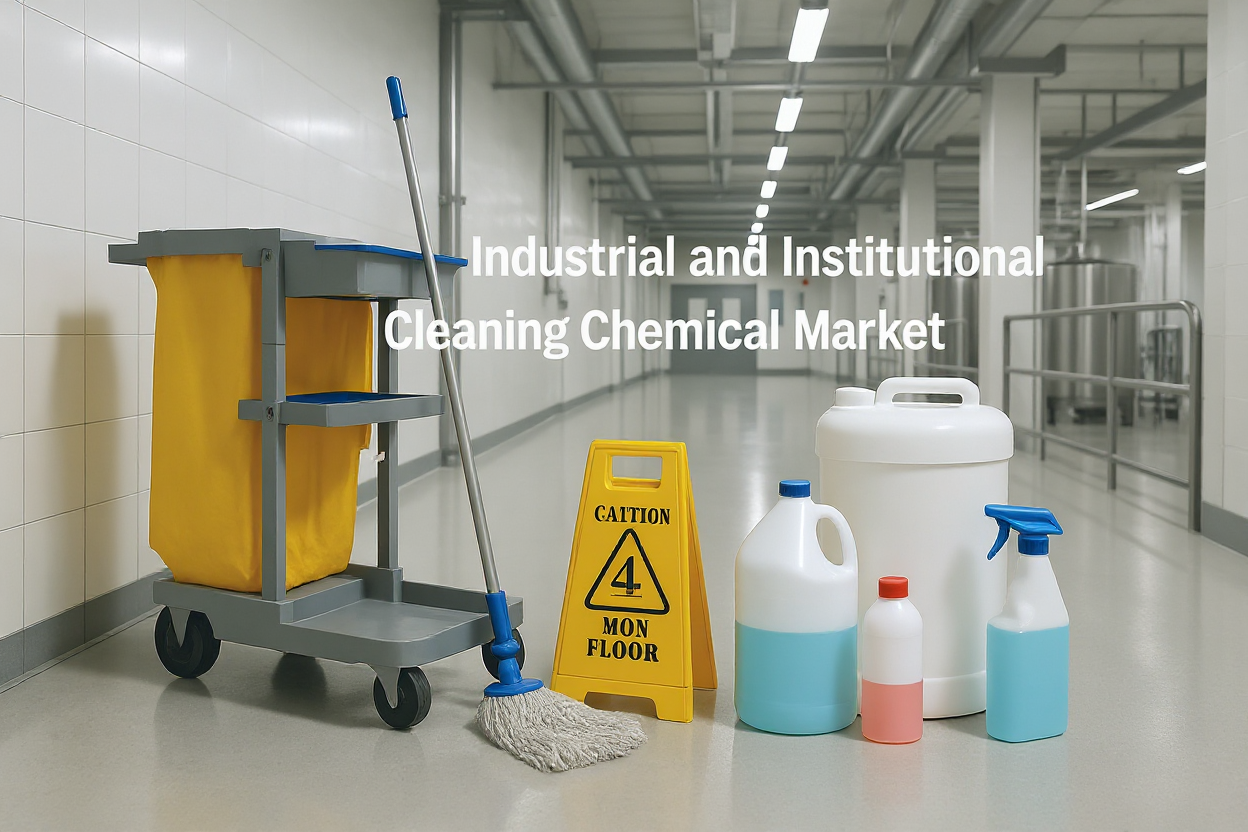
The global industrial and institutional cleaning chemical market is projected to grow from USD 60.9 billion in 2024 to USD 125.5 billion by 2034, registering a CAGR of 7.5% over the forecast period. Growth is driven by rising hygiene standards, sustainability mandates, and increased cleaning needs across healthcare, food processing, hospitality, and commercial sectors worldwide.
Post recognition by the World Health Organization (WHO), the importance of using industrial and institutional cleaning chemicals has significantly increased, with both consumers and institutions prioritizing hygiene across all settings. The heightened focus on sanitation—particularly after the pandemic—has accelerated the demand for effective, safe, and environmentally friendly cleaning agents in public spaces, healthcare, hospitality, and manufacturing industries.
Uncover Essential Data – Get A Sample Copy https://www.futuremarketinsights.com/reports/sample/rep-gb-1088
Market Trends Highlighted:
- Post-Pandemic Hygiene Priorities:
Continued emphasis on cleanliness and infection control in healthcare, schools, and foodservice sectors is sustaining demand for disinfectants and sanitizing agents. - Sustainable & Biodegradable Formulations:
Regulatory pressures and ESG commitments are encouraging the adoption of eco-friendly, phosphate-free, and biodegradable cleaning chemicals. - Automation in Commercial Cleaning:
The rise of smart cleaning systems, robotic janitorial equipment, and sensor-enabled dispensers is driving demand for compatible, high-efficiency chemical products. - Growth in Hospitality and Retail:
Rapid expansion of hotels, quick-service restaurants, and retail outlets worldwide is creating consistent demand for floor cleaners, degreasers, and surface sanitizers. - Healthcare and Food Processing Standards:
Strict sanitation protocols in hospitals, pharmaceutical production, and food plants are pushing usage of specialized I&I chemicals tailored for high-compliance environments.
Key Takeaways of the Report:
- The I&I cleaning chemical market is expected to more than double in size by 2034, with strong momentum in foodservice, healthcare, institutional facilities, and commercial real estate.
- Surface cleaners, sanitizers, degreasers, and dishwashing agents remain top-selling product segments, with green alternatives gaining traction.
- Increased urbanization and global travel contribute to growth in the hospitality and transportation cleaning segments.
- Advancements in formulation technology are leading to concentrated, low-residue, and multi-surface cleaning agents, improving cost and application efficiency.
- Chemical management systems and dosing automation are becoming critical for consistent, safe, and cost-effective usage in large-scale operations.
Rising HAIs and Smart Technologies Drive Cleaning Chemical Demand, While Regulations Pose Hurdles
The growing incidence of healthcare-associated infections (HAIs) is significantly driving demand for industrial and institutional cleaning chemicals, especially in hospitals and medical facilities where stringent hygiene is essential. According to the World Health Organization, HAIs affect one in ten patients globally, prompting healthcare providers to adopt rigorous sanitation protocols using disinfectants and surface cleaners that meet high efficacy standards. Simultaneously, the integration of digital and smart cleaning technologies—such as automated dispensers, cleaning robots, and electrostatic sprayers—is enhancing operational efficiency and expanding the industry’s innovation landscape. However, despite this growth, stringent regulatory requirements surrounding product safety, environmental impact, and efficacy are creating barriers to entry, particularly for smaller manufacturers.
Regional Market Outlook:
United States (CAGR: 7.4%)
Rising regulatory compliance in healthcare and food processing, coupled with a booming commercial real estate sector, drives significant demand. Sustainability goals are pushing reformulation efforts in industrial cleaning products.
United Kingdom (CAGR: 7.1%)
UK’s Net Zero 2050 strategy, along with stricter workplace hygiene rules and a growing online retail infrastructure, is accelerating demand for eco-friendly cleaning agents and automated cleaning systems.
European Union (CAGR: 7.3%)
The EU is leading in sustainability regulations, with high demand from foodservice, manufacturing, and public infrastructure projects. Bio-based and low-VOC cleaning formulations are gaining widespread acceptance.
Japan (CAGR: 6.8%)
Aging infrastructure and healthcare facilities are boosting the need for advanced sanitation chemicals, while smart building automation promotes demand for sensor-compatible cleaning solutions.
South Korea (CAGR: 7.2%)
Growth is fueled by high-tech manufacturing, expanded hospital capacity, and rising e-commerce warehouses requiring large-scale facility maintenance and cleaning.
Key Players of Industrial and Institutional Cleaning Chemical Industry
- Procter & Gamble
- BASF SE
- Clariant
- The Clorox Company, Inc.
- Henkel AG & Co. KGaA
- 3M
- Kimberly-Clark Corporation
- Reckitt Benckiser Group plc
- Croda International PLC
- Albemarle Corporation
- Eastman Chemical Corporation
- Huntsman International LLC
- STEPAN Company
- Westlake Chemicals Corporation
- SOLVAY
- Dow
- Sasol
Key Segments of Industrial and Institutional Cleaning Chemical Industry
By Raw Material:
In terms of Raw Material, the industry is divided into chlor-alkali, surfactant, solvents, phosphates, biocides, and others. The chlor-alkali segment is further divided into sub segments, as caustic soda, soda ash, and chlorine. The surfactant segment is divided as non-ionic, anionic, cationic, and amphoteric. The solvents segments consists of five sub-segments as alcohols, hydrocarbons, chlorinated, ethers, and others.
By Product Type:
In terms of Product Grade, the industry is divided into general purpose cleaners, disinfectants and sanitizers, laundry care products, vehicle wash products, and others.
By End Use Verticals:
In terms of End Use Verticals, the industry is divided into commercial and manufacturing. Commercial segment is further divided into food services, retail, healthcare, laundry care, institutional buildings and others. The manufacturing segment is divided into food and beverage processing, metal manufacturing and fabrication, electronic components and others.
By Region:
Key countries of North America, Latin America, Western Europe, Eastern Europe, East Asia, South Asia Pacific, and Middle East and Africa (MEA) have been covered in the report.
Stay Ahead – Grab the Report: https://www.futuremarketinsights.com/checkout/1088
About Future Market Insights (FMI)
Future Market Insights, Inc. (ESOMAR certified, recipient of the Stevie Award, and a member of the Greater New York Chamber of Commerce) offers profound insights into the driving factors that are boosting demand in the market. FMI stands as the leading global provider of market intelligence, advisory services, consulting, and events for the Packaging, Food and Beverage, Consumer Technology, Healthcare, Industrial, and Chemicals markets. With a vast team of over 400 analysts worldwide, FMI provides global, regional, and local expertise on diverse domains and industry trends across more than 110 countries.
Contact Us:
Future Market Insights Inc.
Christiana Corporate, 200 Continental Drive,
Suite 401, Newark, Delaware – 19713, USA
T: +1-347-918-3531
For Sales Enquiries: sales@futuremarketinsights.com
Website: https://www.futuremarketinsights.com
LinkedIn| Twitter| Blogs | YouTube