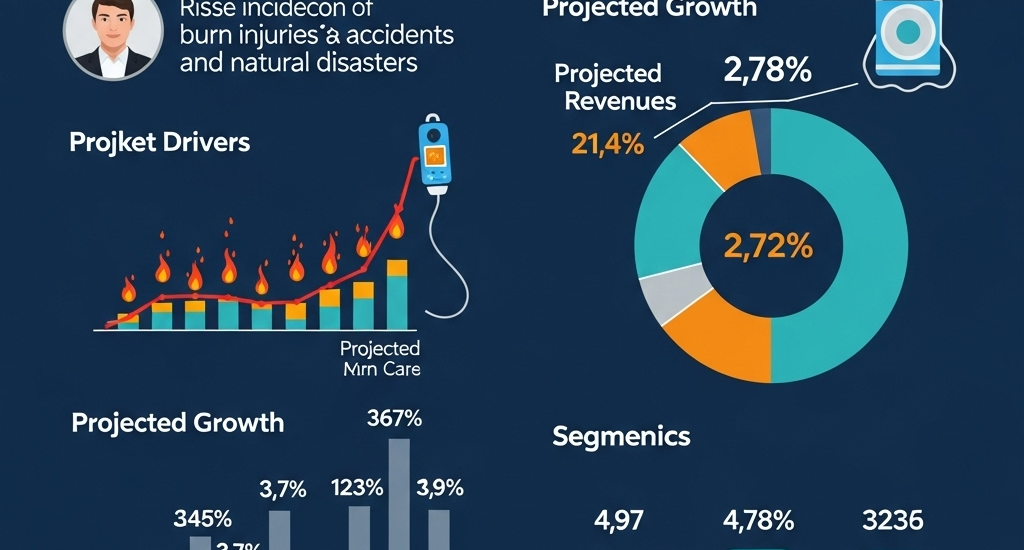
As the global burn care market is projected to skyrocket from USD 2.1 billion in 2025 to USD 4.5 billion by 2035, manufacturers are at the forefront of a profound transformation, directly addressing the critical challenges faced by healthcare providers and positioning themselves for unparalleled growth. This rapid expansion, registering a robust CAGR of 7.9%, is a direct result of manufacturers’ strategic shift toward a solution-focused, patient-centric approach that aligns with the evolving needs of the healthcare ecosystem. The industry is moving beyond traditional treatments, offering innovative products that tackle the core issues of high treatment costs, infection risks, and the scarcity of specialized care.
This market evolution is not a passive trend but a deliberate, competitive push to meet the demands of a high-stakes clinical environment. The leading segment, burn wound dressings, which holds a commanding 67.8% revenue share, is a prime example of this innovation. Manufacturers are developing next-generation dressings—antimicrobial, hydrocolloid, and bioengineered skin substitutes—that are not just bandages but sophisticated healing solutions. These products are designed to maintain optimal moisture balance, deliver antimicrobial agents, and promote faster epithelialization, all while enabling atraumatic dressing changes. For hospitals and burn units, this means improved healing outcomes, reduced complications, and greater patient comfort—solutions to their most pressing daily challenges.
Click Here for More Information:- https://www.futuremarketinsights.com/reports/burn-care-market
Targeting Key Clinical Needs: From Second-Degree Burns to Hospital Partnerships
Second-degree burns, a significant segment with a 43.9% revenue share, highlight another key area where manufacturer solutions are having a major impact. The clinical complexity and high risk of complications associated with these injuries demand advanced, effective management. The focus here is on optimizing functional recovery, and manufacturers are responding with products that support standardized protocols. By developing evidence-supported dressings and therapies that work seamlessly with early excision techniques, companies are empowering hospitals to deliver better, more consistent care. This focus on improving clinical workflows and patient outcomes is a powerful differentiator in a competitive market.
Hospitals, which account for 52.1% of market revenue, are the central hub for burn care, and manufacturers are strategically partnering with these institutions to drive adoption and support growth. This isn’t just about selling a product; it’s about providing comprehensive solutions. Leading companies are investing in staff training, technology upgrades, and infrastructure expansion to help hospitals scale their capacity for complex cases. The competitive landscape is defined by those who can provide not only superior products but also the strategic support necessary for multidisciplinary care teams to succeed. This includes not only advanced wound dressings but also bioengineered skin substitutes and antimicrobial therapies that are integral to a holistic burn management program.
Regional Growth and Technological Innovation Drive Future Opportunities
The challenges of high treatment costs and limited access to specialized care are creating new opportunities for manufacturers who can deliver value and scalability. The data points to a strong growth trajectory across key regions—North America (8.2% CAGR), Europe (7.9% CAGR), and Asia-Pacific (with notable growth in Japan at 8.1% and South Korea at 8.0%)—each with unique drivers. In the U.S., a high incidence of burn injuries and strong government funding for research fuel demand for FDA-approved, next-generation products. The UK is seeing a surge in demand driven by NHS innovation and a world-leading research base in regenerative medicine, while the European Union’s favorable regulatory landscape and focus on sustainability are incentivizing the development of biodegradable, plant-based solutions.
Japan and South Korea are emerging as hubs of innovation, with a strong emphasis on biotechnology, regenerative medicine, and aesthetic outcomes. Manufacturers in these regions are not only developing hydrogel dressings and bioengineered skin substitutes but also leveraging advancements in nanomedicine and AI-based platforms to create smart dressings and remote monitoring solutions. These innovations directly address the problem of limited access to specialists and poor patient management, demonstrating how technology and product development are converging to create a new paradigm in burn care.
Competitive Landscape and Key Developments
To capitalize on this momentum, leading manufacturers are not only expanding production capacity and securing regulatory approvals but also forming strategic partnerships with hospitals and specialized burn centers. These collaborations are crucial for clinician training and the effective adoption of new protocols. Furthermore, investments in digital platforms for remote wound monitoring are enhancing patient engagement and extending the reach of specialized care beyond the hospital walls.
Recent key developments underscore this innovative spirit. In 2025, AVITA Medical, Inc., showcased its wound care portfolio, including RECELL®, Cohealyx™, and PermeaDerm®, at the American Burn Association (ABA) 2025 Annual Meeting, highlighting an expanded evidence base for improving burn and wound management outcomes. Simultaneously, KeriCure Medical and CNTR began the first clinical trial on a cutting-edge spray-on wound dressing for burns, representing a significant leap forward in product form and application.
The competitive landscape is defined by manufacturers who can integrate these diverse elements—advanced products, strategic partnerships, and technological innovation—into a compelling, comprehensive solution for healthcare providers. The future of the burn care market belongs to the companies that recognize and act on the industry’s need for products that not only heal wounds but also solve the systemic problems of cost, access, and clinical complexity.
Get Sample Report: – https://www.futuremarketinsights.com/reports/sample/rep-gb-12621
About Future Market Insights (FMI)
Future Market Insights, Inc. (ESOMAR certified, recipient of the Stevie Award, and a member of the Greater New York Chamber of Commerce) offers profound insights into the driving factors that are boosting demand in the market. FMI stands as the leading global provider of market intelligence, advisory services, consulting, and events for the Packaging, Food and Beverage, Consumer Technology, Healthcare, Industrial, and Chemicals markets. With a vast team of over 400 analysts worldwide, FMI provides global, regional, and local expertise on diverse domains and industry trends across more than 110 countries.
Contact Us:
Future Market Insights Inc.
Christiana Corporate, 200 Continental Drive,
Suite 401, Newark, Delaware – 19713, USA
T: +1-347-918-3531
For Sales Enquiries: sales@futuremarketinsights.com
Website: https://www.futuremarketinsights.com
LinkedIn| Twitter| Blogs | YouTube