 For too long, menstrual care has been treated as a personal burden rather than a public health priority. Now, a market long neglected by serious investment and innovation is finally stepping into the spotlight—and growing fast.
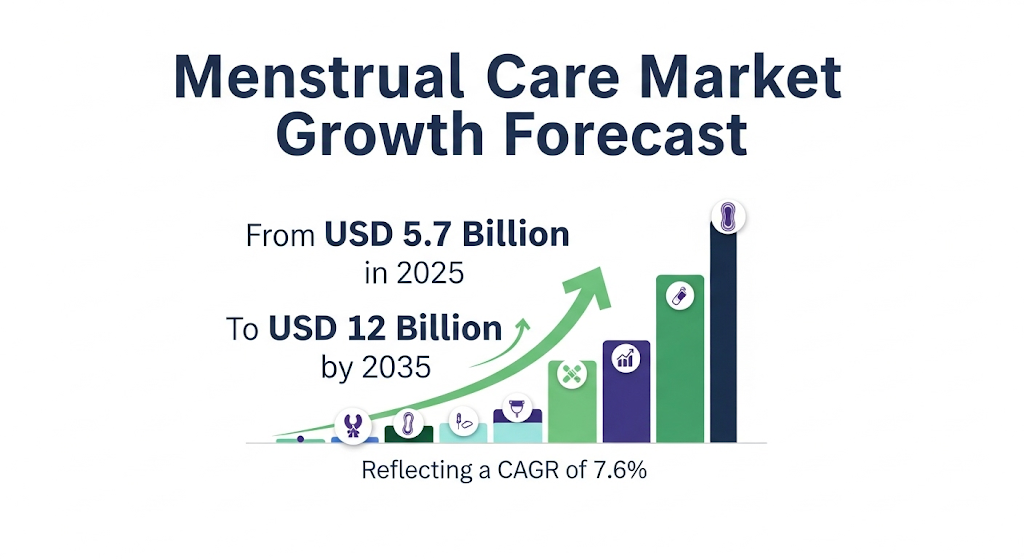
According to Future Market Insights, the global menstrual care market is projected to grow from USD 5.7 billion in 2025 to USD 12 billion by 2035, with a robust compound annual growth rate (CAGR) of 7.6%. This isn’t just a commercial milestone—it’s a sign that menstruation is no longer being ignored in boardrooms or policy discussions.
Demand for Market Analysis: Our Comprehensive Report Offers Detailed Trends and Insights: https://www.futuremarketinsights.com/reports/menstrual-care-market
A Market Rooted in Inequality
Menstruation affects over half the population at some point in life, yet access to safe, affordable, and dignified care remains wildly inconsistent across borders, income levels, and cultures. For many, basic products like pads or tampons are still taxed as luxury goods. In some regions, they’re not available at all.
The growth of this market is both overdue and hard-won. Decades of stigma, silence, and systemic neglect have kept menstrual health on the margins. But rising global awareness—driven by education, advocacy, and shifting cultural norms—is now transforming that silence into demand.
The Shift Toward Innovation
The once-monopolized shelves of conventional pads and tampons are being reshaped by a wave of innovation. Consumers are turning toward reusable menstrual cups, organic cotton products, and absorbent period underwear. The market is no longer just about absorbency—it’s about choice, sustainability, and bodily autonomy.
As awareness grows, so does expectation. Users want transparency, safety, and comfort. And increasingly, they want brands to address not just their needs, but their values—especially around environmental impact and affordability.
This is where market growth becomes more than just economic. It reflects a cultural and generational shift toward reframing menstruation as a normal, visible, and supported part of life.
Beyond Products: A Global Health Imperative
While product innovation flourishes in developed markets, much of the world still faces stark barriers. In low- and middle-income countries, menstruation remains shrouded in taboos, misinformation, and poor infrastructure. Girls miss school. Workers stay home. Millions lack access to even the most basic supplies.
The expanding global market presents an opportunity—but also a responsibility. As manufacturers look to new regions for growth, they must also address the socioeconomic and cultural conditions that have kept menstrual health in the shadows.
If done right, market expansion can drive not just revenue, but real change. It can fund education, shift norms, and bring dignity to those who’ve been denied it.
More Than a Market
The menstrual care market is growing because it’s catching up with reality—because periods don’t pause for politics or profits. Behind the projected USD 12 billion market lies something deeper: a collective decision that menstrual health is not niche, not taboo, and not optional.
Growth is good. But equity is better. If this industry delivers both, then its next decade won’t just be commercially successful—it will be historically necessary.
Key Players:
- Happy Mammoth
- NOW Foods
- Nature’s Way
- Garden of Life
- Procter & Gamble (New Chapter)
- Thorne Health Tech, Inc.
- Life Extension
- FLO Vitamins
- Olly
- Gaia Herbs
- Herbalife Nutrition
- Pfizer
- Bayer AG
- Pharmavite LLC (Nature Made, MegaFood)
- Pure Encapsulations
- Swisse
- Solgar
- GNC
- Vitabiotics
- Herbaland
- MyOva
Explore Market Dynamics: Request Your Sample Report Now: https://www.futuremarketinsights.com/reports/sample/rep-gb-19880
Key Segments
By Product Type:
As per product type, the industry has been categorized into Functional Food (Fruits, Vegetables, Nuts, and Others), Beverages (Probiotic drinks, Herbal Teas, and Smoothies), Supplements (Hormonal Supplements, Non-hormonal Supplements, Nutritional Supplements), and Others.
By Flavour type:
As per ingredient type, the industry has been categorized into Apple, Spearmint, Cinnamon, Ginger, Raspberry, and Others.
By Form:
This segment is further categorized into Gummies, Tablets, Capsules, Powders, and Soft gels.
By Sales Channel:
As per the sales channel, the industry has been categorized into Store-based Retail (Hypermarket/Supermarket, Convenience Store, Specialty Store, and Pharmacies), Online Retail (Company Website, 3rd party website, and Social Media Selling).
By Functionality:
This segment is further categorized into Headache support, Mood Support, Energy support, Hormonal Support, Pain Relief, Hydration Balance, and Pre-Menstrual Syndrome support.
By Region:
Industry analysis has been carried out in key countries of North America, Latin America, Europe, East Asia, South Asia, Oceania, and the Middle East & Africa.
About Future Market Insights (FMI)
Future Market Insights, Inc. (ESOMAR certified, recipient of the Stevie Award, and a member of the Greater New York Chamber of Commerce) offers profound insights into the driving factors that are boosting demand in the market. FMI stands as the leading global provider of market intelligence, advisory services, consulting, and events for the Packaging, Food and Beverage, Consumer Technology, Healthcare, Industrial, and Chemicals markets. With a vast team of over 400 analysts worldwide, FMI provides global, regional, and local expertise on diverse domains and industry trends across more than 110 countries.
Contact Us:
Future Market Insights Inc.
Christiana Corporate, 200 Continental Drive,
Suite 401, Newark, Delaware – 19713, USA
T: +1-347-918-3531
For Sales Enquiries: sales@futuremarketinsights.com
Website: https://www.futuremarketinsights.com
LinkedIn| Twitter| Blogs | YouTube