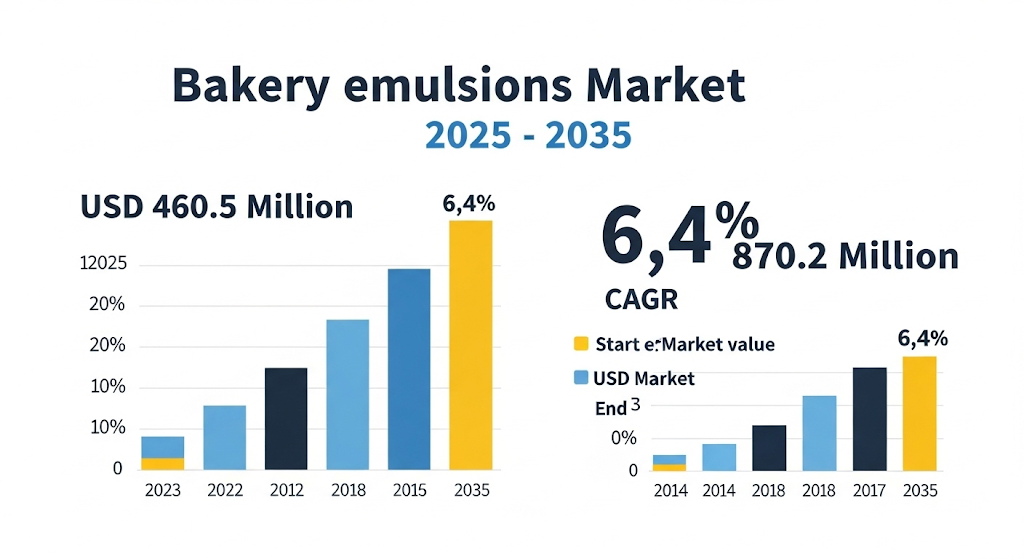
The global bakery emulsions market is on a strong growth trajectory, projected to increase from USD 460.5 million in 2025 to USD 870.2 million by 2035, reflecting a steady 6.4% CAGR. Growing demand for consistent crumb structure, moisture retention, and freeze-thaw stability in high-output bakery operations is fueling this trend. Regulatory reforms and the global shift towards clean-label and natural ingredients further enhance the market potential across key economies.
Surge in Market Needs: Discover Comprehensive Analysis and Insights in Our Detailed Report: https://www.futuremarketinsights.com/reports/bakery-emulsions-market
Key Industry Highlights:
The bakery emulsions market is undergoing a significant transformation, driven by technological innovation and tightening food safety standards. Traditional emulsifiers like mono- and diglycerides are increasingly being replaced with enzymatic and plant-based alternatives, such as lecithin and protein-polysaccharide complexes. This shift is catalyzed by consumer demand for transparency, cleaner labels, and nutritional enhancements in everyday bakery items like bread, pastries, and cakes.
Global regulatory bodies are playing a pivotal role in this shift. From the FDA’s sodium reduction guidance in the U.S. to the EU’s ban on industrial trans fats and India’s new additive inclusion ceilings, the push for healthier formulations has never been stronger. As a result, bakeries are not only reformulating products but also investing in advanced emulsification systems and domestic ingredient sourcing strategies.
Collaboration Between Small Market Players to Strengthen Product Portfolio:
The rise of clean-label emulsions has sparked increased collaboration among small and mid-sized ingredient suppliers and bakeries. These partnerships are focused on R&D to develop enzyme-activated oil blends, plant-based emulsifiers, and spray-dried lecithin systems that meet regulatory and sensory benchmarks. For example, Innovate UK grants are funding co-development projects for rapeseed-based emulsions, while India’s Production-Linked Incentive (PLI) scheme is enabling fermentation startups to scale enzyme-derived additives for mass-market baking applications. These alliances not only diversify the product portfolio but also reduce dependence on synthetic emulsifiers and imported ingredients.
Market Concentration:
The bakery emulsions market remains moderately fragmented, with a mix of global leaders and regional players. However, as compliance demands intensify, there is a gradual shift towards consolidation. Large multinationals continue to dominate institutional baking, but regional players are gaining traction by localizing production, adhering to national food safety standards, and offering clean-label, cost-effective solutions. The trend is especially visible in BRICS and ASEAN countries, where tariff benefits and government subsidies create fertile ground for new entrants and local expansion.
Country-wise Insights:
United States:
With a 6.0% CAGR, the U.S. market is driven by forthcoming Food Labeling Modernization mandates and FDA sodium reduction targets. Reformulations now prioritize enzyme-based and lecithin emulsions, especially in school lunch programs and state-level procurement contracts. Clean-label emulsions are being adopted as replacements for calcium propionate and synthetic esters in dough conditioning.
Germany:
Growing at a CAGR of 5.8%, Germany’s market is reshaping in response to the Federal Reduction and Innovation Strategy and EU trans-fat bans. Sunflower lecithin, modified via enzymatic processes, is gaining ground in breads and cakes. Low-interest loans from KfW are enabling midsize bakeries to install inline emulsification systems, aligning with clean-label and sustainability goals.
India:
The fastest-growing among BRICS with a 6.8% CAGR, India’s market benefits from FSSAI’s additive cap enforcement and state-backed industrial infrastructure. Mega Food Parks subsidize utilities for bakeries operating lecithin hydration and blending equipment, while the PLI scheme incentivizes domestic enzyme-emulsion production.
China:
Expected to grow at 6.5% CAGR, China’s bakery emulsions market is supported by the “Healthy China 2030” initiative and tariff relief from the Hainan Free Trade Port. Protein-polysaccharide emulsions are being favored in soft breads, as the government promotes low-fat formulations and residue-compliant emulsifiers.
United Kingdom:
With a 5.7% CAGR, the UK market is influenced by retained EU additive regulations and national nutrition profiling targets. Retailers are enforcing palm-free emulsifier sourcing, and Innovate UK is funding R&D into rapeseed-lecithin spray-drying technologies. Grocers now routinely audit suppliers for E-471 alternatives, creating pressure for cleaner ingredient sourcing.
Competition Outlook:
Global players like Kerry Group, DuPont, and Cargill are investing in emulsifier reformulation technologies and expanding their clean-label portfolios. However, local companies are rapidly catching up by aligning with national policies and consumer preferences. Strategic mergers and product development partnerships are emerging as key tactics to meet the rising demand for transparent labeling, lower saturated fat, and additive-free formulations.
Key Players in the Bakery Emulsions Market
- Archer Daniels Midland Company (ADM)
- Cargill Inc.
- DuPont de Nemours, Inc.
- ADM (Archer Daniels Midland Company)
- Corbion N.V.
- Kerry Group plc
- Puratos Group
- DSM-Firmenich
- Palsgaard A/S
- Lasenor Emul S.L.
- Bakels Group
- Others
Track Evolving Market Trends: Request Your Sample Report: https://www.futuremarketinsights.com/reports/sample/rep-gb-6267
Key Segmentation
By Source:
The segmentation is into plant, animal, synthetic, microbial, egg-derived, milk-based, and synthetic/bio-based.
By Nature:
The segmentation is into conventional and organic.
By End-Use:
The segmentation is into industrial and household.
By Application:
The segmentation is into bakery, hotels, and restaurants.
By Distribution Channel:
The segmentation is into store-based retail, specialty stores, online retail, supermarkets, and hypermarkets.
By Region:
The segmentation is into North America, Latin America, Eastern Europe, Western Europe, East Asia, South Asia & Pacific, Central Asia, Balkan and Baltic Countries, Russia & Belarus, and the Middle East & Africa.
About Future Market Insights (FMI)
Future Market Insights, Inc. (ESOMAR certified, recipient of the Stevie Award, and a member of the Greater New York Chamber of Commerce) offers profound insights into the driving factors that are boosting demand in the market. FMI stands as the leading global provider of market intelligence, advisory services, consulting, and events for the Packaging, Food and Beverage, Consumer Technology, Healthcare, Industrial, and Chemicals markets. With a vast team of over 400 analysts worldwide, FMI provides global, regional, and local expertise on diverse domains and industry trends across more than 110 countries.
Contact Us:
Future Market Insights Inc.
Christiana Corporate, 200 Continental Drive,
Suite 401, Newark, Delaware – 19713, USA
T: +1-347-918-3531
For Sales Enquiries: sales@futuremarketinsights.com
Website: https://www.futuremarketinsights.com
LinkedIn| Twitter| Blogs | YouTube