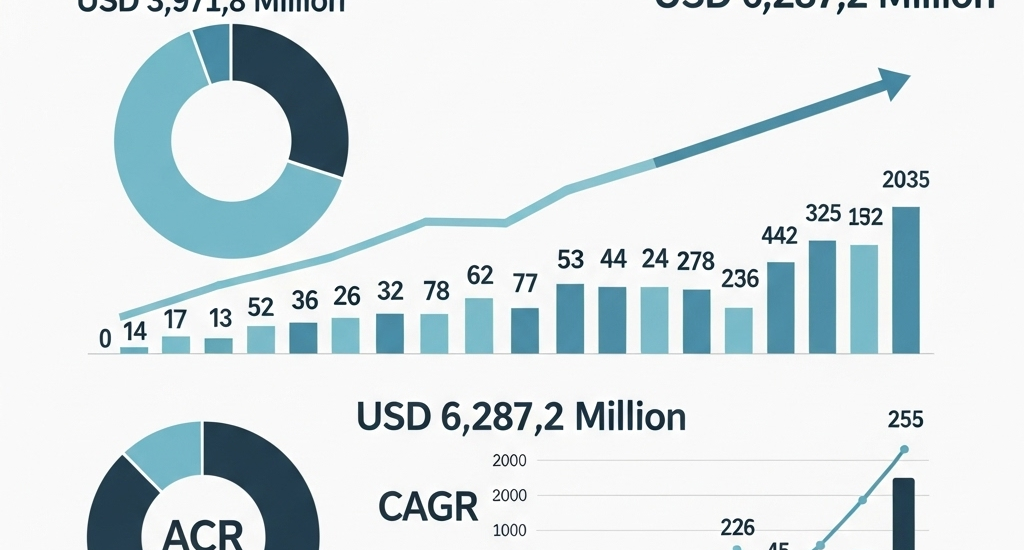
The global Hematology Diagnostics Market is projected for substantial growth, with an estimated value of USD 3,971.8 million in 2025, set to reach USD 6,287.2 million by 2035. This expansion reflects a robust Compound Annual Growth Rate (CAGR) of 6.5% over the forecast period, primarily driven by healthcare systems’ prioritization of early detection and management of hematological disorders.
Market Dynamics: Early Detection and Automation Drive Growth
The hematology diagnostics market has witnessed sustained momentum as global disease prevalence rises, access to laboratory services expands, and there’s a significant shift toward automated, high-throughput analyzers. Clinical laboratories and hospitals are increasingly investing in integrated platforms that combine complete blood count (CBC) testing, differential counts, and advanced cellular morphology capabilities, enhancing diagnostic accuracy and turnaround time. Stringent regulatory guidance and quality assurance initiatives further stimulate demand for validated reagents and consumables.
Click Here for More Information:- https://www.futuremarketinsights.com/reports/hematology-diagnostics-market
Kits & Reagents and Lab-Based Testing Lead Segments
In 2025, Kits and Reagents are estimated to account for a significant 62.1% revenue share, underscoring their indispensable role in hematology workflows due to recurring demand and compliance with stringent quality standards. Hospitals and laboratories prioritize validated reagent systems compatible with automated platforms to meet accreditation and ensure consistent quality.
Lab-Based Testing contributes a dominant 82.0% revenue share. This segment is driven by centralized laboratories’ ability to efficiently process large specimen volumes and deliver standardized, high-quality results. Providers favor these platforms for economies of scale, advanced analytics, and adherence to rigorous regulatory requirements.
Hospitals remain leading end-users, contributing 24.3% of revenue, highlighting their key role in providing hematology testing as part of comprehensive inpatient and outpatient care. Their need for rapid diagnostics in critical care, oncology, and surgical departments fuels demand for automated analyzers and consumables.
Challenges: Cost and Skilled Labor Shortage
The hematology diagnostics arena faces challenges such as the high costs of analyzers and consumables, along with a shortage of specialist personnel required to interpret complex results. While automated systems improve throughput, sophisticated equipment for complex blood disorders remains a financial barrier for smaller labs. Manual review of abnormal cell morphology also creates bottlenecks in resource-limited settings.
Opportunities: Rising Blood Disorders and Automation
Despite infrastructural limitations, the market is forecasted to grow due to the rising incidence of anemia, leukemia, and chronic diseases affecting blood parameters globally. Advancements in automated analyzers, point-of-care (POC) devices, and integrated diagnostic platforms are enhancing test speed, accuracy, and accessibility. AI-assisted blood cell differentiation, cloud-based data analytics, and telehematology are improving diagnostic efficiency, making accurate, high-throughput hematology diagnostics increasingly demanded worldwide.
Key Regional Growth Trends
North America, particularly the USA, is experiencing strong market growth (9.1% CAGR for USA from 2025-2035) propelled by increased demand for CBC testing, innovations in lab automation, and a high incidence of hematologic cancers. Europe, with the UK at 9.0% CAGR and the EU at 9.4% CAGR, is driven by NHS modernization, increased screening, and adoption of advanced differential analyzers. Asia-Pacific, notably South Korea (9.8% CAGR) and Japan (9.2% CAGR), is seeing rapid expansion due to advanced laboratory infrastructure, investment in precision oncology, and government-supported mass health screening programs. China (6.9% CAGR) and India (7.4% CAGR) also show significant growth.
Competitive Landscape and Strategic Initiatives
The competitive landscape is defined by companies expanding automated hematology platforms and validated reagent portfolios. Leading manufacturers, including Sysmex Corporation, Beckman Coulter Inc. (Danaher), Abbott Laboratories, Siemens Healthineers AG, and HORIBA Medical, are investing in digital imaging, AI-powered classification, and connectivity solutions. Strategic partnerships with reference labs and hospital networks are prioritized to strengthen distribution and accelerate adoption in emerging markets. Recent developments include Sysmex Corporation receiving USA FDA 510(k) clearance for its XR-Series Automated Hematology Analyzer in 2025, and HORIBA Medical launching the HELO 2.0, a high-throughput automated hematology platform, in 2024. These trends are expected to maintain innovation intensity and competitive momentum.
Get Sample Report: – https://www.futuremarketinsights.com/reports/sample/rep-gb-9046
About Future Market Insights (FMI)
Future Market Insights, Inc. (ESOMAR certified, recipient of the Stevie Award, and a member of the Greater New York Chamber of Commerce) offers profound insights into the driving factors that are boosting demand in the market. FMI stands as the leading global provider of market intelligence, advisory services, consulting, and events for the Packaging, Food and Beverage, Consumer Technology, Healthcare, Industrial, and Chemicals markets. With a vast team of over 400 analysts worldwide, FMI provides global, regional, and local expertise on diverse domains and industry trends across more than 110 countries.
Contact Us:
Future Market Insights Inc.
Christiana Corporate, 200 Continental Drive,
Suite 401, Newark, Delaware – 19713, USA
T: +1-347-918-3531
For Sales Enquiries: sales@futuremarketinsights.com
Website: https://www.futuremarketinsights.com
LinkedIn| Twitter| Blogs | YouTube