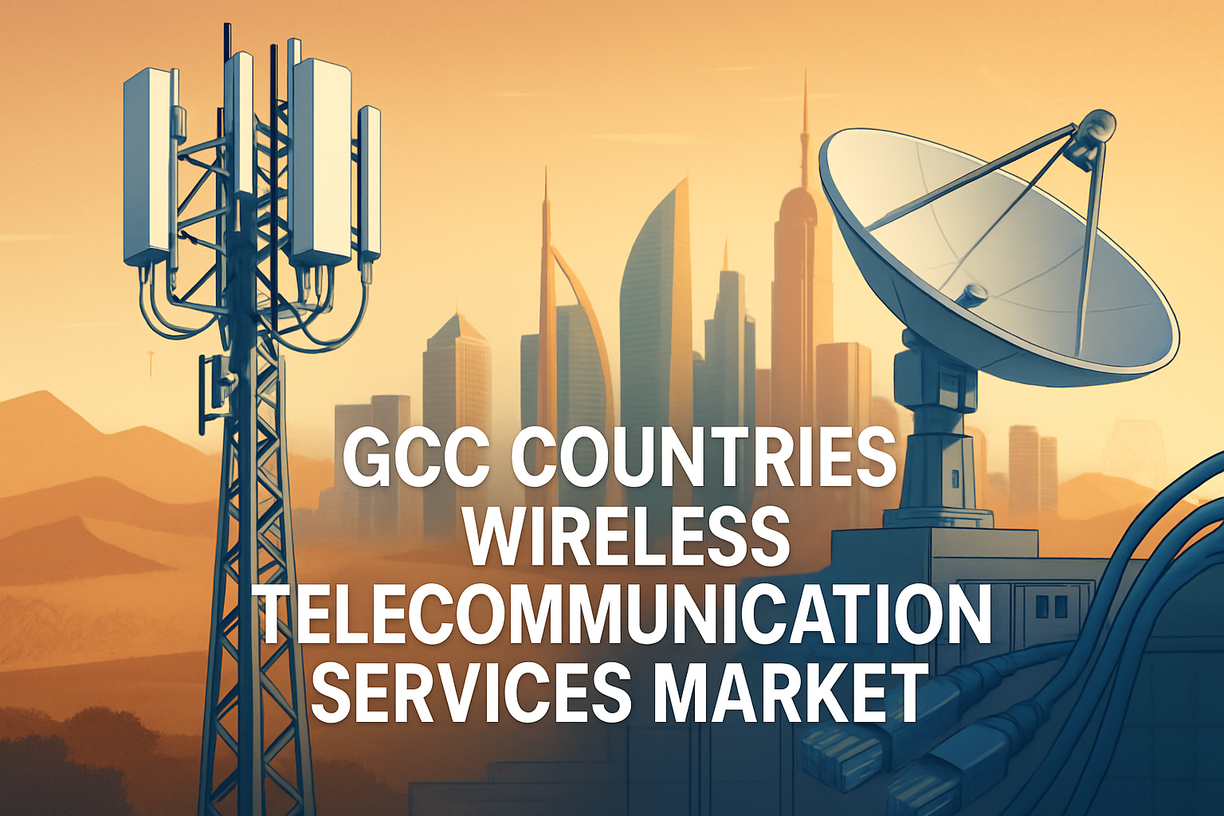
The GCC wireless telecommunication services market is poised for substantial growth, projected to reach USD 85,650.6 million by 2025 and escalate to USD 189,238.6 million by 2035, reflecting a healthy CAGR of 8.3%. The surge is powered by rapid urbanization, increasing mobile penetration, and ongoing investments in 5G infrastructure across the Gulf region. As governments and private sectors continue to digitize services, wireless connectivity is emerging as the backbone of economic modernization.
In the GCC, countries like Saudi Arabia and the UAE are leading wireless telecom growth through major 5G and fiber-optic investments, AI-driven network optimizations, and strong government backing. Initiatives like Vision 2030 and Smart Dubai are accelerating digital transformation, cloud adoption, and IoT integration. High mobile penetration, supportive regulations, and expanding rural coverage are further propelling market expansion across the region.
Uncover Essential Data – Get A Sample Copy https://www.futuremarketinsights.com/reports/sample/rep-gb-20517
Market Trends Highlighted
- Accelerated 5G Rollout:
The deployment of 5G technology is a central trend in the GCC region, with countries like the UAE, Saudi Arabia, and Qatar leading the charge. Faster speeds, lower latency, and improved network capacity are enabling new services, from IoT applications to autonomous vehicles and smart city frameworks.
- Growing Mobile Data Consumption:
Smartphone usage and mobile internet traffic have surged due to increased video streaming, mobile gaming, and social media engagement. Telecom providers are expanding data plans and network capacity to meet evolving user demands.
- Digital Government and Smart Cities:
Government-led digital transformation initiatives—such as Saudi Vision 2030 and UAE’s Smart Government strategy—are heavily reliant on robust wireless networks. These initiatives are fueling demand for seamless, high-speed wireless communication infrastructure.
- Enterprise Mobility and Cloud Adoption:
Businesses across sectors are adopting cloud-based solutions and mobile-first strategies, driving the need for reliable and secure wireless telecommunication services, especially in logistics, fintech, and e-commerce.
- IoT and M2M Connectivity:
Wireless telecom services are crucial for enabling machine-to-machine (M2M) and Internet of Things (IoT) communications in sectors like healthcare, utilities, oil & gas, and industrial automation.
Key Takeaways of the Report
The GCC wireless telecom market is expected to expand from USD 85.7 billion in 2025 to USD 189.2 billion by 2035, growing at a CAGR of 8.3%.
5G subscriptions are projected to dominate the market by 2030, with high-speed connectivity enabling innovative consumer and enterprise services.
Saudi Arabia and the UAE will continue to lead the regional market due to their advanced infrastructure, regulatory support, and public-private investments.
Increasing mobile penetration rates—currently exceeding 100% in several countries—highlight a saturated but innovation-driven market.
Telecom operators are diversifying into value-added services (VAS) like mobile financial services, cybersecurity, and content streaming to boost ARPU (average revenue per user).
Regional Market Outlook
The GCC region shows a unified commitment toward telecom modernization, with Saudi Arabia and the UAE spearheading large-scale investments in wireless infrastructure. Meanwhile, Qatar, Kuwait, Bahrain, and Oman are scaling up 5G, IoT, and cloud services to compete regionally and globally.
Major giants in the market
- STC,
- Etisalat
- Ooredoo
- Zain
- Vodafone Qatar
Top Segments Studied in the GCC Wireless Telecommunication Services Market Outlook
By Service Type:
Data/internet services, fixed voice services & messaging, telecom-managed services, and cloud services dominate. Data services lead due to high-speed internet reliance.
By Technology:
The market spans 3G, 4G, and 5G technologies. The rapid shift from 4G to 5G highlights growing connectivity and smart device usage.
By End-use Industry:
BFSI, healthcare, retail & eCommerce, IT & telecom, travel & hospitality, and government are key industries. BFSI and healthcare dominate, needing robust wireless solutions.
Stay Ahead – Grab the Report: https://www.futuremarketinsights.com/checkout/20517
About Future Market Insights (FMI)
Future Market Insights, Inc. (ESOMAR certified, recipient of the Stevie Award, and a member of the Greater New York Chamber of Commerce) offers profound insights into the driving factors that are boosting demand in the market. FMI stands as the leading global provider of market intelligence, advisory services, consulting, and events for the Packaging, Food and Beverage, Consumer Technology, Healthcare, Industrial, and Chemicals markets. With a vast team of over 400 analysts worldwide, FMI provides global, regional, and local expertise on diverse domains and industry trends across more than 110 countries.
Contact Us:
Future Market Insights Inc.
Christiana Corporate, 200 Continental Drive,
Suite 401, Newark, Delaware – 19713, USA
T: +1-347-918-3531
For Sales Enquiries: sales@futuremarketinsights.com
Website: https://www.futuremarketinsights.com
LinkedIn| Twitter| Blogs | YouTube