In an increasingly unstable global food ecosystem—rattled by disease outbreaks, climate unpredictability, and logistics snarls—one unlikely product is quietly rising to the occasion: frozen eggs.
Long overlooked outside the industrial kitchen, frozen eggs are now finding their moment as a strategic, shelf-stable protein with far-reaching implications for foodservice, emergency preparedness, and global supply chain resilience.
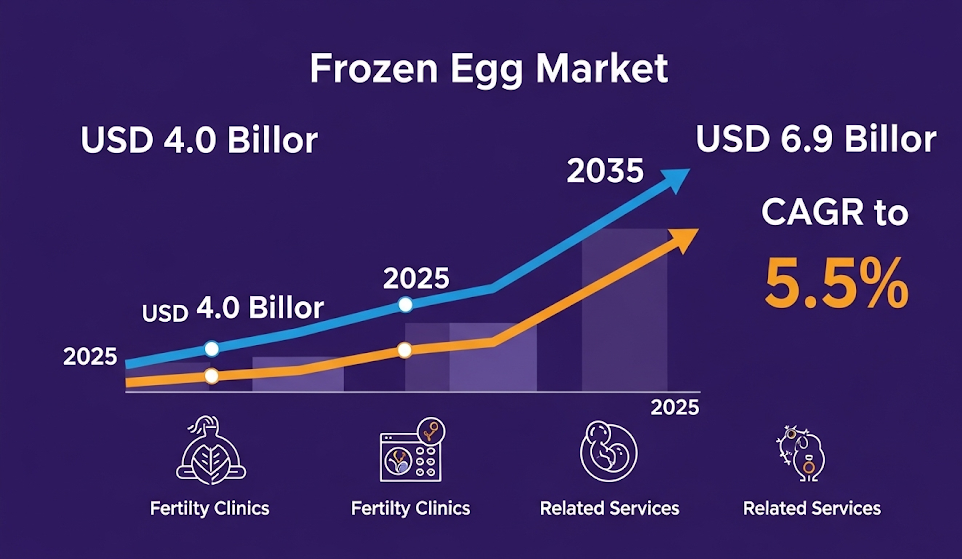
According to Future Market Insights (FMI), the global frozen egg market is projected to grow from USD 4.0 billion in 2025 to USD 6.9 billion by 2035, reflecting a compound annual growth rate (CAGR) of 5.5% over the forecast period. That’s more than just incremental growth—it’s a clear signal that frozen eggs are shifting from a back-of-house convenience to a frontline solution in food security.
Stay Informed on Key Market Changes: Get a Sample Report: https://www.futuremarketinsights.com/reports/sample/rep-gb-14338
Frozen Eggs: A Global Supply Chain Answer
Why are frozen eggs gaining traction now?
Because they solve a growing list of problems. They offer extended shelf life, eliminate the contamination risks of raw shell eggs, and are logistically easier to store, transport, and scale globally. In a world where eggs are often caught in the crosshairs of animal disease outbreaks or volatile pricing, frozen formats provide predictability and control.
They’re also adaptable across a wide range of food applications—from commercial baking to meal kits—making them an operational no-brainer for institutions, caterers, and manufacturers alike.
From Fragile to Strategic
Traditionally seen as a utility ingredient, frozen eggs are evolving into a strategic food asset. The ability to pasteurize and freeze whole eggs, yolks, and whites not only reduces waste and labor but insulates against unpredictable egg supply shocks.
And this is more than just a Western story. As cold-chain logistics improve globally, emerging markets are positioning themselves to integrate frozen eggs into broader nutrition and protein strategies—particularly where refrigeration and egg safety are long-standing challenges.
Convenience, Consistency, and Cost Control
In high-volume food production, frozen eggs aren’t just a workaround—they’re an upgrade. They deliver consistency in texture and yield, save time in food preparation, and reduce the labor and safety hazards associated with shell cracking and raw handling.
This shift aligns with broader operational priorities: lean labor, lower spoilage, and predictable inputs. With more restaurants, hotels, and packaged food companies seeking scalable solutions, frozen eggs offer a ready-made answer.
An Underrated Growth Engine
While headlines obsess over lab-grown meat and plant-based innovation, the frozen egg market is steadily becoming a quiet growth engine in the global food economy. Its projected market size—USD 6.9 billion by 2035—underscores that this isn’t a niche play. It’s a sector responding to real, structural demands in how the world produces, distributes, and consumes protein.
And as food systems shift from reactive to resilient, the frozen egg market may prove to be one of the most important developments you’ve never heard about.
Key Market Players
- Ballas Egg
- Crystal Lake LLC
- Cargill Inc.
- Pace Farm
- Sonstegard Foods
- Ovobel Foods Limited
- Rembrandt Foods
- Willamette Egg Farms
- Nature-Egg LLP
- NestFresh Eggs
- Bumble Hole Foods Ltd
Frozen Egg Market Segmentation
The market is segmented by product type, end use, and region.
By Product Type:
By product type, the sub-segmentation is as whole eggs, egg whites, and egg yolk.
By End Use:
By end use, the sub-segmentation is as food processing industry, retail/household, and food service providers.
By Region:
By region, the market is classified into Asia Pacific, the Middle East & Africa, North America, Europe, and Latin America.
 All the Data You Need: Buy the Complete Report: https://www.futuremarketinsights.com/checkout/14338
About Future Market Insights (FMI)
Future Market Insights, Inc. (ESOMAR certified, recipient of the Stevie Award, and a member of the Greater New York Chamber of Commerce) offers profound insights into the driving factors that are boosting demand in the market. FMI stands as the leading global provider of market intelligence, advisory services, consulting, and events for the Packaging, Food and Beverage, Consumer Technology, Healthcare, Industrial, and Chemicals markets. With a vast team of over 400 analysts worldwide, FMI provides global, regional, and local expertise on diverse domains and industry trends across more than 110 countries.
Contact Us:
Future Market Insights Inc.
Christiana Corporate, 200 Continental Drive,
Suite 401, Newark, Delaware – 19713, USA
T: +1-347-918-3531
For Sales Enquiries: sales@futuremarketinsights.com
Website: https://www.futuremarketinsights.com
LinkedIn| Twitter| Blogs | YouTube