From keeping yogurt creamy and sauces emulsified to ensuring plant-based meats hold together through transit, stabilizers are the unsung architects of texture, shelf life, and visual appeal. But while most people don’t know their names—like carrageenan or guar gum—these microscopic agents are essential to the global food supply chain.
And they’re becoming big business.
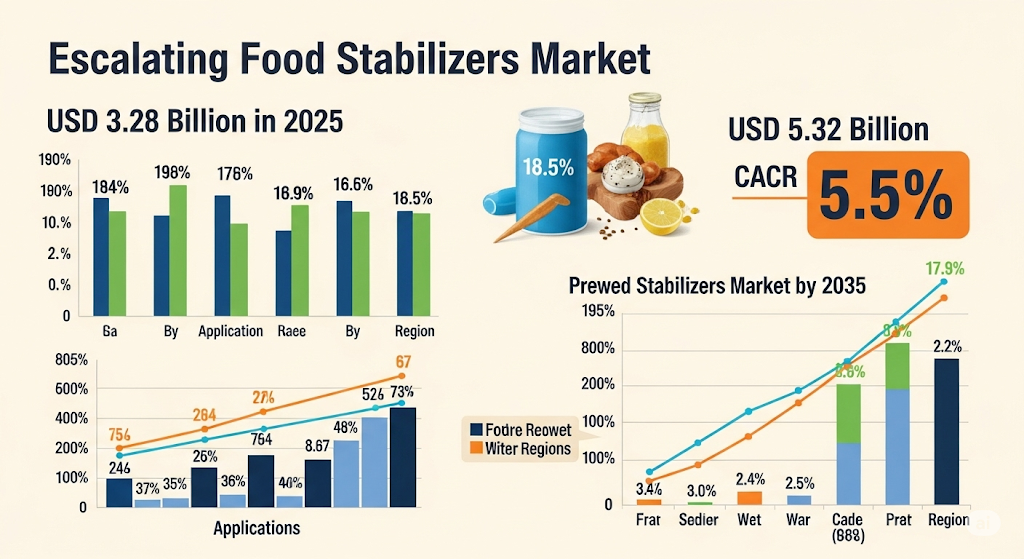
According to Future Market Insights, the global food stabilizers market is projected to grow from USD 3.28 billion in 2025 to USD 5.32 billion by 2035, expanding at a compound annual growth rate (CAGR) of 5.5%. It’s a steady climb that reflects not just consumer trends, but the increasing technological demands of feeding a complex world.
Gain Access to Market Trends: Request Your Sample Report: https://www.futuremarketinsights.com/reports/sample/rep-gb-15444
Invisible, But Indispensable
Food stabilizers rarely get a starring role on ingredient labels. Yet they’re central to product integrity. Remove them, and your favorite almond milk separates, your frozen entrée becomes a watery mess, and your dairy-free cheese turns into a rubbery disaster.
Despite the low visibility, stabilizers play a pivotal role in nearly every processed food category—bakery, dairy, beverages, meat analogs, and sauces. They enable mass production, long-distance shipping, and consistency across batches. In other words: they make the global food system possible.
The Clean Label Dilemma
The challenge is this: as consumers increasingly demand “fewer ingredients” and “natural products,” stabilizers have become targets of skepticism—even when they’re derived from plants or fermentation.
Brands are now under pressure to swap out traditional stabilizers with so-called “cleaner” alternatives. But the substitution isn’t simple. Often, replacing a tried-and-tested stabilizer means investing in R&D, reformulating products, and risking changes in texture or shelf life.
It’s not just a question of marketing—it’s a question of science, cost, and consistency.
Global Growth, Local Pressure
The growth trajectory of food stabilizers is being fueled by diverse forces. In developing markets, it’s about infrastructure—products must remain shelf-stable across longer logistics chains. In developed economies, it’s about premiumization and plant-based innovation—new formats require more sophisticated ingredient systems to match consumer expectations.
With the market set to surpass USD 5.3 billion by 2035, stabilizers are becoming essential tools in the race to meet global food demand—without sacrificing safety, flavor, or sustainability.
Final Thought
Food stabilizers may never become a buzzword. But behind every glossy label and perfectly textured bite, there’s a web of science that makes it all possible. This market may be quiet, but its impact is enormous—and its value is only growing.
In the next decade, the difference between a product that thrives and one that fails may come down to what holds it together. Quite literally.
Top Food Stabilizer Manufacturers by Market Share
- Cargill Incorporated
- National Stabilizers Inc.
- Tate & Lyle Plc
- Ingredion Incorporation
- Palsgaard
- Holton Food Products
- Kilo Ltd
- Profile Food Ingredients
- FBC Industries Inc.
- Arthur Branwell and Co. Ltd
- Vantage Specialty Chemicals™
- Crest Foods Co., Inc.
- TER (UK) LTD.
- CONDIO GmbH
Top Segments Studied in the Food Stabilizers Market
By Product Type:
In this segment, the industry has been categorized into Pectin, Agar, Gelatin, Xanthan Gum, Carrageenan, Guar Gum and Others
By Source:
By source, industry has been categorized into Seaweed, Plant, Microbial, Synthetic, Animal, and Others
By Function:
Key Functions such as Stability, Moisture Retention, Texture, and Others are included in the report.
By Application:
Various applications of products like Bakery Products, Dairy and Desserts, Confectionery Items, Sauces and Dressings, Meat and Poultry Products, Convenience Foods, Beverages and Others
By Region:
Industry analysis has been carried out in key countries of North America, Latin America, Europe, Middle East and Africa, East Asia, South Asia, and Oceania

About Future Market Insights (FMI)
Future Market Insights, Inc. (ESOMAR certified, recipient of the Stevie Award, and a member of the Greater New York Chamber of Commerce) offers profound insights into the driving factors that are boosting demand in the market. FMI stands as the leading global provider of market intelligence, advisory services, consulting, and events for the Packaging, Food and Beverage, Consumer Technology, Healthcare, Industrial, and Chemicals markets. With a vast team of over 400 analysts worldwide, FMI provides global, regional, and local expertise on diverse domains and industry trends across more than 110 countries.
Contact Us:
Future Market Insights Inc.
Christiana Corporate, 200 Continental Drive,
Suite 401, Newark, Delaware – 19713, USA
T: +1-347-918-3531
For Sales Enquiries: sales@futuremarketinsights.com
Website: https://www.futuremarketinsights.com
LinkedIn| Twitter| Blogs | YouTube