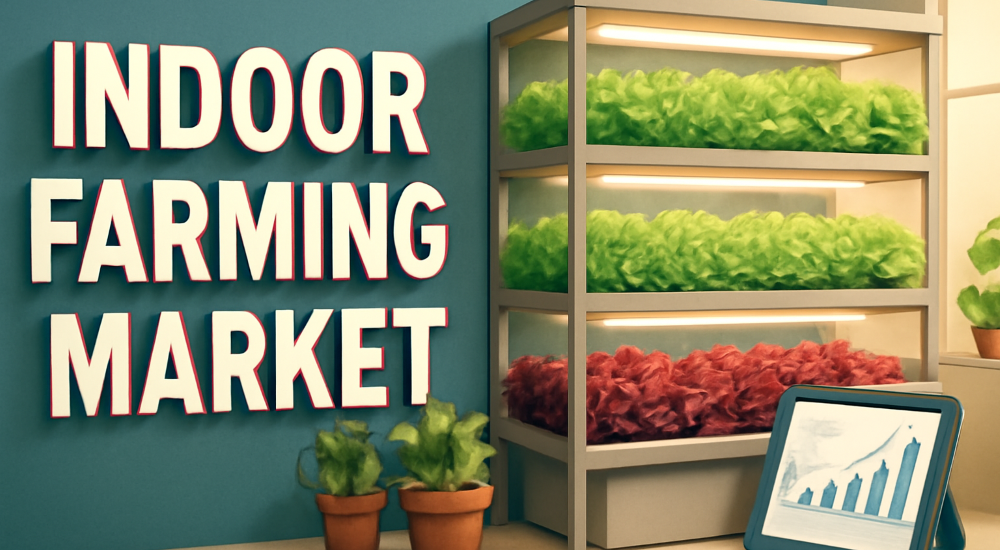
In the midst of growing concerns over climate change, food security, and sustainable development, the indoor farming industry is rapidly emerging as a transformative force in global agriculture. Projected to grow from USD 49.4 billion in 2025 to USD 108.6 billion by 2035, the market is expanding at a compound annual growth rate (CAGR) of 10.1% — a pace that signals significant structural change across the food production landscape.
Indoor farming — the practice of growing crops within controlled environments using methods such as vertical farming, hydroponics, aeroponics, and aquaponics — is no longer a fringe innovation. It is evolving into a cornerstone of modern agriculture, especially in urban centers where space is limited and the demand for locally grown, sustainable food is on the rise.
Discover Insights into the Market Request Your Sample Report! https://www.futuremarketinsights.com/reports/sample/rep-gb-14291
Redefining Agriculture Through Control and Efficiency
Unlike traditional farming, indoor farming decouples crop production from unpredictable weather, seasons, and outdoor environmental risks. This approach allows for consistent yields throughout the year, reduced use of water and pesticides, and minimized transportation emissions due to proximity to urban markets.
Crops are cultivated under artificial lighting, precisely regulated humidity, and nutrient-controlled water systems. These advanced techniques allow farms to grow more produce in less space, with greater reliability — a significant advantage in an era where arable land is diminishing and population density in cities is increasing.
Driving Forces Behind the Market Boom
Several trends are propelling the expansion of the indoor farming market:
- Urbanization: As global populations continue to concentrate in urban areas, the need for food systems that can operate within city limits has become more urgent. Indoor farms can be established in warehouses, shipping containers, and even high-rise buildings, offering a flexible solution to land scarcity.
- Sustainability: Indoor farming significantly reduces the carbon footprint associated with food production. It requires less water, eliminates the need for chemical pesticides, and cuts the distance food must travel to reach consumers. These factors align with growing global interest in sustainable consumption.
- Supply Chain Resilience: The disruptions caused by global events in recent years have emphasized the need for localized, resilient food sources. Indoor farming offers a stable alternative that is less vulnerable to weather, geopolitical tensions, and logistical breakdowns.
- Technological Advancements: Improved LED lighting, environmental sensors, and automation are making indoor farming more efficient and scalable. Smart systems can now monitor and adjust growing conditions in real time, optimizing resources and minimizing waste.
Regional Outlook and Growth Potential
The market is seeing strong development globally, with North America leading in adoption and infrastructure. However, the fastest growth is expected in the Asia-Pacific region, where dense urban populations, limited agricultural land, and government incentives are encouraging the deployment of high-tech indoor farming systems.
Countries such as Singapore, Japan, and China are investing heavily in vertical farming projects, recognizing the potential to boost food self-sufficiency and reduce reliance on imports.
In Europe and the Middle East, indoor farming is also gaining momentum, supported by sustainable agriculture initiatives, water conservation goals, and food innovation policies.
Key Technologies Shaping the Future
The evolution of indoor farming is closely tied to technology. Innovations in lighting, data analytics, automation, and artificial intelligence are making it possible to grow a wider variety of crops with greater precision. Modular farm units and fully automated systems are reducing labor costs and increasing output per square foot.
While leafy greens and herbs currently dominate the product offerings, ongoing research and development are expanding the range of crops that can be grown indoors. This includes fruits, berries, and even grains, though large-scale production of staple crops remains in the early stages of feasibility.
Challenges on the Road Ahead
Despite its strong growth potential, the indoor farming industry faces several challenges:
- High Capital Costs: Setting up an indoor farm requires substantial initial investment in equipment, real estate, and technology. This can be a barrier for smaller players and may limit adoption in low-income regions.
- Energy Consumption: Running climate-controlled environments and artificial lighting systems consumes a significant amount of energy. While renewable energy integration is improving, operational costs remain a critical concern.
- Crop Diversity Limitations: Currently, most indoor farms focus on fast-growing, high-value crops. Expanding to staple crops or proteins requires further innovation and cost reductions.
Key Market Players
- AeroFarms
- Bowery Farming
- Plenty Unlimited Inc.
- BrightFarms
- Gotham Greens
- AppHarvest
- Infarm
- Nordic Harvest
- Netled
- Agricool
Segmentation
By Facility Type:
By facility type, the industry is segmented into greenhouse, indoor vertical farm, container farm, indoor deep water culture system, and other facility types, with greenhouses leading due to their efficiency in controlled-environment agriculture.
By Growing System:
By growing system, the industry includes aeroponics, hydroponics, aquaponics, soil-based, and hybrid methods, with hydroponics being the most widely adopted due to its water efficiency and high crop yield potential.
By Region:
By region, the industry spans North America, Latin America, Europe, South Asia, East Asia, Oceania, and the Middle East & Africa (MEA), with North America leading due to strong investments in advanced farming technologies and urban agriculture initiatives.
Purchase the in-depth market report now! https://www.futuremarketinsights.com/checkout/14291
About Future Market Insights (FMI)
Future Market Insights, Inc. (ESOMAR certified, recipient of the Stevie Award, and a member of the Greater New York Chamber of Commerce) offers profound insights into the driving factors that are boosting demand in the market. FMI stands as the leading global provider of market intelligence, advisory services, consulting, and events for the Packaging, Food and Beverage, Consumer Technology, Healthcare, Industrial, and Chemicals markets. With a vast team of over 400 analysts worldwide, FMI provides global, regional, and local expertise on diverse domains and industry trends across more than 110 countries.
Contact Us:
Future Market Insights Inc.
Christiana Corporate, 200 Continental Drive,
Suite 401, Newark, Delaware – 19713, USA
T: +1-347-918-3531
For Sales Enquiries: sales@futuremarketinsights.com
Website: https://www.futuremarketinsights.com
LinkedIn| Twitter| Blogs | YouTube