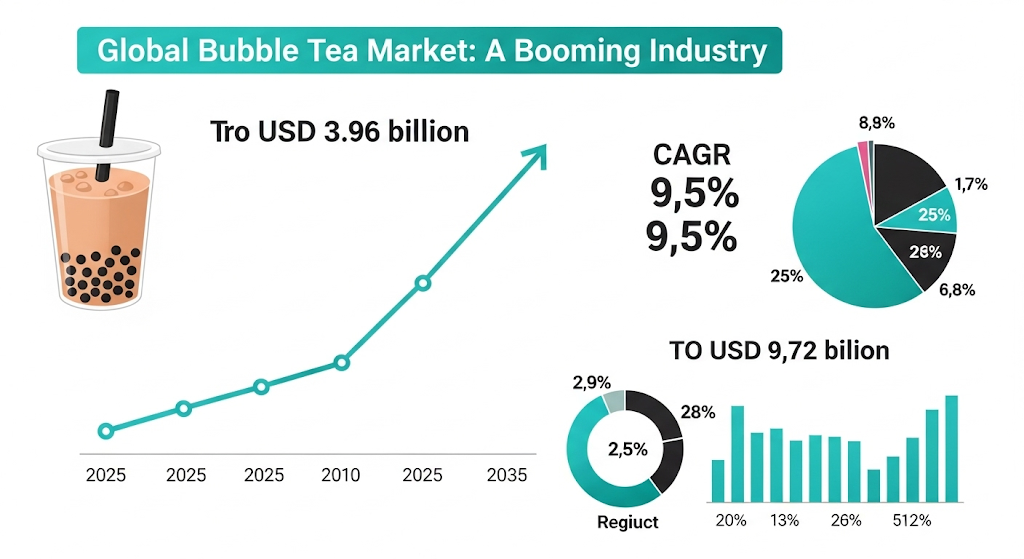
Once a street-side curiosity in Taiwanese night markets, bubble tea has gone global—and now, it’s big business. According to Future Market Insights, the global bubble tea market, valued at USD 3.96 billion in 2025, is projected to reach USD 9.72 billion by 2035, expanding at a rapid compound annual growth rate (CAGR) of 9.5%.
For a drink made from milk, tea, and chewy tapioca pearls, those numbers are eye-popping. But beneath the frothy surface of this expansion is a deeper question: Is the bubble tea market ready for the scale it’s chasing?
Access Key Market Insights: Request a Sample Report Now: https://www.futuremarketinsights.com/reports/sample/rep-gb-12310
Beyond the Hype: A Global Industry in Transition
Bubble tea’s appeal is clear—customization, novelty, and a playful drinking experience. It’s gained traction from Seoul to San Francisco, London to Lagos. The drink has evolved into an everyday indulgence for many, with regional variants and flavor innovations pushing it into mainstream menus worldwide.
Yet the commercial explosion is starting to raise serious structural and strategic questions.
As brands rush to ride the boba wave, quality control, ingredient sourcing, and operational sustainability have become hot-button issues behind closed doors in the food and beverage industry. Small, artisanal operations once rooted in culture and community are now competing with chains offering hyper-scaled versions of the drink—sometimes at the cost of authenticity, and often with a weaker nutritional profile.
Sweet Profits, Bitter Aftertaste?
Customization may be king, but sugar still rules the cup. As the industry scales, many bubble tea products remain loaded with artificial flavors, syrups, and caloric payloads that rival soft drinks. While indulgence has always been part of bubble tea’s charm, evolving consumer expectations—especially in urban centers—are beginning to demand more: cleaner labels, plant-based alternatives, and reduced sugar content.
This leaves many brands in a tight spot: innovate or risk becoming the next soda aisle casualty.
The Cultural Tightrope
Another issue simmering within the global bubble tea market is cultural credibility. What started as a deeply localized tradition—rooted in Taiwan’s food culture—is now increasingly filtered through Western brand lenses. In many cities, “Instagrammable” storefronts and neon-lit menus have stripped the drink of its heritage in favor of visual appeal and marketing buzzwords.
And that leads to a bigger risk: consumer disconnect. For all the flavor options and fusion upgrades, the drink’s soul is at risk of dilution.
Bubble Tea’s Big Moment—Handled Right?
The numbers don’t lie: the bubble tea market has become a heavyweight contender in the global beverage space. But now it must grow responsibly.
That means maintaining supply chains that prioritize real tea and ethically sourced ingredients. It means innovating to meet modern dietary demands without sacrificing what makes bubble tea… bubble tea. And perhaps most importantly, it means staying connected to the cultural story that brought the drink this far.
Final Word
The global bubble tea market is riding a high—financially, culturally, and trend-wise. But now comes the hard part: navigating the intersection of global scale, health consciousness, and cultural respect.
In short, it’s no longer enough for bubble tea to be popular. It has to grow up.
Leading Bubble Tea Brands
- 7 Leaves Café
- Boba Guys
- Boba Loca
- Bubbleology
- CoCo Fresh Tea & Juice
- DaBoba
- Del Monte Foods Inc.
- Gong Cha
- Happy Lemon Bubble Tea
- J Way Foods
- Jazen Tea
- Kung Fu Tea
- La Kaffa International Co.
- Quickly
- Sharetea
- Tapioca Express
- Ten Ren Tea Co., Ltd.
- Tiger Sugar
- Yifang USA Inc.
- Others (on additional request)
Key Segments of Research Report
By Format:
As per Format type, the industry has been categorized into Ready-To-Drink, and Ready-To-Mix.
By Toppings:
As per the Toppings, the industry is sub-segmented into Tapioca Pearls, Popping Bob Bursting Bubbles, Taro Balls, Coconut Jelly, Red Bean, Grass Jelly, and Fruit Bites.
By Flavor:
Unflavored, Flavored, Nut Flavored, Honey, Mocha, Caramel, Vanilla, Taro, and others are key Flavors covered in report.
By Distribution Channel:
The distribution channel segment includes Food Service Industry, and Direct Sales the direct sales is further categorized into Hypermarket Supermarket, Convenience store, Grocery Retailers, Specialty Retailers, Wholesale Stores.
By Region:
Industry analysis has been carried out in key countries of the regions such as North America, Latin America, Europe, East Asia, South Asia, Oceania, and the Middle East & Africa.
Stay Ahead of Emerging Trends: Get the Complete Report Today: https://www.futuremarketinsights.com/checkout/12310
About Future Market Insights (FMI)
Future Market Insights, Inc. (ESOMAR certified, recipient of the Stevie Award, and a member of the Greater New York Chamber of Commerce) offers profound insights into the driving factors that are boosting demand in the market. FMI stands as the leading global provider of market intelligence, advisory services, consulting, and events for the Packaging, Food and Beverage, Consumer Technology, Healthcare, Industrial, and Chemicals markets. With a vast team of over 400 analysts worldwide, FMI provides global, regional, and local expertise on diverse domains and industry trends across more than 110 countries.
Contact Us:
Future Market Insights Inc.
Christiana Corporate, 200 Continental Drive,
Suite 401, Newark, Delaware – 19713, USA
T: +1-347-918-3531
For Sales Enquiries: sales@futuremarketinsights.com
Website: https://www.futuremarketinsights.com
LinkedIn| Twitter| Blogs | YouTube