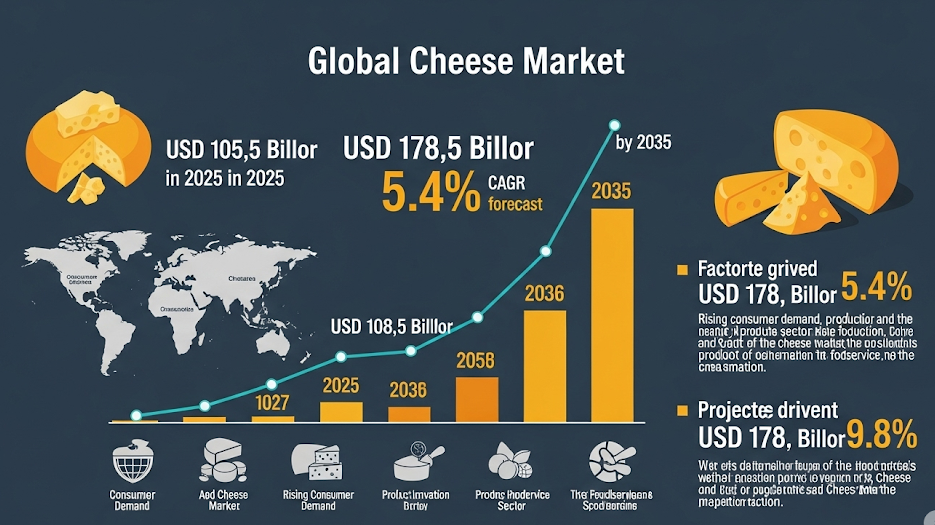
Cheese is no longer just a European or American obsession—it’s gone global. Once rooted in centuries-old culinary tradition, the cheese industry is now entering its most transformational decade yet. According to Future Market Insights, the global cheese market is projected to surge from USD105.5 billion in 2025 to USD178.5 billion by 2035, driven by rising demand across developing economies and an evolving global palate. But as the market expands, it’s also exposing weaknesses in the very regions that once defined it.
In the world’s fastest-growing food markets, cheese is making inroads at a pace few anticipated. It’s turning up on menus, in snack packs, and increasingly, in homemade meals—even in countries where dairy wasn’t part of the traditional kitchen.
Unlock Key Market Trends: Get Your Sample Report: https://www.futuremarketinsights.com/reports/sample/rep-in-242
India Steps Into the Spotlight
Take India, for example. Once considered an unlikely player in the cheese economy, the country is now positioning itself as a major growth driver. As reported by Future Market Insights, the Indian cheese market is booming—fueled by urbanization, growing disposable income, and a population that’s increasingly open to global flavors.
What’s notable is that this growth isn’t just about importing cheddar or mozzarella. Indian producers are innovating, localizing, and scaling up, creating a domestic cheese economy that caters to regional tastes while still borrowing from global trends. In short: India is no longer a passive consumer—it’s becoming a competitive cheese producer in its own right.
Western Markets Face a Harder Cut
By contrast, the U.S. and Europe—longtime cheese titans—are confronting a different reality. Growth is sluggish, consumers are more selective, and producers are burdened by rising costs and shifting expectations. In the U.S., a crowded dairy aisle and changing consumer behavior have led to product fatigue. Meanwhile, European producers face regulatory and environmental headwinds that make expansion tougher than ever.
While global appetite for cheese is stronger than ever, traditional players risk losing ground—not for lack of product quality, but for failing to keep pace with global change.
Aged Traditions Meet Fresh Disruption
As cheese demand grows more geographically diverse, so too does its future. Smaller producers in emerging markets are more agile, more attuned to local needs, and faster to innovate with packaging, distribution, and health-conscious formulations. That gives them a competitive edge, even without the centuries of tradition that their Western counterparts lean on.
According to Future Market Insights, the global cheese market is entering a high-growth era, expanding by over USD73 billion in the next decade. That’s not just an opportunity—it’s a wake-up call.
If legacy producers want a place at the global table, they’ll need to do more than age cheese. They’ll need to age their strategy—and fast.
Key Players
- Glanbia plc
- BEL Group
- Dalter Alimentari Spa
- The Kraft Heinz Company
- Associated Milk Producers Inc.
- Treeline Cheese
- Follow Your Heart
- Daiya Foods Inc.
- Kite Hill
- Heirloom Cultured Foods
- Miyoko’s Creamery
- Violife
Key Segmentation
By Nature:
The industry is segmented into organic cheese and conventional cheese.
By Source:
The industry includes dairy-based cheese and plant-based cheese
By Product Type:
The industry is segmented into mozzarella, cheddar, pepper jack, parmesan, gouda, and others.
By Form:
Cheese is available in block, cube, shreds, slice, spread, powder, and sticks.
By End Use:
The industry is categorized into food and beverage industry, HoReCa (hotels, restaurants, cafes), and household retail.
By Sales Channel:
Cheese is distributed through B2B, B2C, modern trade, convenience stores, traditional grocery stores, specialty stores, online retail, and other retail formats.
By Region:
The industry is analyzed across North America, Latin America, Europe, East Asia, South Asia, Oceania, and the Middle East & Africa.
 Stay Ahead of the Curve: Purchase the Full Report Today: https://www.futuremarketinsights.com/checkout/242
About Future Market Insights (FMI)
Future Market Insights, Inc. (ESOMAR certified, recipient of the Stevie Award, and a member of the Greater New York Chamber of Commerce) offers profound insights into the driving factors that are boosting demand in the market. FMI stands as the leading global provider of market intelligence, advisory services, consulting, and events for the Packaging, Food and Beverage, Consumer Technology, Healthcare, Industrial, and Chemicals markets. With a vast team of over 400 analysts worldwide, FMI provides global, regional, and local expertise on diverse domains and industry trends across more than 110 countries.
Contact Us:
Future Market Insights Inc.
Christiana Corporate, 200 Continental Drive,
Suite 401, Newark, Delaware – 19713, USA
T: +1-347-918-3531
For Sales Enquiries: sales@futuremarketinsights.com
Website: https://www.futuremarketinsights.com
LinkedIn| Twitter| Blogs | YouTube