In a global economy obsessed with beauty, wellness, and “clean” ingredients, marine collagen has gone from obscure supplement to billion-dollar buzzword. Promoted for improving skin elasticity, joint health, and gut function, this fish-derived protein is now embedded in everything from high-end skincare to supermarket smoothies.
But while demand is exploding, one question remains largely unaddressed: What’s the real cost of turning fish waste into a wellness commodity?
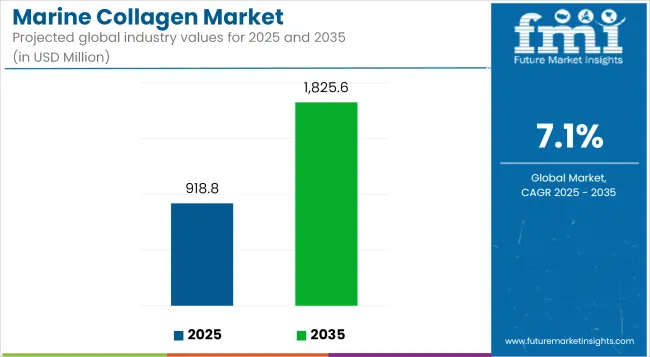
According to Future Market Insights, the global is projected to grow from USD 918.8 million in 2025 to USD 1,825.6 million by 2035, advancing at a compound annual growth rate (CAGR) of 7.1%. That’s a remarkable doubling in value within a decade, driven largely by increasing consumer demand for natural, functional ingredients across food, pharmaceuticals, and cosmetics.
Discover Market Shifts: Secure Your Sample Report Now: https://www.futuremarketinsights.com/reports/sample/rep-gb-11528
From Fish Scraps to Functional Gold
Marine collagen is sourced from the skin, scales, and bones of fish—often byproducts from the seafood industry. This has led many to tout it as a more sustainable option than bovine or porcine collagen. On the surface, it’s a smart value-add: instead of going to waste, marine scraps are transformed into high-margin products for the global wellness economy.
But as the market balloons, the underlying infrastructure hasn’t caught up. The reality is this: most consumers don’t know what species their collagen came from, where it was caught, or how it was processed. And few brands are offering answers.
Rising Interest in Market Trends: Our Detailed Report Provides Essential Insights: https://www.futuremarketinsights.com/reports/marine-collagen-market
The Illusion of “Clean Beauty”
As companies rush to capitalize on the marine collagen boom, labels are filled with terms like “wild-caught,” “deep-sea,” and “sustainably sourced”—but none of these phrases are clearly defined or regulated. Without universal standards or supply chain transparency, the marine collagen narrative risks becoming yet another wellness promise built on vague marketing rather than verified practices.
What began as a functional beauty solution could quickly turn into a sourcing and environmental headache—especially as global demand places more pressure on fisheries, processors, and logistics networks to meet it.
High Growth, Low Accountability
The market’s 7.1% annual growth rate underscores strong demand—but it also signals a critical need for oversight. With collagen-rich supplements and beauty powders flying off shelves, there’s a widening gap between how marine collagen is sold and how it’s sourced.
If the beauty and wellness sectors want to lean into marine collagen’s “clean” narrative, they’ll need to back it up with meaningful disclosure: Where is the fish from? How is it caught? Is it traceable?
Until that happens, marine collagen’s green halo may be more cosmetic than credible.
The Road Ahead
There’s no denying that marine collagen has staying power. Its bioavailability is high, its applications are diverse, and its appeal spans wellness trends from anti-aging to gut health.
But with growth comes responsibility.
The industry’s next phase must move beyond market expansion and toward accountability—building infrastructure for traceability, setting standards for sourcing, and treating marine collagen not just as a beauty product, but as part of the broader blue economy.
Because if the marine collagen market is truly going to double by 2035, it can’t just sell results—it must prove they’re sustainable.
Key Players in the Marine Collagen Market
- Ashland Inc.
- Darling Ingredients Inc. (including Rousselot brand)
- Weishardt Group
- Gelita AG
- Nitta Gelatin Inc.
- Seagarden AS
- Vital Proteins LLC
- Amicogen, Inc.
- BHN International Co. Ltd.
- Connoils LLC
- Italgelatine S.p.A
- COBIOSA
- ETChem
- Hangzhou Nutrition Biotechnology Co., Ltd.
- HUM Nutrition Inc.
- Titan Biotech Limited
 Explore Animal Nutrition Industry Analysis: https://www.futuremarketinsights.com/industry-analysis/animal-nutrition
Market Segmentation
By Source:
- Skin
- Muscles
- Scales
- Bones & Tendons
By Animal Type:
- Fish
- Marine Organisms
By Application:
- Cosmetic
- Healthcare
- Medical
- Nutraceuticals
By Region:
- North America
- Latin America
- Western Europe
- Eastern Europe
- Asia Pacific (APAC)
- Middle East & Africa (MEA)