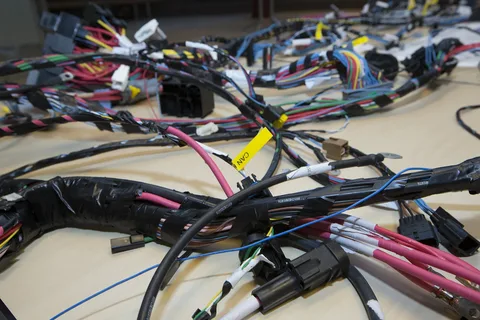
The automotive wire market is on the path of consistent growth between 2025 and 2035, mainly fueled by the trend of increasing vehicle electrification, the continuous rise in the acceptance of electric vehicles (EVs) and hybrids, and the growing level of sophistication of in-vehicle electronics and connectivity systems.
The market is expected to have a valuation of USD 5 Billion by 2025 and is anticipated to increase at a compound annual growth rate (CAGR) of 4.7%, there by reaching its valuation of USD 8 Billion by 2035. Wires are the fundamental part of every automobile’s electrical system as they allow power transmission and data communication across different subsystems like lighting, infotainment, safety features, powertrain, and battery management.
In today’s automotive landscape, where vehicles are rapidly evolving into complex electronic systems on wheels, automotive wires have taken on a critical role. Much like the nervous system in the human body, these wires serve as the essential conduits that transmit signals, data, and power—ensuring that every component, from the headlights to advanced driver assistance systems (ADAS), functions seamlessly.
As cars become more intelligent, electrified, and software-driven, the automotive wires market is experiencing a quiet but transformative revolution—shaping everything from vehicle performance and safety to sustainability and design.
Get Ahead with Our Report: Request Your Sample Now!
https://www.futuremarketinsights.com/reports/sample/rep-gb-5334
From Mechanical Machines to Electrified Ecosystems
Gone are the days when vehicles were driven primarily by mechanical linkages. Today, a modern vehicle houses thousands of meters of wiring, connecting everything from infotainment units and climate control to battery management systems and autonomous sensors.
The rise of electric vehicles (EVs), hybrids, and advanced internal combustion engine (ICE) models has drastically increased the demand for specialized wire types capable of handling high voltages, harsh conditions, and complex data transmissions. Automotive wires now serve dual purposes—delivering power and enabling communication in real time.
Diverse Applications Across Vehicle Systems
Automotive wires are used in nearly every subsystem of a vehicle. These include:
-
Power Transmission: Carrying electrical energy from the battery to lighting, motors, HVAC, and auxiliary components.
-
Signal Transmission: Supporting the flow of sensor data for functions like airbag deployment, braking control, and lane assistance.
-
Communication: Enabling in-vehicle networking through protocols like CAN, LIN, and Ethernet, allowing different ECUs (Electronic Control Units) to interact efficiently.
From low-voltage copper wires to high-voltage aluminum cables and shielded coaxial wires for radar and camera feeds, the variety is vast—and growing with technological advancements.
Lightweighting and Material Innovations
As automakers seek to reduce vehicle weight for better fuel efficiency and extended EV range, wire weight becomes a critical factor. This has led to a shift toward lighter materials such as aluminum and advanced copper alloys.
New insulation materials and wire coatings are also being developed to withstand extreme temperatures, abrasion, and chemical exposure—especially in engine compartments and battery enclosures. Innovations in wire harness design, such as flat or ribbon cable configurations, are helping reduce bulk while improving installation flexibility.
Rise of EVs and High-Voltage Wiring Demands
The growth of electric and hybrid vehicles has introduced unique challenges to wire design. High-voltage systems, often exceeding several hundred volts, require specialized insulation, electromagnetic shielding, and thermal protection to ensure safety and performance.
Battery packs, inverters, and charging systems all rely on robust wiring infrastructure to function effectively. As the EV market accelerates, so too does the need for wires that can support rapid charging, thermal monitoring, and energy-efficient power delivery.
Integration with Smart Vehicle Architectures
With the proliferation of features like ADAS, vehicle-to-everything (V2X) communication, and over-the-air (OTA) updates, automotive wires are now central to intelligent vehicle functionality. Wires must be capable of supporting high-speed data transmission with minimal signal loss, often within compact and densely populated environments.
To meet these demands, automakers and suppliers are adopting modular wiring systems and standardized network architectures, enabling faster assembly, easier maintenance, and improved scalability for future updates.
Challenges in Complexity, Cost, and Space Optimization
While essential, wiring systems add considerable weight, complexity, and cost to vehicle manufacturing. Engineers face the ongoing challenge of optimizing wire routing within increasingly compact engine bays and cabin spaces, all while meeting strict safety and electromagnetic compatibility (EMC) standards.
Additionally, the growing number of sensors and electronic devices has increased the demand for wire harnessing solutions that simplify assembly and reduce the risk of failure due to wear or environmental stress.
Exhaustive Market Report: A Complete Study
https://www.futuremarketinsights.com/reports/automotive-wires-market
Sustainability and Recycling Considerations
Sustainability is becoming a major driver in wire production and usage. Automakers are exploring recyclable insulation materials, halogen-free wires, and lead-free soldering practices to reduce environmental impact. The move toward circular economy models includes designing wiring systems that are easier to disassemble and recover at the end of vehicle life.
A Backbone for the Future of Mobility
As the automotive industry transitions to a future defined by electrification, autonomy, and connectivity, automotive wires will continue to serve as the silent backbone of innovation. Their role will only grow in importance as vehicles evolve into platforms for software, services, and sustainable mobility.
With advances in materials, smart design, and manufacturing automation, the next generation of automotive wiring systems will be lighter, faster, more efficient—and more intelligent. In every turn of the wheel, every press of a button, and every streamed command, these wires will remain unseen yet indispensable—quietly powering the journey forward.