As global industries move toward sustainability without compromising on efficiency, the Reconditioned Intermediate Bulk Container (IBC) Market stands at the crossroads of eco-consciousness and industrial utility. Estimated to reach USD 5,491.9 million in 2025, the market is poised for steady growth at a CAGR of 5.1%, ultimately achieving USD 9,031.2 million by 2035.
This growth story highlights how reconditioned IBCs are becoming central to modern bulk packaging solutions, offering a win-win for businesses aiming to reduce costs and their environmental footprint.
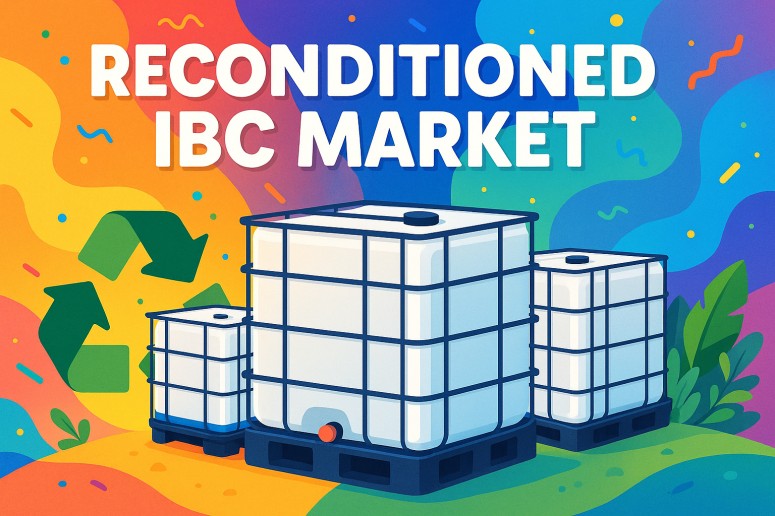
An Intermediate Bulk Container (IBC) is a reusable container used for storing and transporting bulk liquids and granulated substances such as chemicals, food ingredients, solvents, or pharmaceuticals. A reconditioned IBC is one that has been cleaned, repaired, and tested for reuse according to industry regulations and standards.
Explore Opportunities – Get Your Sample of Our Industry Overview Now!
https://www.futuremarketinsights.com/reports/sample/rep-gb-8886
These containers typically come in rigid, stackable designs, often made with a plastic inner bottle encased in a metal cage, and are considered one of the most economical and eco-friendly choices for packaging in various industrial verticals.
Key Takeaways from the Reconditioned IBC Market
- Achieved a CAGR of 3.9% during the historical period of 2020 to 2024.
- Market value reached USD 2,600 million in 2024, indicating consistent growth.
- The USA is projected to register a CAGR of 4% through 2035.
- Spain is expected to witness strong growth in Europe with a CAGR of 4.7% by 2035.
- 1040-litre capacity IBCs are estimated to hold 52% market share by 2025.
- Composite IBCs are set to dominate the material segment with over 65% share by 2025.
Rising Demand for Sustainable Bulk Packaging
One of the most compelling growth factors in the reconditioned IBC market is the global shift toward sustainability. With mounting pressure on industries to reduce carbon footprints and waste generation, reconditioned IBCs offer a practical and eco-friendly alternative to single-use containers. Unlike new IBCs, which require fresh raw materials and higher energy inputs, reconditioned units minimize environmental impact through reuse, refurbishment, and recycling.
This is particularly relevant as more organizations pursue ESG (Environmental, Social, and Governance) objectives and adopt circular economy models. As a result, the demand for reusable industrial packaging, including reconditioned IBCs, is projected to accelerate in the coming decade.
Regulatory Push for Reusability and Safety Standards
Government agencies and international bodies have increasingly mandated strict compliance to safety and reusability norms. Regulatory frameworks such as the United Nations Recommendations on the Transport of Dangerous Goods and standards set by the U.S. Department of Transportation (DOT) or European Agreement concerning the International Carriage of Dangerous Goods by Road (ADR) are pushing the adoption of certified, durable containers.
Advancements in Reconditioning Technology
Technology is reshaping how IBCs are reconditioned. Modern reconditioning facilities now use automated cleaning systems, robotic inspections, pressure testing, and RFID tagging to ensure quality and traceability. These advancements enhance the performance, safety, and lifecycle management of each container.
Furthermore, tracking technologies allow customers to monitor IBC usage and maintenance histories, facilitating predictive maintenance and inventory optimization. This boosts confidence in reconditioned products and promotes broader industry adoption.
Food-Grade and Pharma-Grade Expansion
Beyond chemicals, the food & beverage and pharmaceutical sectors are beginning to explore the use of certified, hygienically reconditioned IBCs. These containers must meet stricter standards related to sanitization, material compatibility, and traceability. As supply chains for edible oils, syrups, dairy, and liquid pharmaceuticals expand globally, there’s rising interest in cost-effective and compliant packaging.
Although these segments currently hold smaller market shares, their long-term growth potential is significant due to increasing investments in clean-label products, international pharma exports, and health-focused consumer trends.
Competitive Outlook
The Reconditioned Intermediate Bulk Container (IBC) Market is expanding steadily due to rising demand for cost-effective, ecological, and reusable bulk packaging solutions. Reconditioned IBCs are a viable alternative to new containers, drastically lowering waste generation, raw material consumption, and overall packaging costs.
These containers are frequently used in the chemical, food and beverage, pharmaceutical, agricultural, and industrial sectors to store bulk liquid and dry commodities.
Key Company Offerings and Activities
- SCHÜTZ GmbH & Co. KGaA – A global leader in reconditioned IBCs, offering comprehensive collection, cleaning, and refurbishment services.
- Mauser Packaging Solutions – Specializes in reusable industrial packaging solutions, including reconditioned IBCs for chemical and food applications.
- Greif Inc. – Provides reconditioned IBCs with advanced decontamination processes, ensuring safe reuse for industrial liquids.
- Myers Container – Focuses on environmentally friendly IBC reconditioning, utilizing sustainable cleaning and refurbishment processes.
- Cleanaway Waste Management – Offers reconditioning and recycling of IBCs, promoting waste reduction and sustainable bulk packaging.
Key Segmentation of the Reconditioned IBC Market
By Material:
In terms of material, the industry is divided into metal IBCs and composite IBCs.
By Capacity:
In terms of capacity, the industry is segregated into standard and customized capabilities. The standard segment has been further segregated into 1,040 liters (275 US gal), and 1,250 liters (330 US gal).
By End-use:
The industry is classified by end use industries as industrial chemicals, petroleum & lubricants, paints, inks & dyes, food & beverages, waste disposal/recycling & silage, and others.
By Region:
Key Countries of North America, Latin America, East Asia, South Asia & Pacific, Western Europe, Eastern Europe and Middle East & Africa are covered.
About Future Market Insights (FMI)
Future Market Insights, Inc. (ESOMAR certified, recipient of the Stevie Award, and a member of the Greater New York Chamber of Commerce) offers profound insights into the driving factors that are boosting demand in the market. FMI stands as the leading global provider of market intelligence, advisory services, consulting, and events for the Packaging, Food and Beverage, Consumer Technology, Healthcare, Industrial, and Chemicals markets. With a vast team of over 400 analysts worldwide, FMI provides global, regional, and local expertise on diverse domains and industry trends across more than 110 countries.
Contact Us:
Future Market Insights Inc.
Christiana Corporate, 200 Continental Drive,
Suite 401, Newark, Delaware – 19713, USA
T: +1-347-918-3531
For Sales Enquiries: sales@futuremarketinsights.com
Website: https://www.futuremarketinsights.com
LinkedIn| Twitter| Blogs | YouTube