 The world’s obsession with salmon shows no signs of slowing down. Whether it’s grilled in American kitchens, served raw in Tokyo sushi bars, or featured in Scandinavian smørrebrød, salmon has gone global. But behind every silky pink fillet is a massive, complex, and increasingly controversial industry—salmon farming—and its most overlooked driver: feed.
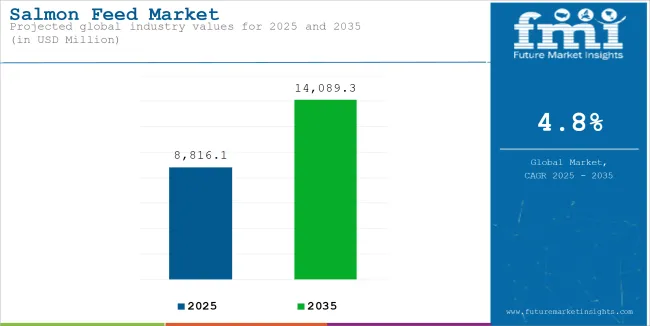
According to Future Market Insights, the global salmon feed market is projected to grow from USD 8.8 billion in 2025 to USD 14.1 billion by 2035, expanding at a compound annual growth rate (CAGR) of 4.8% over the forecast period (Future Market Insights).
That growth raises a pressing question: What exactly are we feeding the fish that feed the world?
Keep Up with Market Trends: Access Your Sample Report:https://www.futuremarketinsights.com/reports/sample/rep-gb-19922
Aquaculture’s Dirty Secret: It Still Relies on Wild Fish
Salmon farming was meant to solve overfishing. But for decades, the feed used to raise farmed salmon has included fishmeal and fish oil—derived from wild-caught forage fish like anchovies and sardines. The irony? To reduce pressure on wild salmon, we’re depleting other fish stocks.
Now, the industry is racing to innovate. The shift toward plant-based proteins, algae oils, and insect meal is gaining traction, not only to reduce reliance on ocean resources but to stabilize feed costs. Yet these “solutions” come with their own tradeoffs. Soy production, for instance, often brings deforestation and pesticide use. Algae is still expensive. Insects? Scalable, but not yet mainstream.
Innovation is happening—but it’s not moving fast enough.
Rising Interest in Market Trends: Our Detailed Report Provides Essential Insights:https://www.futuremarketinsights.com/reports/salmon-feed-market
The Market Is Booming—But So Are the Risks
With projections putting the salmon feed market at $14.1 billion by 2035, it’s clear the global demand for salmon isn’t slowing down. Rising incomes in Asia and Latin America are driving up consumption, while Western markets are doubling down on salmon as a “health food.”
But aquaculture isn’t a silver bullet. The more salmon we farm, the more feed we need—and that feed has ripple effects across ecosystems, economies, and ethics. Marine pollution, antibiotic overuse, and carbon-intensive feed sourcing all threaten to undermine the promise of “sustainable seafood.”
Final Take: Feed Is the Frontline of the Food Fight
The salmon feed market is where environmentalism, food security, and big business collide. It’s not just about what we feed fish—it’s about what kind of food system we’re building.
The next decade will define whether salmon farming can truly become a sustainable solution or remain part of the problem. Feed is no longer an afterthought. It’s the battleground.
Company Profile
- Cargill
- Skretting
- Biomar
- Nutreco
- Mowi
- Aller Aqua
- Ewos
- Ridley Corporation
- Yadong Group
- Tongwei Group
- Grobest Group

Top Segments Studied in the Salmon Feed Market Report
By Salmon Type:
By type industry has been categorised into Atlantic salmon and pacific salmon.
By Feed Type:
By feed type global business landscape categorised into Starter feed, grower feed, medicated feed and others.
By Ingredient Type:
Key Ingredient types which are Fish Oil, fish meal and Corn and others
By Region:
Industry analysis has been carried out in key countries of North America, Latin America, Europe, Middle East and Africa, East Asia, South Asia, and Oceania