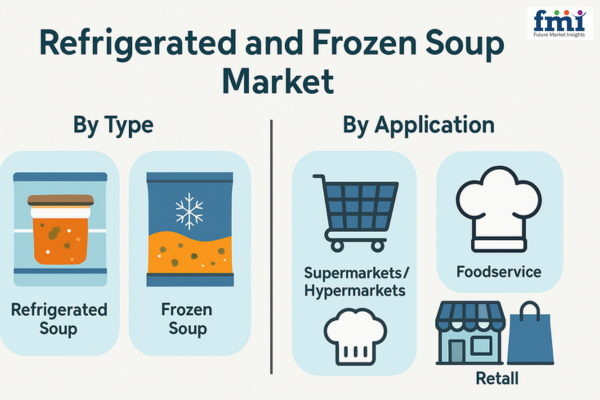
Gone are the days when soup was made slowly, savored at home, passed down through generations. Today, the world is cracking open a refrigerated container or pulling a pouch from the freezer, expecting warmth, nutrition, and nostalgia in under five minutes. According to a report by Future Market Insights, the refrigerated and frozen soup market is set to explode — from USD 2,790.27 million in 2025 to USD 6,845.7 million by 2035.
That’s not a niche. That’s a movement.
As modern life accelerates, consumers are leaning toward products that offer both quality and efficiency. Refrigerated and frozen soups fit this niche, providing the warmth and nourishment of traditional meals without the hassle of preparation. This category is no longer just about convenience—it’s evolving into a premium offering with cleaner labels, international flavor profiles, and functional ingredients.
Explore Key Insights – Request Your Sample Now! https://www.futuremarketinsights.com/reports/sample/rep-gb-19691
Convenience Is the New Comfort Food
We’re tired. We’re busier than ever. And we’ve been sold the idea that nutrition can — and should — fit into a plastic container.
These soups aren’t just about saving time. They’re marketed as clean, wholesome, even artisanal. Labels shout “organic,” “plant-based,” “gluten-free,” and “chef-inspired.” It feels like wellness. But dig deeper and you’ll find this isn’t about health — it’s about hustle.
We’ve traded hours in the kitchen for seconds at the microwave. Some call it innovation. Others might call it surrender.
What We’re Gaining — and Losing
Sure, there’s upside. Global demand for easy-to-prepare meals is real. Dual-income households. Solo living. Urbanization. Post-pandemic cooking burnout. All of it is fueling the trend. Soup, once an afterthought, is now a strategic meal category.
But something’s missing. Maybe it’s flavor. Maybe it’s ritual. Maybe it’s authenticity.
With frozen and refrigerated options flooding grocery shelves, the soup we’re eating today has been engineered to survive months — even years — of logistics. And that means compromises. On ingredients. On taste. On integrity.
This isn’t grandma’s chicken noodle. It’s algorithm-approved bisque in vacuum-sealed armor.
The Global Shift
This isn’t just a U.S. obsession. From Tokyo to Berlin, consumers are grabbing soups that promise both tradition and speed. Local flavors are being mass-produced and flash-frozen to meet demand. Innovation is moving fast — and crossing borders.
But with this global boom comes a creeping sameness. The mass-market soup may be globally available, but it’s becoming culturally hollow.
When every aisle looks the same, every bite starts to taste like convenience.
The Illusion of Health
These soups often come dressed in the language of health — low-fat, fiber-rich, “naturally preserved.” But marketing isn’t nutrition. Consumers trust what they see on the front of the label and ignore what’s in the fine print.
It’s not that these products are bad. It’s that they’re over-promised.
The illusion is that quick equals better. That frozen is fresher. That a ready-to-eat lentil stew has the soul of a slow-cooked pot. Spoiler: it doesn’t.
Packaging Progress or Pollution in Disguise?
There’s a darker layer under all this — plastic waste and cold-chain emissions. Every bowl of soup kept chilled from factory to freezer comes with a cost. One the environment continues to pay. We don’t see it, but it’s there.
Flashy pouches and recyclable-looking lids don’t hide the fact that we’re generating more waste for fewer real meals.
We Need to Ask Better Questions
We’re not just eating soup. We’re consuming a story about modern life. About what we value, and what we’ve let go.
Is it progress if we can’t pronounce the ingredients? Is it health if the sodium rivals a bag of chips? Is it nourishment if we never lift a spoon until the microwave beeps?
The refrigerated and frozen soup market is here to stay. It’s growing. It’s convenient. It’s profitable. But it’s also hollowing out one of the last culinary traditions we once made time for.
And maybe — just maybe — the question isn’t how fast we can heat our food. It’s how long we’re willing to wait for something real.
Unlock Comprehensive Insights – Get the Full Report Now: https://www.futuremarketinsights.com/reports/refrigerated-and-frozen-soup-market
Region-Wise Insights:
- United States: With a projected CAGR of 5.7%, the U.S. market is mature but far from stagnant. Rising interest in wellness-focused products and premium offerings is keeping innovation alive.
- Germany: Germany’s 6.7% CAGR growth reflects growing demand for organic and preservative-free soups in the refrigerated section, driven by health-aware consumers and increased cold chain capabilities.
- India: India is emerging as a hotbed of opportunity with an impressive CAGR of 8.3%, fueled by rising disposable incomes, urbanization, and growing affinity for Western-style meals in urban households.
Leading Manufacturers
- Blount Fine Foods
- Campbell Soup Company
- Kettle Cuisine
- Tabatchnick
- Conagra Foods
- Ivar’s Soup & Sauce Company
- The Schwan Food Company
- Spring Glen Fresh Food
- Boulder Organic Foods
- Amy’s Kitchen
- Progresso
- Kraft Heinz
- Nestle