If you’ve sipped a cherry soda, crunched a neon-orange chip, or licked a bright blue lollipop, you’ve consumed synthetic food dye — likely derived from petroleum. But that’s changing. And fast.
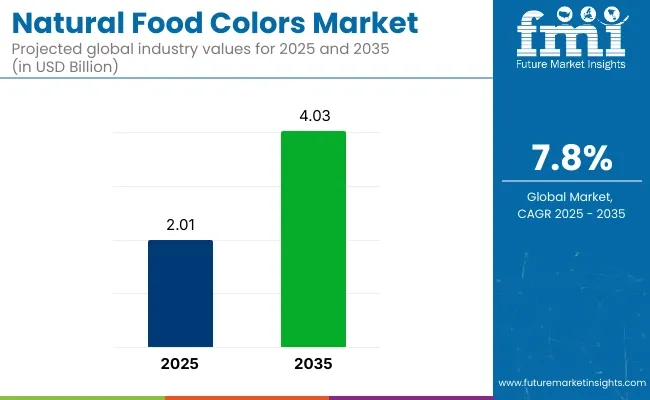
The natural food colors market, once confined to organic labels and niche wellness products, is now experiencing explosive global growth. According to Future Market Insights, sales are projected to reach $2.01 billion in 2025, and that number is set to double to $4.03 billion by 2035, growing at a compound annual growth rate (CAGR) of 7.8%.
This isn’t a passing fad. It’s a sweeping correction of decades-old food industry practices — a shift from synthetic to plant-derived colorants that’s changing how our food looks, and how we feel about eating it.
Keep Up with Market Trends: Access Your Sample Report: https://www.futuremarketinsights.com/reports/sample/rep-gb-35
A Turning Point for Food Transparency
For years, bright, shelf-stable dyes like Red 40 and Yellow 5 have helped processed food look more appealing. But consumer sentiment has shifted. Today’s buyers want ingredient lists they can pronounce and sources they can recognize. Synthetic dyes, with their chemical origins and artificial associations, no longer pass the sniff test.
Enter natural food colors — derived from plants, fruits, vegetables, and algae — now being adopted across food categories, from beverages to snacks, bakery to dairy.
The appeal isn’t just cosmetic. Natural pigments like carotenoids, which are expected to dominate the segment with a 35.8% market share in 2025, often bring added benefits such as antioxidant properties and nutrient content. That’s a win-win for brands eager to align with health-conscious consumers without sacrificing visual appeal.
Increased Market Demand: Get In-Depth Analysis and Insights with Our Complete Report: https://www.futuremarketinsights.com/reports/global-natural-food-colours-market
Beverages Are Leading the Shift
According to FMI, beverages will account for the largest share of application — 38.8% in 2025 — signaling a strong industry pivot toward clean-label liquid nutrition. From smoothies to sodas, energy drinks to infused waters, natural colorants are becoming standard as companies remove synthetic additives from their recipes.
This shift isn’t limited to boutique brands. Large-scale beverage producers are now reformulating legacy products to meet demand for transparency, clean labels, and natural sourcing — even if it means higher costs and greater formulation complexity.
The Challenges Behind the Brightness
Despite the momentum, natural food coloring is not without its obstacles. Plant-derived pigments are notoriously less stable than synthetic dyes, often reacting poorly to heat, light, or changes in pH. That makes manufacturing and shelf-life management more difficult — and more expensive.
Yet, these are hurdles the industry is learning to overcome. As technology evolves, ingredient innovators are developing new ways to stabilize and enhance natural colors without compromising their source integrity or consumer trust.
The surge in demand is also pushing growth in new production methods such as fermentation, cold extraction, and microencapsulation — all designed to improve the performance of nature-based dyes while keeping them clean-label compliant.
More Than a Trend — A Global Movement
With global consumers growing more aware of what goes into their food, natural colorants are no longer a premium option — they’re becoming the baseline. The forecasted market doubling over the next decade isn’t driven by marketing fluff; it reflects a fundamental shift in how food is being formulated, sourced, and consumed around the world.
Food companies that once relied on synthetic dyes for cost and convenience are now facing a different reality: transparency, simplicity, and consumer perception are the new priorities. And nothing communicates a brand’s values faster than what’s visible at first glance — color.
Conclusion: Nature’s Palette Wins
The rise of natural food colors isn’t a soft pivot; it’s a full-scale transformation. According to Future Market Insights, the numbers are clear: consumer trust, clean label expectations, and health-conscious choices are driving manufacturers away from synthetics and into the arms of nature.
Natural colors aren’t just safer or more appealing — they represent a deeper shift in values. A desire for food that reflects what it claims to be. A move toward ingredients that do more than dazzle — they nourish, signal honesty, and respect the intelligence of the consumer.
This is more than just a new chapter for the color of our food. It’s the start of a global redefinition of what we’re willing to accept in what we eat.
Leading Players
- Sensient Technologies Corporation
- Archer Daniels Midland
- Naturex S.A.
- Döhler GmbH
- Symrise AG
- McCormick & Company
- Kalsec Inc.
- DDW The Color House Corporation
- ROHA Dyechem Pvt. Ltd. (JJT Group)
- Aakash Chemicals and Dyestuffs
- AFIS (Australian Food Ingredient Suppliers)
- San-Ei Gen F.FI Inc.
- GNT International BV (EXBERRY)
- Adama Agricultural Solutions Ltd. (LycoRed)
- Chr. Hansen Holding A/S

Natural Food Colors Market Analyzed by Key Investment Segments
By Pigment Type:
The natural food colors market is segmented by pigment types, including carotenoids (such as beta carotene, annatto, lutein, and lycopene), curcumin, anthocyanin, paprika extract, spirulina extract, chlorophyll, and carmine.
By Functionality:
Based on application functionality, the market is classified into dairy food products, beverages, packaged/frozen foods, confectionery, and bakery products.
By Source:
The industry is also segmented by source, including plant-based, animal-based (e.g., carmine), and microbial sources such as spirulina.
By Form:
Natural food colors are available in liquid, powder, and gel forms.
By Region:
Regionally, the market spans North America, Latin America, Europe, East Asia, South Asia, Oceania, and Middle East & Africa.