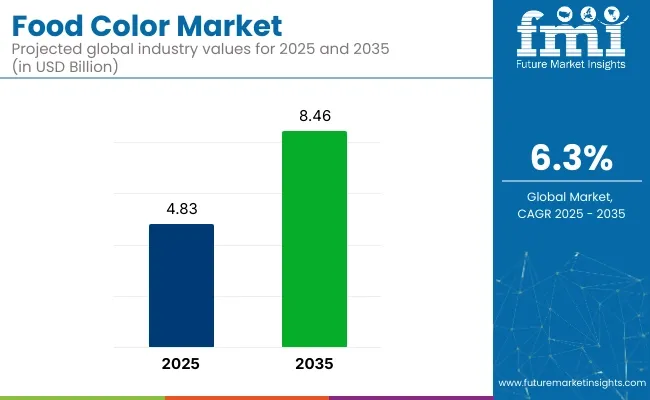
The global food color market is undergoing significant transformation, with consumer demand steering a shift toward natural, clean-label, and sustainable colorants. Valued at USD 4.83 billion in 2025, the market is expected to grow at a compound annual growth rate (CAGR) of 6.3%, reaching USD 8.46 billion by 2035. This surge is driven by innovation, evolving dietary trends, and increased application across food and beverage categories.
Understand Market Trends: Get Your Sample Report: https://www.futuremarketinsights.com/reports/sample/rep-gb-14818
Key Industry Highlights
The growth of the food color market is underpinned by strong global trends such as the rise in plant-based diets, consumer preference for natural ingredients, and regulatory support for safe, eco-friendly additives. Major players, including Sensient Technologies, Chr. Hansen, and Symrise, are investing in R&D to introduce stable, sustainable, and cost-effective natural alternatives to synthetic dyes. From beverages and confectionery to dairy and functional foods, the application of food colors continues to broaden, responding to visual appeal and health-conscious demands.
Heightened Market Interest: Our Complete Report Delivers Extensive Analysis and Trends: https://www.futuremarketinsights.com/reports/food-colors-market
Collaboration Between Small Market Players to Strengthen Product Portfolio
While global giants dominate much of the food color landscape, small and medium enterprises are leveraging partnerships and collaborations to enhance their market presence. These strategic alliances allow for technological sharing, resource optimization, and expanded product offerings, particularly in niche areas like organic and region-specific colorants. For instance, emerging players in India and Southeast Asia are collaborating with European firms to introduce turmeric- and beetroot-based colors that comply with international safety standards while catering to traditional palates.
Market Concentration
Despite the emergence of several new players, the food color market remains moderately consolidated, with a handful of multinational companies controlling a significant market share. Key companies are continually expanding through acquisitions and partnerships to maintain dominance. The top players are focusing on vertically integrated supply chains, ensuring traceability and sustainability from raw material sourcing to product development. Their dominance is reinforced by strong distribution networks, brand recognition, and deep-rooted relationships with major food and beverage manufacturers.
Country-wise Insights
United States
The U.S. food color market is projected to grow at a CAGR of 5.6% from 2025 to 2035. Growth is fueled by rising demand for visually appealing and health-conscious products. Natural and organic food colors are increasingly preferred by consumers looking for clean-label options. Key manufacturers are pushing innovation in plant-based alternatives and enhancing stability in color formulations. The boom in functional foods and dairy-free alternatives is driving application expansion across categories.
Germany
Germany is expected to register a CAGR of 5.5%, supported by a robust food industry and regulatory frameworks that promote clean-label ingredients. Consumer awareness around sustainability and wellness is boosting demand for food colors sourced from fruits, vegetables, and spices. Companies like Naturex and Symrise are spearheading innovation with a focus on traceability and natural sourcing.
Japan
Japan’s food color market is expected to grow at a modest CAGR of 1.6%. The market leans heavily on tradition, with natural colorants such as matcha and adzuki beans dominating applications. However, younger consumers and premium product manufacturers are gradually shifting towards incorporating modern, functional colorants, including both natural and synthetic options, particularly in the beverage and organic sectors.
India
India’s food color market is forecasted to grow at a CAGR of 3.1%. Traditional food culture, combined with rising consumption of processed and packaged foods, is creating demand for both natural and synthetic colorants. Local producers like Synthite and Savera Industries are investing in plant-based colors to align with health-conscious consumer trends and expand export potential.
China
With a projected CAGR of 4.2%, China’s food color market is benefiting from its expanding middle class and rising demand for packaged foods. While synthetic dyes still hold a significant market share, growing safety concerns and a shift toward healthful eating are encouraging the adoption of natural food colorants. Domestic producers are increasing investments in R&D to develop cost-effective, plant-based alternatives tailored to local tastes.
Competition Outlook
The competitive landscape of the food color market is marked by innovation, sustainability, and strategic expansion. Global leaders such as Sensient Technologies, Chr. Hansen, Givaudan (Naturex), and DDW (a Kerry company) continue to lead with cutting-edge products derived from botanical sources. At the same time, regional players are gaining ground through specialization and agile market responses. As competition intensifies, the focus is shifting toward offering customizable solutions, cleaner labels, and enhanced functionality in various food applications.
Leading Players
- Sensient Colors LLC.
- Archer Daniels Midland Company
- Allied Biotech Corporation
- DIC Corporation (BASF SE)
- BioconColors
- Symrise AG
- Döhler Group
- GNT International B.V.
- Kalsec Inc.
- DSM
- Naturex S.A.

Food Color Market Analyzed by Key Investment Segments
By Color Type:
The market is divided into natural colors (Beta Carotene, Carmine, Black Carrot Concentrated Juice, Grape Skin Red/Anthocyanidin, Lutein, Turmeric, Red Beet, Malt Extract, Spirulina) and synthetic colors.
By End-Use Application:
The market is categorized into beverages (milk drinks & milk alternatives, alcoholic beverages, carbonates, sports drinks, coffee & cocoa, tea, energy drinks), bakery items, snacks, & cereals (breakfast cereals, bread, cakes & pastries, cookies, biscuits & cones), dairy products, fruit preparations & fillings, meat, poultry, fish & eggs, sauces, soups & dressings, seasonings, and pet food.
By Region:
The market is segmented into North America, Latin America, Western Europe, Eastern Europe, South Asia and the Pacific, East Asia, and the Middle East & Africa.