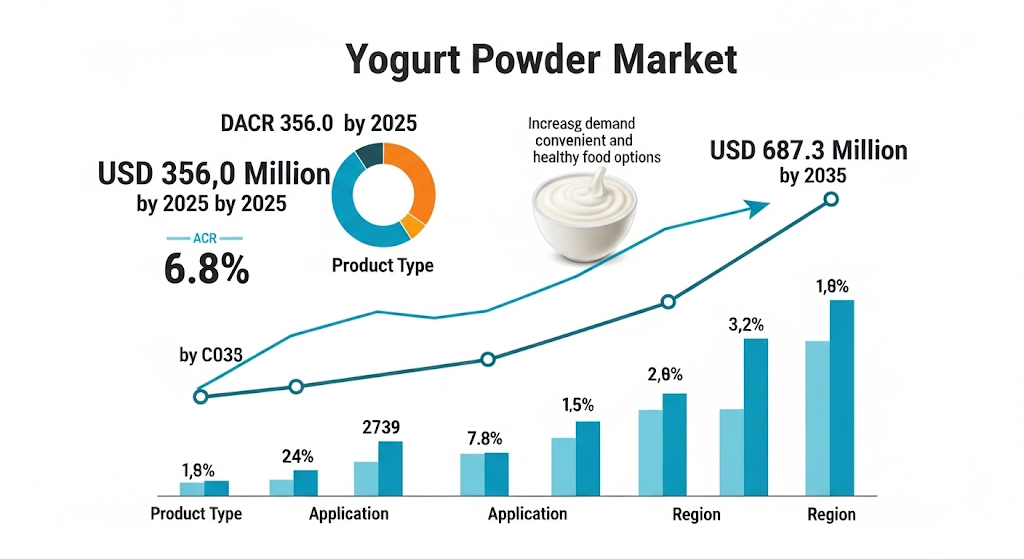
 The global yogurt powder market is entering a period of robust expansion, driven by changing lifestyles, growing nutritional awareness, and rising demand for shelf-stable food solutions. According to projections from Future Market Insights, the market is set to reach a valuation of USD 356.0 million by 2025, and surge to USD 687.3 million by 2035, reflecting a compound annual growth rate (CAGR) of 6.8% over the forecast period (Future Market Insights).
Unveil Market Trends: Get Your Sample Report Now: https://www.futuremarketinsights.com/reports/sample/rep-gb-7871
A Convenient Health Play—With Caveats
Yogurt powder is gaining traction as a go-to ingredient across industries—from protein shakes and bakery mixes to personal care and dietary supplements. Its appeal lies in the promise of yogurt’s traditional benefits—probiotics, calcium, protein—delivered in a dry, long-lasting form. For manufacturers, it offers lower transport costs, longer shelf life, and greater formulation flexibility.
But there’s a growing question: how much of yogurt’s core nutritional value survives the drying and processing? Without live and active cultures—a feature central to traditional yogurt’s digestive and immune health claims—powdered versions risk falling short of consumer expectations.
Increased Market Demand: Get In-Depth Analysis and Insights with Our Complete Report: https://www.futuremarketinsights.com/reports/yogurt-powder-market
Global Demand, Fragmented Adoption
The Future Market Insights report highlights North America as a dominant market, but significant growth is also expected in emerging regions. Flavored yogurt powders are leading the charge, accounting for more than half of global revenue as of 2024. These products align well with consumer trends toward personalized nutrition and indulgent yet functional snacks.
Still, adoption is uneven. Many consumers remain skeptical of powder-based dairy products, particularly in regions where fresh yogurt is a cultural staple. For the category to move beyond niche applications, it must overcome lingering perceptions that powdered means “processed”—and by extension, less healthy.
Health Meets Hype
The success of yogurt powder depends on science catching up to marketing. While demand is accelerating, regulatory clarity and standardized testing around probiotic efficacy in powdered formats remain limited. Without consistent labeling or verified claims, consumers are left to navigate vague messaging about gut health and “active cultures.”
The market is growing, yes—but trust must grow with it.
Final Take
The yogurt powder market is on a strong upward path—poised to nearly double in value over the next decade. But turning forecast into foundation will require more than innovation. It will demand transparency, regulation, and honest communication with consumers about what yogurt powder is—and what it isn’t.
If the industry gets it right, this humble powder could reshape how we think about dairy. If it doesn’t, it may join the long shelf of health foods that promised more than they delivered.
Leading Yogurt Powder Brands
- Nestlé S.A.
- Danone S.A.
- General Mills, Inc.
- Yakult Honsha Co., Ltd.
- FrieslandCampina N.V.
- The Kraft Heinz Company
- Lactalis Group
- Kerry Group plc
- Morinaga Milk Industry Co., Ltd.
- Chr. Hansen Holding A/S
- Chobani, LLC
- Others
 Explore Dairy and Dairy Products Industry Analysis: https://www.futuremarketinsights.com/industry-analysis/dairy-and-dairy-products
Key Segments of the Report
By Type:
This segment is further categorized into regular, low-fat and non-fat.
By Flavor:
This segment is further categorized into plain and flavored.
By Packaging Type:
This segment is further categorized into sachets/pouches, cans/jars, and bulk packaging.
By Application:
This segment is further categorized into food and beverage industry, nutraceuticals, dietary supplements, and cosmetics and personal care products.
By Distribution Channel:
This segment is further categorized into supermarkets and hypermarkets, convenience stores, online retailing, specialty stores, and others.
By Region:
Industry analysis has been carried out in key countries of North America, Latin America, Eastern Europe, Western Europe, East Asia, South Asia & Pacific, Central Asia, Balkan and Baltic Countries, Russia & Belarus and the Middle East & Africa.