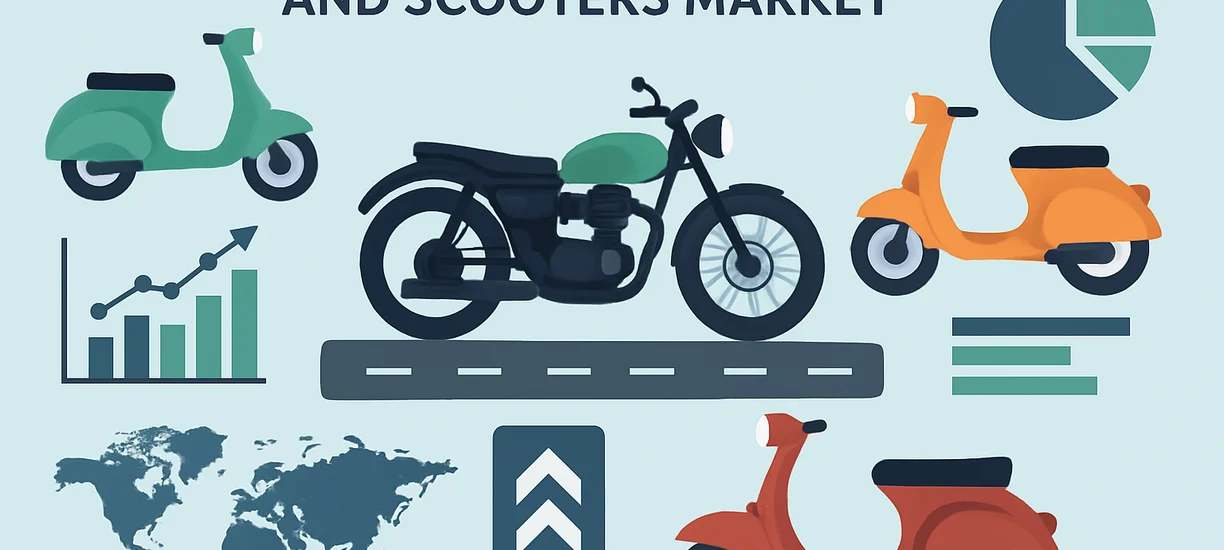
The conventional motorcycles and scooters market is projected to expand from USD 214,560.4 million in 2025 to USD 314,561.1 million by 2035, registering a CAGR of 3.9% over the forecast period. This growth is being driven by rising demand for affordable, fuel-efficient, and practical urban transportation, particularly in emerging economies with large populations and developing road infrastructure. Continued reliance on internal combustion engine (ICE) two-wheelers in regions where electric alternatives remain cost-prohibitive or infrastructural limited is reinforcing the relevance of conventional models globally.
In an age dominated by electrification, automation, and hyper-connectivity, it’s easy to assume that traditional transportation forms are fading into the background. Yet, on roads across cities, villages, and highways worldwide, the unmistakable hum of conventional motorcycles and scooters continues to be a defining rhythm of everyday mobility.
Far from obsolete, these two-wheelers remain essential—powering economies, enabling livelihoods, and offering unmatched flexibility in both urban and rural environments. Their enduring relevance is not a relic of the past, but a testament to their adaptability, reliability, and universal appeal.
Get Ahead with Our Report: Request Your Sample Now!
https://www.futuremarketinsights.com/reports/sample/rep-gb-4752
More Than a Ride: A Workhorse for the Masses
Conventional motorcycles and scooters serve more than just personal transport. In many regions, they are tools of trade—used by delivery workers, field technicians, and small business owners alike. Whether navigating dense traffic or covering long rural distances, they provide a practical, affordable, and efficient solution for millions.
Their internal combustion engines may lack the allure of electric drivetrains, but they offer well-understood mechanics, long-range endurance, and easy maintenance—key factors in regions where infrastructure and support for EVs are still developing.
Outshined by New Tech, But Undefeated in Utility
In the shadow of electric scooters, ride-sharing apps, and next-gen mobility platforms, conventional two-wheelers might seem outdated. But the numbers and road realities tell a different story. These vehicles still dominate in areas where cost-efficiency, performance, and fueling convenience matter most.
For millions, owning a motorcycle or scooter is not just about getting from point A to B—it’s a rite of passage, a symbol of independence, and often, a necessity. Even as mobility trends shift, the demand for conventional models remains strong, particularly in rapidly urbanizing or economically developing regions.

Designed for Every Journey, Built to Endure
The modern conventional motorcycle or scooter is the result of decades of engineering evolution. With fuel-efficient engines, ergonomic designs, and rugged durability, they are built to handle diverse terrains and daily wear.
From lightweight scooters designed for city commuting to high-performance motorcycles built for long-distance travel, manufacturers continue to innovate within the traditional combustion framework—enhancing comfort, safety, and fuel economy while maintaining cost accessibility.
Navigating Headwinds: Regulation, Emissions, and Electrification
Conventional two-wheelers face growing scrutiny over emissions and environmental impact. Urban policies, government mandates, and consumer awareness are pushing manufacturers to reimagine engine technologies, adopt cleaner fuels, and improve exhaust systems.
While electric vehicles are steadily gaining traction, challenges like charging infrastructure gaps, battery costs, and rider preference still give conventional models a strong foothold. In response, OEMs are investing in hybrid solutions, BS6/Euro-compliant engines, and lightweight designs to extend the lifecycle of their combustion platforms.
Exhaustive Market Report: A Complete Study
https://www.futuremarketinsights.com/reports/conventional-motorcycles-and-scooters-market
Economic Enabler, Cultural Icon
Beyond transportation, motorcycles and scooters are deeply embedded in local cultures—from Southeast Asian city streets to Latin American highways. They fuel gig economies, support family incomes, and serve as lifelines in areas with limited public transport.
Their affordability and adaptability make them a powerful enabler of mobility equality—allowing people from all walks of life to access education, healthcare, and economic opportunities. They are more than machines—they are instruments of progress.
Still Kicking, Still Relevant
While the global mobility conversation accelerates toward digital dashboards and electric drivetrains, conventional motorcycles and scooters hold their ground—not as outdated machines, but as evolving mainstays of transportation.
As the world transitions to greener alternatives, the journey will be gradual. And until then, these two-wheelers will continue doing what they’ve always done—carrying people forward, reliably and relentlessly. Practical, proven, and persistently relevant, conventional motorcycles and scooters remain an irreplaceable force in the rhythm of mobility—fueling not just movement, but everyday life.