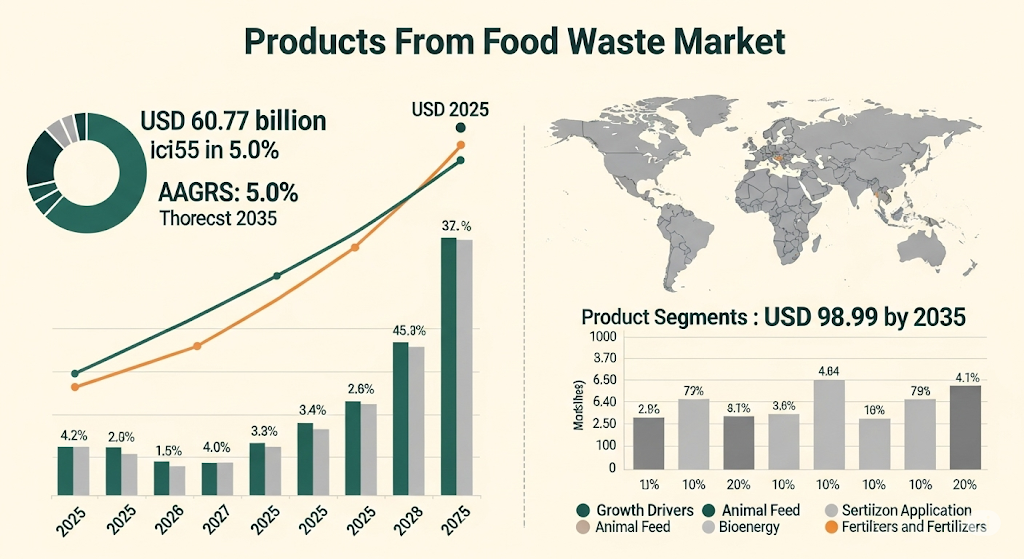
 The global for products derived from food waste is experiencing unprecedented momentum, with market value projected to surge from USD 60.77 billion in 2025 to USD 98.99 billion by 2035. This growth trajectory reflects a compound annual growth rate (CAGR) of 5.0%, driven by innovations in upcycling, growing consumer consciousness, and the widespread adoption of circular economy frameworks. Companies are increasingly capitalizing on surplus and by-product streams to develop sustainable and high-value goods that align with environmental, social, and governance (ESG) goals.
Explore Market Dynamics: Request Your Sample Report Now: https://www.futuremarketinsights.com/reports/sample/rep-gb-9548
Market Trends Highlighted
The transformation of food waste into value-added products is reshaping industries. A notable trend includes the use of discarded fruits, vegetables, and grains in creating ingredients for dietary supplements, biodegradable packaging, and sustainable cosmetics. Global brands are launching zero-waste product lines and adopting food waste valorization as a core sustainability strategy. Meanwhile, heightened consumer interest in ethical consumption is fueling demand for transparent, eco-friendly product sourcing.
Expanding Market Need: Access Our Full Report for In-Depth Analysis and Trends: https://www.futuremarketinsights.com/reports/products-from-food-waste-market
Recent Developments
- Technological Innovation: U.S.-based startups are pioneering advanced processing methods to extract proteins, fibers, and bioactive compounds from food waste.
- Legislative Momentum: Countries like Japan have introduced regulatory mandates such as the Food Waste Reduction Promotion Law, encouraging sustainable production.
- Industry Collaboration: In Germany, collaborations between R&D institutions and private companies are yielding breakthroughs in food waste conversion technologies.
- Consumer Behavior Shift: Asia Pacific consumers, especially in China and India, are showing a rising preference for upcycled and sustainable goods amid rapid urbanization.
Key Takeaways of the Report
- The market is expected to grow at a CAGR of 5.0% from 2025 to 2035.
- Surplus ingredients are now being used in the production of high-value items such as snacks, supplements, and personal care products.
- Circular economy and ESG strategies are central to long-term market investments.
- Demand is heavily influenced by regulatory support, R&D advancements, and changing consumer values.
Market Drivers
- Circular Economy Initiatives: Businesses are aligning their models with sustainable resource management, seeing food waste not as waste but as raw material.
- Consumer Awareness: Environmentally conscious buyers are pressuring brands to provide sustainable alternatives.
- Government Mandates and Incentives: Regulatory bodies across regions are implementing frameworks to reduce food waste and promote its valorization.
- Technological Advances: New extraction and processing methods have made food waste recycling more economically viable and scalable.
Regional Insights
North America
North America—particularly the United States—dominates the market due to strong innovation ecosystems and corporate sustainability mandates. Companies are increasingly incorporating food waste reuse into their CSR strategies to appeal to eco-aware consumers.
Europe
Germany is emerging as a frontrunner in food waste innovation through intense R&D activity. Partnerships between academia and industry are instrumental in developing cutting-edge waste-to-product technologies that serve as blueprints for sustainability in the food industry.
Asia Pacific
The region is witnessing dynamic growth due to increasing urbanization and strict waste management policies in countries like China and India. Japan’s cultural shift towards seasonal and local foods is creating fresh demand for innovative upcycled food products.
Country-wise CAGR Analysis (Market Value by 2035)
United States: USD 27,923.7 million – Leads global growth with innovation-driven strategies and robust consumer demand.
Germany: USD 4,731.0 million – Focused on tech-enabled transformation and policy-driven sustainability.
China: USD 1,156.2 million – Government mandates fuel demand for waste-derived solutions.
India: USD 789.3 million – Growing middle class and urban infrastructure drive upcycling adoption.
Japan: USD 345.8 million – Cultural and legislative support promote local food waste reduction efforts.
Competition Outlook
The market is moderately consolidated with a mix of established corporations and agile startups. Key players are prioritizing ESG compliance, R&D investments, and strategic partnerships to gain competitive advantage. U.S.-based innovators are leveraging biotechnology and AI to optimize food waste transformation, while European companies are focusing on integrating sustainability into entire value chains.
Leading Products from Food Waste Brands
- Aeropowder
- Bio-bean Ltd.
- Circular Systems S.P.C.
- Fruitcycle
- GroCycle
- Jrink Juicery
- Misfit Foods
- ReGrained, LLC
- Rise Products
- Rubies in the Rubble
- Snact Ltd.
- Toast Ale Ltd.
- Others
 Explore Food Technology Industry Analysis: https://www.futuremarketinsights.com/industry-analysis/food-technology
Key Segments of the Report
By Source:
This segment is further categorized into Mangoes, Apples, Grapes, Citrus Fruits, Carrots, Beetroot, Berries and Others.
By End User:
This segment is further categorized into Food Processing, Beverage Processing, Cosmetics & Personal Care, Dietary Supplements & Nutraceuticals, Animal Feed and Others.
By Region:
Industry analysis has been carried out in key countries of North America, Latin America, Eastern Europe, Western Europe, East Asia, South Asia & Pacific, Central Asia, Balkan and Baltic Countries, Russia & Belarus and the Middle East & Africa.