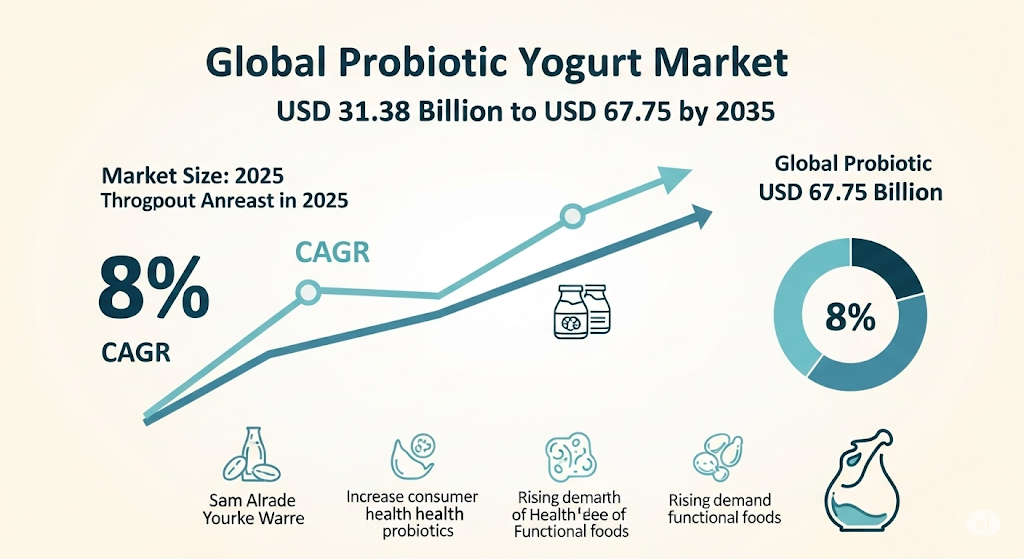
 The global probiotic yogurt market is on a trajectory of robust expansion, forecasted to rise from USD 31.38 billion in 2025 to USD 67.75 billion by 2035, registering a CAGR of 8%. Fueled by increasing health awareness and the demand for functional foods, probiotic yogurt is transitioning from a niche wellness product to a mainstream dietary staple. With the convergence of scientific innovation, plant-based alternatives, and tech-enabled health tracking, the market is evolving to meet the needs of a health-conscious, digitally connected consumer base.
Unveil Market Trends: Get Your Sample Report Now: https://www.futuremarketinsights.com/reports/sample/rep-gb-3259
Market Trends Highlighted
Diversification in Product Formats: Consumers are gravitating toward both spoonable and drinkable formats, with a notable uptick in single-serve and portable products catering to busy lifestyles.
Clean Label and Organic Surge: Rising demand for natural, non-GMO, and reduced-sugar formulations is prompting manufacturers to rework ingredient profiles.
Rise of Plant-Based Alternatives: The launch of oat, almond, and coconut milk-based probiotic yogurts has broadened market accessibility for lactose-intolerant and vegan consumers.
Strain-Specific Innovation: Companies are increasingly investing in advanced probiotic strains with clinically validated health benefits, including gut-brain axis regulation, mental wellness, and immune function.
Enhanced Market Demand: Discover Thorough Trends and Insights in Our Complete Report: https://www.futuremarketinsights.com/reports/probiotic-yogurt-market
Key Market Developments
- Expansion into Digital Channels: E-commerce platforms and DTC models are improving product accessibility across both urban and rural markets.
- Retail Shelf Growth: Supermarkets are dedicating more space to probiotic yogurts, boosting consumer visibility and selection.
- Strategic Partnerships: Collaborations between food tech startups and global dairy giants are accelerating innovation, particularly in non-dairy formats.
- Consumer Education: Health influencers and digital platforms are playing a key role in increasing trial rates and consumer literacy on probiotic benefits.
Key Takeaways of the Report
- The probiotic yogurt market is projected to double by 2035, driven by a global shift toward preventive healthcare.
- Innovation in both dairy and non-dairy categories is key to market expansion.
- Consumer education, particularly through digital media and health apps, is transforming probiotics from optional supplements into essential wellness products.
- Regional trends indicate particularly high growth in Europe and Asia-Pacific due to cultural alignment with fermented foods and health-focused diets.
Market Drivers
- Rising Health Consciousness: With increasing awareness of digestive and immune health, consumers are prioritizing functional foods like probiotic yogurt.
- Growth of Personalized Nutrition: Integration with wearable tech and health apps is creating personalized probiotic experiences and recommendations.
- Advancements in Probiotic Science: Ongoing research into new strains is unlocking benefits beyond gut health, including mood and metabolic support.
- Expanding Vegan Population: The shift to plant-based lifestyles is propelling growth in dairy-free probiotic options.
Regional Insights
- Asia-Pacific: Rapid urbanization, long-standing dietary traditions, and high health consciousness fuel strong demand in countries like Japan and China.
- Western Europe: Preventive nutrition culture and a well-established dairy industry make this region a leader in functional dairy product consumption.
- North America: Innovation and DTC models dominate, with health-focused branding resonating with younger demographics.
Country-Wise CAGR Analysis (2025–2035)
United Kingdom – 12.2%: Fastest-growing market, driven by gut health awareness, plant-based options, and supportive food labeling laws.
France – 11.5%: Growth fueled by a mature dairy culture and clean-label preference. Premiumization and organic product lines are gaining traction.
Germany – 9.9%: Health-conscious consumers favor high-quality, strain-specific probiotic yogurts. Retailers are increasingly adopting lifestyle-aligned SKUs.
United States – 8.3%: Strong demand from millennials and boomers alike. Functional foods and plant-based innovations dominate shelf space.
Japan – 7.6%: Tradition of fermented foods and FOSHU-backed regulations support strong market fundamentals and innovation in probiotic delivery systems.
Competition Analysis
-
- Danone S.A.
- General Mills, Inc.
- Nestlé S.A.
- Fonterra Co-operative Group Limited
- Groupe Lactalis S.A.
- Chobani LLC
- AGE International S.A.
- Good Karma Foods, Inc.
- The Coconut Collaborative
- Mother Dairy Fruit & Vegetable Pvt Ltd.
- Lancashire Farm Dairies
- Meiji Holdings Company, Ltd.
- Ehrmann AG
- Yofix Probiotics Ltd.
- GT’s Living Foods LLC
Key Segments Covered in the Probiotics Yogurt Market Report
By Product Type:
- Drinkable Probiotic Yogurt
- Spoonable Probiotic Yogurt
By Source:
- Animal-based
- Plant-based
- Soy Milk
- Almond Milk
- Coconut Milk
- Others
By Nature:
- Organic
- Conventional
By Flavor:
- Regular/Unflavored
- Flavored
- Vanilla
- Strawberry
- Blueberry
- Peach
- Others
By Fat Content:
- Regular/Whole Milk
- Low-fat
- Fat-free
By Sales Channel:
- Hypermarkets/Supermarkets
- Convenience Stores
- Specialty Stores
- Online Retailers
- Wholesalers
- Grocery Stores
- Other Retail Format
By Region:
- North America
- Latin America
- Western Europe
- Eastern Europe
- Asia Pacific excluding Japan (APEJ)
- Japan
- The Middle East & Africa (MEA)