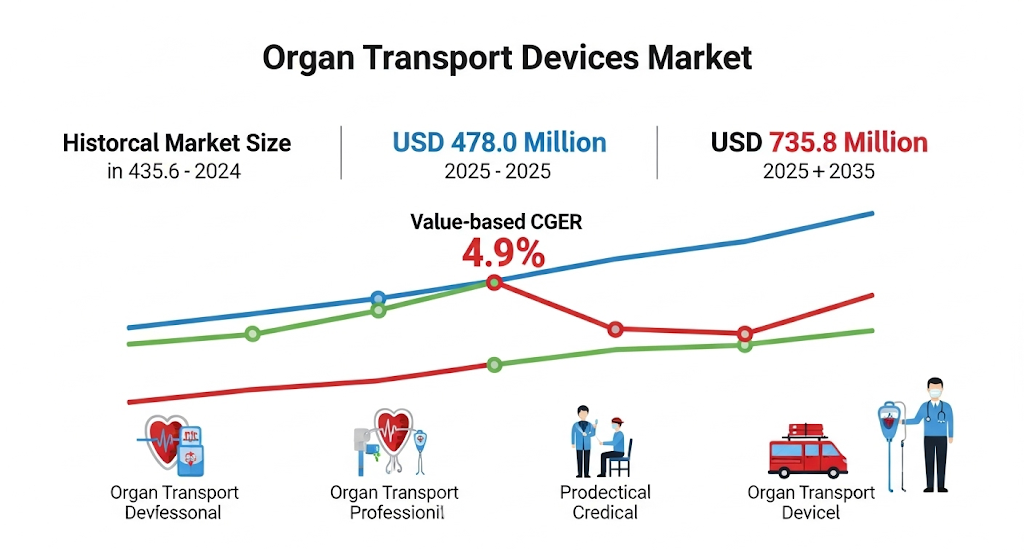
The global sales of organ transport devices are estimated to be worth USD 478.0 million in 2025 and anticipated to reach a value of USD 735.8 million by 2035. Sales are projected to rise at a CAGR of 4.9% over the forecast period between 2025 and 2035. The revenue generated by organ transport devices in 2024 was USD 435.6 million.
More than 100,000 Americans wait for a life-saving organ. Every single day, dozens die waiting. This isn’t just a tragedy — it’s a national failure. The culprit? Not the donors. Not the surgeons. It’s the decades-old methods we still rely on to move organs from donor to patient.
Get Sample Report: – https://www.futuremarketinsights.com/reports/sample/rep-gb-15180
🚑 The Problem: Time Is a Relentless Killer
Organ transport has long been stuck in the dark ages. Ice chests and coolers. That’s it. That’s the “technology” saving lives? It’s absurd. Hearts can survive outside the body for barely 4 to 6 hours. Minutes wasted in transit are lives lost. The clock is merciless. We can do better — and we must.
💡 Innovation Is Here — But It’s Fighting an Uphill Battle
Future Market Insights reports the global organ transport devices market was worth $478 million in 2024 and will hit $736 million by 2035—a steady 4.9% annual growth. That’s progress. Real progress.
These devices aren’t science fiction. They’re here now. Machines that keep hearts beating, lungs breathing, and livers alive. They’re a game-changer, turning hours into days.

🇺🇸 The U.S. Is Falling Behind Because It Refuses to Modernize
Despite being a global leader in medicine, the U.S. lets organs languish in cargo holds. No real-time tracking. No streamlined transport networks. Just old-school chaos disguised as protocol.
This fragmented system isn’t just inefficient—it’s deadly. Meanwhile, other countries move quickly, with centralized coordination and policies that match modern tech.
The U.S. must stop pretending that progress happens in labs alone. It demands overhaul of policies, infrastructure, and funding. Otherwise, these breakthrough devices are just expensive paperweights.
🌍 A Global Wake-Up Call
Worldwide, demand for transplants is soaring. Governments and manufacturers are responding—developing compact, efficient devices that preserve and even rejuvenate organs during travel. The future is here, but only if the system can catch up.
🧠 The Bottom Line: Innovation Means Nothing Without Action
Technology has delivered a lifeline. But lifelines are useless if they’re tangled in red tape.
We stand at a crossroads. Do we upgrade our policies, invest in infrastructure, and make these devices accessible? Or do we watch thousands more die waiting for organs trapped in outdated logistics?
Explore In-Depth Analysis-Click Here to Access the Report:- https://www.futuremarketinsights.com/reports/organ-transport-devices-market
Key Segments Studied in the Organ Transport Devices Market Research Report
By Product:
In terms of product, the industry is divided into- devices, disposables, cold storage solution, perfusion solution and slush preparation solutions.
By Organ:
In terms of organ, the industry is segregated into- heart, lung, liver, kidney, pancreas, small bowel/intestine.
By End User:
In terms of end user, the industry is segregated into- hospitals, transplant centers, organ procurement organizations (OPOs).
By Region:
Key countries of North America, Latin America, Western Europe, Eastern Europe, South Asia and Pacific, East Asia and Middle East and Africa (MEA) have been covered in the report.