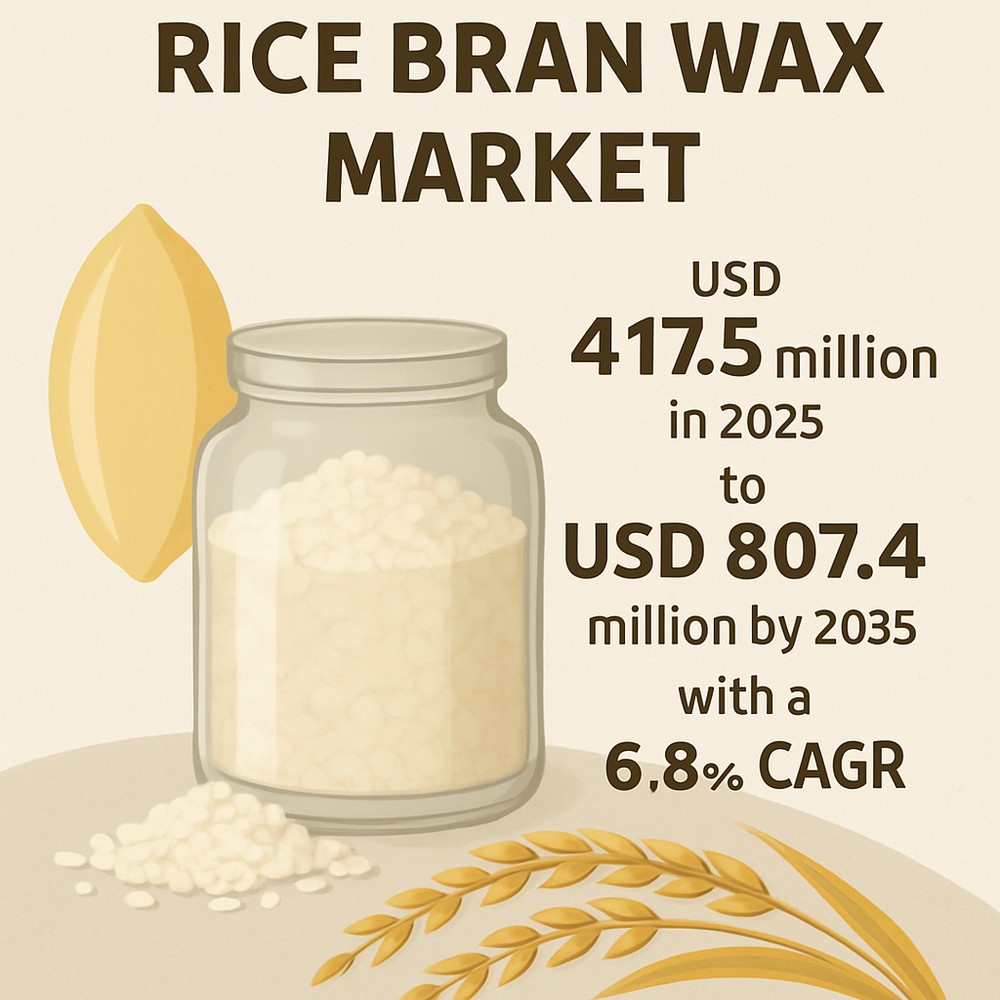
The Global Rice Bran Wax Market an eco‑friendly structuring agent prized in cosmetics, food coatings, nutraceuticals and polishes—is poised for robust expansion. Valued at USD 417.5 million in 2025, it is projected to almost double to USD 807.4 million by 2035, advancing at a compound annual growth rate (CAGR) of 6.8 % over the forecast period. Surging demand for plant‑derived waxes that boost product stability while aligning with “free‑from” and sustainability claims is the engine behind this growth.
Uncover Essential Data – Get A Sample Copy:
https://www.futuremarketinsights.com/reports/sample/rep-gb-4523
Market Trends Highlighted
- Shift to natural emulsifiers: Multinationals in personal care and color cosmetics are replacing synthetic microcrystalline waxes with rice bran wax to satisfy rising vegan and clean beauty standards, particularly across Asia–Pacific and Western Europe.
- Booming food glazing agents: Confectionery and bakery brands leverage rice bran wax for its superior gloss and oxygen barrier—extending shelf life without compromising label friendliness.
- Biodegradable packaging: Wax coated paper and molded fiber trays using rice bran wax achieve enhanced moisture resistance, supporting the global push away from single use plastics.
- Nutraceutical delivery systems: The high ester content in rice bran wax enables controlled release tablets and omega 3 microcapsules, creating a lucrative sub segment in functional foods.
- Green polishing & industrial finishes: Automotive, leather and wood care manufacturers adopt rice bran wax blends to cut volatile organic compounds (VOCs) and petroleum dependence.
- Supply side tailwinds: Recovery of rice milling by products in Southeast Asia ensures ample feedstock, while advances in dewaxing technology raise extraction yields and lower unit costs.
Get Report Link https://www.futuremarketinsights.com/reports/rice-bran-wax-market
Key Takeaways of the Report
Market size & trajectory: Revenues will climb from USD 417.5 million (2025) to USD 807.4 million (2035), representing an absolute opportunity during the period.
Fastest‑growing end‑use: Color cosmetics exhibit a double‑digit CAGR, propelled by lipstick and eyebrow‑pencil formulators seeking high‑melting, cruelty‑free wax matrices.
Emerging application hubs: Biodegradable barrier coatings for produce packaging show a CAGR 1.4 percentage points above the market average, underpinned by bans on PFAS‑laden grease‑resistant films.
Technology focus: Fractional crystallization and super‑critical CO₂ extraction are cutting solvent residues below 5 ppm—critical for pharmaceutical compliance.
Regional Market Outlook
United States (CAGR 4.9 %)
Mature demand from confectionery glazes, wood care polishes, and high end skin care keeps the U.S. the single largest value contributor. Growth is fueled by “clean label” reformulations in mainstream food brands and stricter VOC caps that favor bio wax blends in industrial coatings.
United Kingdom (CAGR 4.3 %)
Premium cosmetics and artisan bakery coatings dominate consumption, with formulators drawn to rice bran wax’s vegan credentials amid rising consumer scrutiny of synthetic ingredients. Post Brexit incentives for “green industry” investments are catalyzing pilot scale micronization plants in northern England.
China (CAGR 5.6 %)
Explosive expansion of color cosmetics manufacturing clusters in Guangdong and Zhejiang is accelerating uptake, while e commerce personal care labels showcase rice bran wax as a cruelty free differentiator. Government backed programs to valorize rice milling by products bolster local feedstock security and cap import reliance.
India (CAGR 6.1 %)
The fastest growing national market, driven by domestic rice abundance and rising disposable incomes that lift demand for natural lipsticks, ayurvedic balms, and edible fruit coating sprays. New downstream investments in Telangana and Maharashtra target export grade high purity waxes, narrowing the supply gap with Southeast Asia.
Germany (CAGR 4.5 %)
Automotive and engineered wood sectors increasingly adopt low PAH rice bran wax dispersions for eco label compliance, while bakery and chocolate confectioners leverage its superior gloss to replace shellac. Federal subsidies for bio based materials R&D underpin small batch specialty wax producers clustered around Bavaria and North Rhine Westphalia.
Leading Brands
- Clariant AG
- Poth Hille
- SVROIL
- Strahl & Pitsch
- Croda International Plc.
- Arjun Bees Wax Industries
- The British Wax Refining Company Ltd
- Koster Keunen
- Nexira SAS
- Starlight Products
- Paras Group
- Frank B. Ross
- Huzhou Shuanglin Shengtao Vegetable Fat Factory
- H Foster & Co Ltd.
- Likang Weiye
- Modi Naturals
- Others

Explore Functional Food Ingredients Industry Analysis: https://www.futuremarketinsights.com/industry-analysis/functional-food-ingredients
Key Segments of the Report
- By Grade:
As per grade, the industry has been categorized into Cosmetic Grade, Food Grade, Industrial Grade, and Others.
- By Applications:
This segment is further categorized into Cosmetic Products, Coatings (Shoe Polish, Packaging (Paper Coating), Leather Sizing (Coating), Medicine Coating, Electric Insulation Coating, Car Interior Coating, Upholstery Coating, and Others), Confectionery, Ointments, Explosives, and Other.
- By End-use:
This segment is further categorized into Personal Care, Pharmaceuticals, Paper and Pulp, Leather, Textile, Food and Beverages, Electronics, Defense, Mining, and Others.
- By Region:
Industry analysis has been carried out in key countries of North America, Latin America, Western Europe, Eastern Europe, Balkans & Baltic, Russia & Belarus, Central Asia, East Asia, South Asia & Pacific, and the Middle East & Africa.