Yeast Demand Spikes as the World Ferments Faster Than Ever
The global yeast market is rising faster than a sourdough starter on a summer day. Once confined to baking aisles and breweries, yeast has become a linchpin in food innovation, biofuel development, and even gut health. But with that growth comes a pressing question: Are we scaling responsibly, or just chasing profit at the cost of resilience?
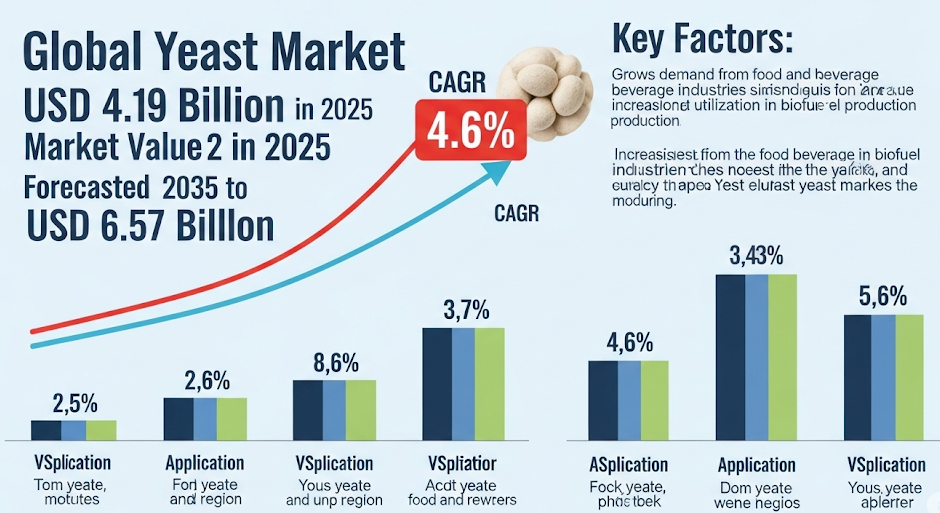
According to Future Market Insights (FMI), the yeast market is projected to surge from USD 4.19 billion in 2025 to USD 6.57 billion by 2035, expanding at a CAGR of 4.6%. FMI identifies food and beverage innovation, the rise of functional health products, and industrial demand (notably in bioethanol and feed yeast) as the primary drivers of this exponential growth.
Explore Key Trends in the Market: Request Your Sample Report: https://www.futuremarketinsights.com/reports/sample/rep-gb-225
From Breadbasket to Biofuel: A Global Shift in Yeast Application
This isn’t just about dinner rolls anymore. Yeast is now a foundational element in:
- Plant-based meat and dairy alternatives
- Bioethanol fuel production
- Probiotic supplements
- Specialty brewing and artisanal foods
FMI emphasizes that the active dry yeast segment continues to dominate due to its long shelf life and ease of use, especially in developing economies. Meanwhile, the brewer’s yeast category is seeing rapid innovation as the craft beer industry expands globally, driving demand for specialized strains.
Soaring Demand for Market Information: Uncover Detailed Trends and Insights in Our Report: https://www.futuremarketinsights.com/reports/yeast-market
The U.S. Paradox: Robust Demand, Fragile Foundations
In the United States, the yeast market is strong—but not unshakable. While American consumers drive high per-capita usage in baking, brewing, and supplements, the domestic industry is still heavily dependent on agricultural feedstocks like molasses and corn syrup. Climate volatility, supply chain disruptions, and regulatory delays can ripple through the system with little warning.
FMI notes that North America holds a significant share of the global yeast market, yet much of the momentum is shifting toward Asia-Pacific, where rising disposable incomes, urbanization, and a growing taste for bakery and convenience foods are reshaping the market’s center of gravity.
Under Pressure: What the Growth Narrative Isn’t Telling You
- Environmental Costs Are Rising
Fermentation is energy-intensive. As yeast production scales, so does its environmental footprint. Water use, CO₂ emissions, and waste disposal from industrial plants are issues still flying under the regulatory radar. - Overconcentration in Inputs
The majority of commercial yeast is produced using just a few agricultural by-products. This lack of diversification makes the entire ecosystem vulnerable to crop failures, trade barriers, and price volatility. - Innovation Is Outpacing Oversight
Novel yeast strains are being deployed in everything from pharmaceuticals to synthetic biology. Yet safety standards haven’t kept pace with the speed of R&D, raising questions about quality control, cross-contamination, and labeling accuracy.
What Needs to Change
Diversify Substrates
Future yeast production should explore feedstocks beyond molasses and corn, such as food waste, lignocellulosic biomass, or algae.
Enforce Environmental Compliance
National and global regulators must step up oversight of emissions and waste from yeast fermentation facilities.
Standardize Functional Claims
As yeast becomes a common ingredient in “functional” and probiotic-labeled products, clear definitions and scientific backing are essential to avoid misleading consumers.
Strengthen Local Production Capacity
Countries reliant on imports for yeast strains or raw materials must incentivize domestic production to insulate themselves from global shocks.
Final Rise or Sudden Collapse?
The yeast market is rising—and it smells like opportunity. But if we ignore the structural cracks in how yeast is sourced, produced, and regulated, this growth could prove brittle.
Yeast may be microscopic, but its implications are massive. From your morning toast to tomorrow’s energy grid, this humble fungus is doing more heavy lifting than ever before. Let’s make sure we’re feeding that growth responsibly—before it collapses under its own pressure.
Leading Yeast Brands
- Associated British Foods plc
- Angel Yeast (Chifeng) Co., Ltd.
- Lallemand Inc.
- Lesaffre International
- Oriental Yeast India Pvt Ltd.
- AB Mauri Foods, Inc.
- Chr. Hansen Holding A/S
- Kerry Group Plc
- Koninklijke DSM N.V.
- Leiber GmbH
- Ohly GmbH & Co. KG
- Fadayeast.Com
- AGRANO Gmbh & Co. KG
- Kothari Fermentation and Biochem Ltd.
- Others

Key Segments of the Report
By Type:
This segment is further categorized into Baker’s Yeast, Bi-ethanol Yeast, Feed Yeast, Wine Yeast, and Brewer’s Yeast.
By Form:
This segment is further categorized into Dry Yeast, Fresh Yeast, and Instant Yeast.
By Region:
Industry analysis has been carried out in key countries of North America, Latin America, Eastern Europe, Western Europe, East Asia, South Asia & Pacific, Central Asia, Balkan and Baltic Countries, Russia & Belarus and the Middle East & Africa.