 A Market in Overdrive with Hidden Risks
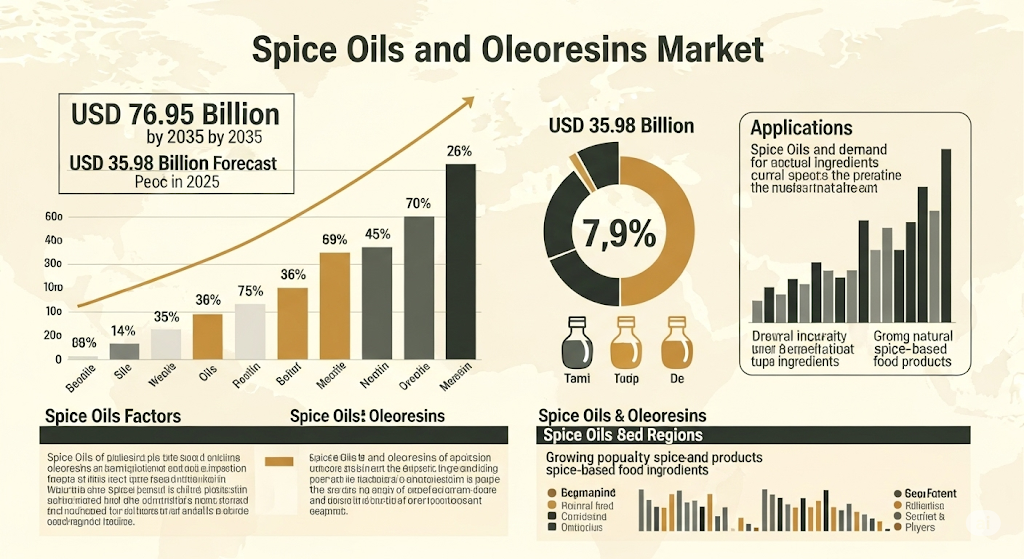
The global market for spice oils and oleoresins market is in full acceleration—expected to grow from USD 35.98 billion in 2025 to USD 76.95 billion by 2035, at a solid 7.9% CAGR, according to Future Market Insights (FMI). This surge is driven by rising demand for clean-label, natural ingredients across food, beverage, nutraceutical, personal care, and pharmaceutical industries. But while market numbers dazzle, the supply chain that feeds it is starting to buckle.
Track Evolving Market Trends: Request Your Sample Report: https://www.futuremarketinsights.com/reports/sample/rep-gb-4510
Raw Material Volatility: The Unseen Cost of Flavor
The prices of essential spices—paprika, capsicum, turmeric, black pepper—have shown increased volatility, leaving manufacturers exposed to unpredictable cost swings. And unlike synthetic additives, these natural extracts rely on a delicate balance of agricultural stability, climate predictability, and sustainable farming. When crops fail, so do flavor consistency, product launches, and pricing strategies.
FMI notes that this instability is pushing producers to seek long-term supplier relationships, local sourcing initiatives, and R&D in advanced extraction techniques. But those solutions take time—time the industry may not have as demand continues to outpace sustainable supply.
Rising Interest in Market Trends: Our Detailed Report Provides Essential Insights: https://www.futuremarketinsights.com/reports/spice-oils-and-oleoresins-market
Global Demand Meets Supply Chain Strain
Oleoresins and spice oils are increasingly favored over whole spices due to their potency, shelf-life, and ease of transport. But this demand exposes cracks in a global system that wasn’t built for precision. From export delays and inconsistent quality checks to overharvested crops and inadequate processing infrastructure in developing regions, the entire pipeline is stretched thin.
FMI identifies Asia Pacific as the dominant production hub—particularly India, which accounts for a significant share of global exports. Yet as other regions increase demand for high-quality, traceable, and organic-certified oils, many small-scale producers remain locked out of the value chain due to lack of certifications or modern technology.
Regulatory and Quality Oversight Still Lagging
Though spice oils and oleoresins are now foundational to global flavor systems, regulation remains patchy. There’s no universal quality benchmark, and many countries lack enforcement mechanisms. As FMI points out, inconsistent regulatory environments are leading to uneven product quality—leaving buyers to shoulder the burden of verification and compliance.
In a world where “natural” labeling influences consumer decisions, producers are walking a tightrope between authenticity and affordability. Without stronger regulation, the door remains open for dilution, adulteration, and misleading labeling.
What the Industry Must Do Now
- Secure the Supply Chain – Manufacturers need to invest in long-term agricultural partnerships and regional processing hubs to create resilience.
- Invest in Transparency – Full traceability and third-party testing must become industry standard, not marketing fluff.
- Push for Global Standards – Regulators and industry bodies must collaborate on harmonized quality benchmarks for spice oils and oleoresins.
A Fragile Future for a Fast-Growing Market
There’s no denying the promise of the spice oils and oleoresins market. The numbers are bold. The applications are vast. But beneath that surface lies a fragile system—one that hinges on stable climates, ethical farming, fair trade, and transparent processing. If we fail to secure the foundations, this flavor boom will collapse under its own weight.
It’s time the industry sees this not just as an opportunity—but as a responsibility. If global cuisine, wellness trends, and clean-label consumer goods are to keep evolving, the market must fix the cracks in its own roots.
Some of the Key Players in the Spice Oil and Oleoresin are:
- Young Living Essential Oils Ltd.
- Reckitt Benckiser Group Plc (RB)
- Symrise AG
- Givaduan AG
- Greenleaf Extractions Pvt. Ltd.
- Indian Spice Oil Industries
- Synthite Industries Ltd.
- Universal Oleoresins Pvt. Ltd.
 Explore Convenience Food Industry Analysis: https://www.futuremarketinsights.com/industry-analysis/convinience-food
Key Segments
By Product Type:
- Spice Oils
- Oleoresins
By Distribution Channel:
- B2B/Direct
- B2C/Indirect
By Nature:
- Organic
- Conventional
By Application:
- Food & Beverages
- Bakery & Confectionery
- Beverages
- Dressings & Condiments
- Sauces, Spreads & Soups
- Cosmetics and Personal Care
- Skin Care
- Hair Care
- Toiletries.
- Aromatherapy
- Pharmaceuticals
- Household
- Dietary Supplements
- Foodservice
- Industrial
By Region:
- North America (United States & Canada)
- Latin America (Mexico, Brazil, Peru, Argentina & Rest of Latin America)
- Europe (EU-4, BENELUX, Nordic Countries, Russia, Poland & Rest of Europe)
- South Asia (India, Thailand, Indonesia, Malaysia, and Rest of South Asia)
- East Asia (China, Japan & South Korea)
- Oceania (Australia & New Zealand)
- Middle East & Africa (GCC, Northern Africa, South Africa & Rest of MEA)