 A Sweet Surge in a Nostalgic Bottle
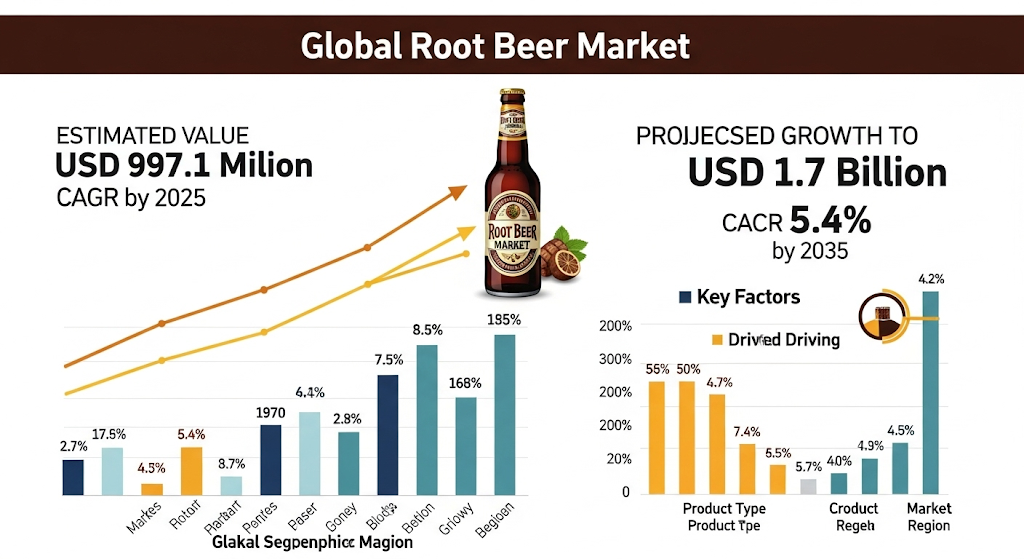
The global root beer market is no longer just an American cultural relic—it’s a growing international commodity. According to Future Market Insights (FMI), the market was valued at USD 997 million in 2025 and is projected to grow to USD 1.7 billion by 2035, expanding at a compound annual growth rate (CAGR) of 5.4%. Behind this growth is a cocktail of nostalgia, rising interest in craft beverages, and an expanding consumer base beyond North America.
Root beer, long rooted in U.S. culinary heritage, is now finding fans in Europe, Asia, and Latin America—many encountering it for the first time not through major soda brands, but through boutique brewers and niche imports. FMI highlights that specialty, low-alcohol, and no-alcohol variants are gaining particular momentum, especially among younger demographics seeking novelty and non-alcoholic alternatives.
Get Ahead of Market Shifts: Request Your Sample Report: https://www.futuremarketinsights.com/reports/sample/rep-gb-3094
The Craft Craze and the Sugar Problem
The industry owes much of its momentum to the craft movement. Small-batch, artisan-style root beers are tapping into a consumer craving for authenticity and tradition. But behind the retro labels and nostalgic branding lies a growing public health concern: sugar.
Many root beers, especially mainstream brands, contain high levels of sugar and artificial additives. Despite some innovations in sugar-free or naturally sweetened formulas, FMI notes that the sugar-rich versions still dominate sales globally. With growing awareness around obesity, diabetes, and sugar consumption, the market may soon face a reckoning.
Soaring Demand for Market Information: Uncover Detailed Trends and Insights in Our Report: https://www.futuremarketinsights.com/reports/root-beer-market
A Global Health Dilemma Brewing
Root beer’s growing popularity comes at a time when public health authorities worldwide are cracking down on sugary beverages. While FMI does not forecast regulatory action directly, the report’s emphasis on consumer shifts toward “health-conscious” choices signals where the winds are blowing.
As the beverage continues to spread beyond its North American roots, global scrutiny may follow. If sugary soda-like drinks are taxed or regulated more aggressively—something already happening in various countries—root beer won’t be spared. That puts brands in a difficult position: preserve flavor and tradition, or reformulate to stay relevant and responsible?
What’s Next for the Industry?
FMI’s data suggests several trends will shape the market’s future:
- Premiumization – Consumers are willing to pay more for organic, all-natural, or botanically brewed versions.
- Flavor Innovation – Vanilla-heavy and herbal variants are being explored to distinguish products in a crowded category.
- Packaging Matters – Eco-conscious and vintage-style packaging is emerging as a purchase driver.
- Health Repositioning – Brands leaning into sugar-free or functional versions (with added probiotics or herbs) are poised for long-term success.
The Bottom Line
The root beer market is fizzing with potential—but it also carries a bitter aftertaste. With growing scrutiny on sugary drinks, the industry must choose its next steps carefully. The charm of root beer lies in its roots, yes—but the future depends on how well it can adapt to a world that’s growing less tolerant of sugar-laden indulgence.
Root beer can absolutely remain a cultural icon. But it must evolve to become a smarter, healthier one. The world is thirsty—but not for empty calories.
Leading Brands
- Craft
- A&W Restaurants
- Sage Mixology Company
- Dr. Pepper Snapple Group
- Crazy Uncle
- Mill Street Brew Hall
- Seagram
- Rhineland Brewing Co
- Best Damn Brewing Co
 Explore Alcoholic and Non Alcoholic Beverages Industry Analysis: https://www.futuremarketinsights.com/industry-analysis/alcoholic-and-non-alcoholic-beverages
Key Segmentation
By Type:
The Root Beer Market is segmented into Alcoholic and Non-Alcoholic varieties, catering to both traditional soft drink consumers and those seeking alcoholic alternatives.
By End-Use:
Root beer finds applications in Ayurvedic Medicine, Food and Beverage, Dietary Supplements, and Cosmetics, reflecting its diverse functional and commercial uses.
By Region:
Industry analysis has been carried out in key countries of North America, Latin America, Western Europe, Eastern Europe, Balkans & Baltic, Russia & Belarus, Central Asia, East Asia, South Asia & Pacific, and the Middle East & Africa.