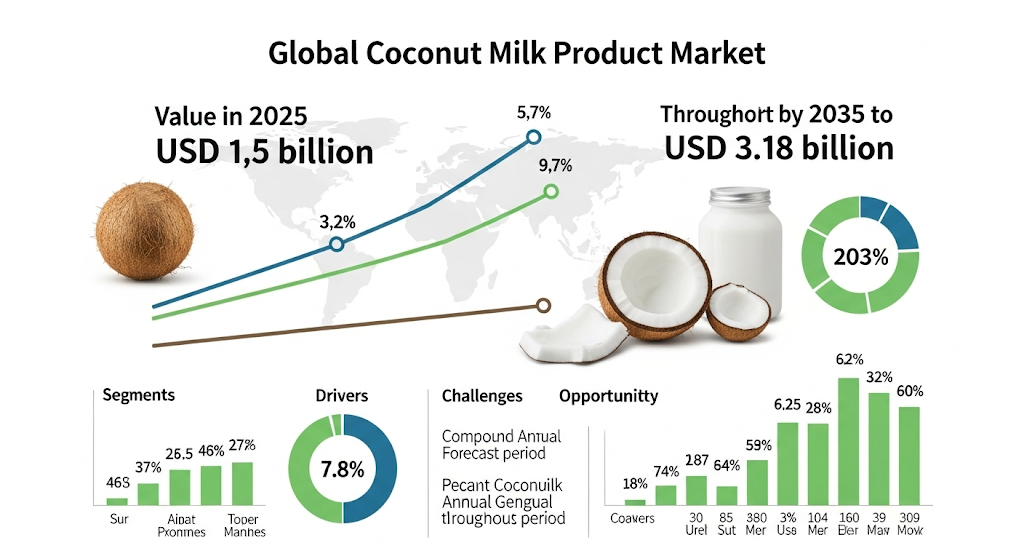
 The global coconut milk products market is poised for dramatic growth, projected to rise from USD 1.5 billion in 2025 to USD 3.18 billion by 2035, The market is poised to expand at a 7.8% CAGR during the forecast period. according to Future Market Insights (FMI). This trajectory reflects a powerful convergence of lifestyle shifts: rising lactose intolerance, surging plant-based diets, and the appeal of shelf-stable, versatile ingredients. Liquid coconut milk leads the charge—claiming nearly 74% of market share—while conventional products still dominate over organic.
But this rapid growth, impressive as it is, masks deeper questions about what we consume, why we consume it, and what it costs—not just in dollars, but in truth, nutrition, and sustainability.
Track Evolving Market Trends: Request Your Sample Report: https://www.futuremarketinsights.com/reports/sample/rep-gb-9164
Health Halo or Just Fat in Disguise?
Coconut milk is often lauded for its health benefits—particularly its medium-chain triglycerides (MCTs), which are said to promote metabolism and heart health. Yet, it’s also extremely high in saturated fat, a fact conveniently overlooked in wellness marketing.
Unlike fortified plant milks like soy or oat, coconut milk is naturally low in protein and often lacks essential nutrients unless enriched. Consumers looking for a true dairy alternative may find themselves nutritionally shortchanged unless they read the label closely—which most don’t.
Increased Market Demand: Get In-Depth Analysis and Insights with Our Complete Report: https://www.futuremarketinsights.com/reports/coconut-milk-products-market
Behind the Creamy Curtain: Manufacturing and Misconceptions
FMI notes that powdered coconut milk is growing in demand due to its stability, transport efficiency, and multi-use applications—from beverages and baked goods to cosmetics and culinary sauces. The rise of powdered formats also reflects broader trends in food tech: scalability, global trade, and year-round availability.
However, the mass manufacturing of coconut milk products—especially in conventional, non-organic formats (still 82% of the global market)—raises questions about agricultural sustainability and production ethics, many of which remain unaddressed in public discourse.
Ethical Blind Spots and Environmental Shadows
While FMI underscores demand growth across North America, Europe, and East Asia, it stops short of examining the industry’s sourcing practices. Coconut plantations are concentrated in Southeast Asia and the Pacific, regions historically fraught with labor exploitation, wage suppression, and low environmental oversight.
As this market grows, so too does the need for accountability. A product celebrated for its plant-based promise should not be built on the backs of exploited workers or at the cost of local ecosystems.
What Needs to Happen
- Clearer Labeling – Coconut milk products must clearly state nutritional gaps—especially low protein and high saturated fat.
- Stricter Standards – Regulatory bodies should enforce stronger rules on what qualifies as a dairy alternative.
- Ethical Sourcing – Brands must be pushed to transparently share their supply chains and labor practices.
- Consumer Education – People need to understand that “plant-based” does not always mean “better.”
The Bottom Line
Coconut milk isn’t just a fad—it’s a mainstay in the modern pantry. But the industry’s current path leans heavily on opaque sourcing, nutritional shortcuts, and wellness marketing that often stretches the truth.
Future Market Insights paints a picture of opportunity. But real growth should mean more than just revenue. It must mean transparency, nutrition, and integrity. Otherwise, we’re not drinking progress—we’re swallowing spin.
The key players in this market include:
- Thai Coconut Public Company Limited
- Danone S.A.
- Theppadungporn Coconut
- M&S Food Industries
- Goya Foods Incorporation
- Primex Coco Products Incorporation
- Asiatic Agro Industry
- Santanku Sdn. Bhd.
- The Sambu Group
- Monty & Totco Corporation Limited
- PT. Sari Segar Husada
- Pacific Foods of Oregon
- Thai Agri Foods PLC
- Ahya Coco Organic Food Manufacturing
- Celebes Coconut Corporation
- Heng Guan Food Industrial
- Nestle SA
- The WhiteWave Foods Company
- Grace Kennedy Limited
- Coconut Palm Group
- McCormick & Company Incorporation

Key Segments Profiled in the Global Coconut Milk Products Market
By Product Type:
- Coconut Milk Powder
- Coconut Cream Powder
By Nature:
- Organic
- Conventional
By End Use:
- Food and Beverage Processing
- Bakery and Confectionery
- Ice-creams and Desserts
- Breakfast Solutions
- Curries, Sauces and Soups
- Juices, Milkshakes and Cocktails
- Other Food and Beverage Processing
- Personal Care and Cosmetics
- Functional Foods and Dietary Supplements
- Foodservice/HoReCa (Hotels/Restaurants/Cafe)
- Household
By Distribution Channel:
- Direct Sales/B2B
- Indirect Sales
- Hypermarkets/Supermarkets
- Convenience Stores
- Mass Grocery Retailers
- Specialty Stores
- Online Retailing
By Region:
- North America
- Latin America
- Europe
- Asia Pacific
- Middle East and Africa