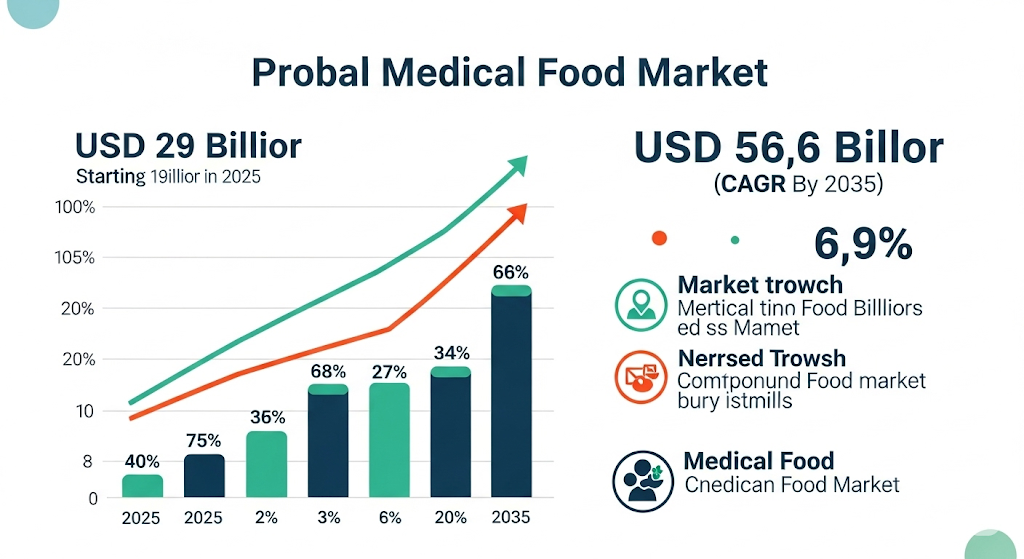
The global medical foods market is on a breath taking ascent, underpinned by rising chronic disease rates, growing geriatric demands, and evolving dietary intervention strategies. Yet, as sales soar, the industry is bumping against the U.S. regulatory architecture and public trust fractures in critical ways.
Market Boom Meets Business Realities
According to Future Market Insights, the medical foods market is projected to grow from USD 29 billion in 2025 to USD 56.6 billion by 2035, reflecting a steady CAGR of 6.9%North America holds a dominant share of around 32%, with demand being driven by a rise in lifestyle diseases such as diabetes, cancer, and chronic kidney disorders. FMI also highlights the increasing role of hospitals, home healthcare, and institutional settings as key channels for medical food delivery.
Medical foods aren’t your average dietary supplements. These are targeted nutritional products designed to manage specific disease-related dietary needs—used under medical supervision, and often when conventional diets fall short. As such, they sit in a unique regulatory gray zone, distinct from both supplements and pharmaceuticals.
Get Insights into Market Movements: Request a Sample Report: https://www.futuremarketinsights.com/reports/sample/rep-gb-19856
Regulatory Uncertainty Undermining Quality Assurance
Despite this market momentum, the U.S. Food and Drug Administration (FDA) has not kept pace. The medical food category remains governed by outdated guidelines, and the FDA has not meaningfully updated its oversight framework in nearly three decades. With minimal enforcement and no premarket approval required, the category is vulnerable to misuse and mislabeling.
This absence of rigorous regulatory mechanisms puts both clinicians and patients in a bind. Physicians are expected to recommend medical foods without robust oversight, while patients are left navigating a crowded and often opaque market.
Surge in Market Demand: Explore Comprehensive Trends and Analysis in Our Full Report: https://www.futuremarketinsights.com/reports/medical-food-market
Health Opportunity or Hype?
Medical foods hold tremendous potential in managing conditions ranging from metabolic disorders and inflammatory diseases to cancer-related cachexia. But as the lines blur between clinical nutrition and commercial health products, the risk of overpromising—and underdelivering—grows.
Future Market Insights notes that conditions like diabetes and cancer are among the key drivers of demand, with oral supplements dominating the delivery format. Yet, in the U.S. particularly, gaps in insurance coverage, physician training, and regulatory clarity limit access and informed use. There is also concern that commercial players are racing ahead of science, launching products without adequate clinical validation or monitoring.
America’s Imperative: Modernize, Regulate, Trust
With the medical foods market poised to nearly double by 2034, the U.S. must confront three urgent needs:
- Update the Regulatory Framework – The FDA must revisit its outdated definition of medical foods and impose clear, enforceable standards that distinguish these products from supplements and conventional foods.
- Demand Evidence-Based Claims – Any product purporting to manage a disease should be held to strict clinical standards, including peer-reviewed research and post-market surveillance.
- Integrate Medical Foods into Care Models – These products should be part of physician-led care plans, with clearer insurance pathways and educational support for providers.
The global rise in demand signals a new frontier in nutrition and chronic disease care—but the U.S. risks falling behind. If medical foods are to fulfill their promise, they must be held to the standards of the healthcare system they seek to complement. It’s time for policymakers, regulators, and health leaders to treat medical foods not as an industry trend—but as a clinical necessity.
Key Players
- Abbott Nutrition
- Danone Nutricia
- Nestle Health Science
- Mead Johnson Nutrition
- Fresenius Kabi
- Nutricia
- Sanofi
- Baxter International
- B. Braun
- Victus
 Explore Food Supplement and Nutrition Industry Analysis: https://www.futuremarketinsights.com/industry-analysis/food-supplement-and-nutrition
Medical Food Market Segmentation
By Product Type:
In terms of product type, the medical food market is segmented into amino acid-based, vitamin/mineral-supplemented, lipid-based, carbohydrate-based, and protein-based.
By Route of Administration:
In terms of route of administration, the market is segmented into oral, enteral, and parenteral.
By Application:
In terms of application, the market is segmented into nutritional deficiencies, gastrointestinal disorders, metabolic disorders, neurological disorders, renal disorders, and paediatric nutrition.
By Distribution Channel:
In terms of distribution channel, the market is segmented into hospital pharmacies, retail pharmacies, online pharmacies, and nursing homes.
By Region:
By region, the market is segmented into North America, Latin America, Western Europe, South Asia and Pacific, East Asia, Middle East and Africa.