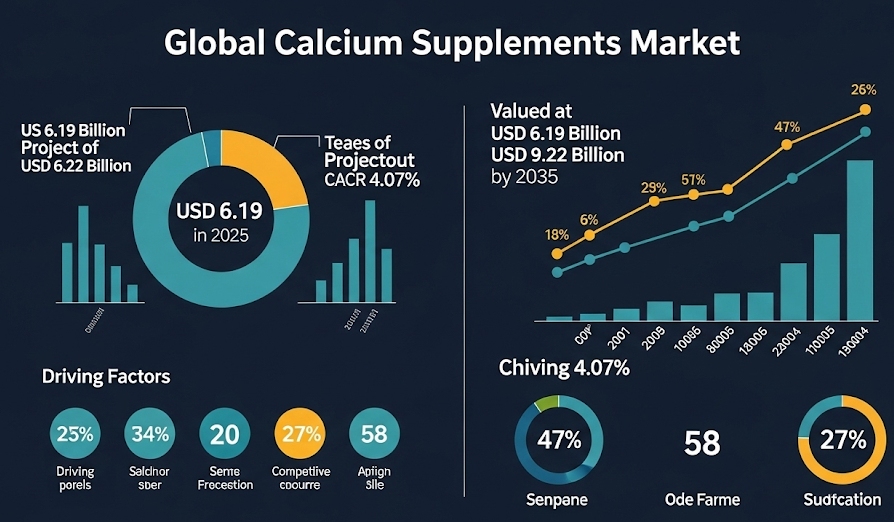
 The global calcium supplements market is on a steady growth trajectory, valued at USD 6.19 billion in 2025 and projected to reach USD 9.22 billion by 2035, exhibiting a consistent compound annual growth rate (CAGR) of 4.07% during the forecast period. This sustained expansion is significantly influenced by increasing global awareness surrounding bone health, particularly among the rapidly expanding aging population and women who are more susceptible to conditions like osteoporosis and post-menopausal bone density loss.
Track Evolving Market Trends: Request Your Sample Report: https://www.futuremarketinsights.com/reports/sample/rep-gb-9449
Market Trends Highlighted
- Aging Global Population: The significant increase in the elderly demographic, especially in developed regions, is a primary driver, as older individuals are more prone to bone density loss and related conditions.
- Rising Awareness of Bone Health: Growing consumer and medical understanding of the importance of calcium for long-term skeletal health is shifting demand towards preventive supplementation.
- Increased Incidence of Osteoporosis: The high prevalence of osteoporosis, particularly among women, directly fuels the demand for calcium supplements as a preventive and management strategy.
- Shift to Preventive Nutrition: There’s a broader trend where calcium supplementation is becoming a regular part of daily routines, moving beyond therapeutic use to proactive health management.
- Medical Recommendations: Healthcare professionals increasingly recommend calcium supplements, especially for at-risk groups, further boosting market growth.
- Diverse Product Formats: While tablets remain dominant, there’s a growing popularity of alternative formats such as soft chews, gummies, powders, and liquid formulations, catering to varied consumer preferences and age groups.
- Government and Public Health Initiatives: Various government-led health programs and public awareness campaigns are contributing to increased adoption, particularly in developing nations.
Surge in Market Demand: Explore Comprehensive Trends and Analysis in Our Full Report: https://www.futuremarketinsights.com/reports/calcium-supplements-market
Key Takeaways of the Report
- Consistent Market Expansion: The global calcium supplements market is set for steady growth, with a projected increase from USD 6.19 billion in 2025 to USD 9.22 billion by 2035.
- Moderate but Stable CAGR: A Compound Annual Growth Rate (CAGR) of 4.07% indicates a stable and reliable growth pattern throughout the forecast period.
- Demographic and Health-Driven Growth: The market’s evolution is primarily influenced by the expanding aging population and heightened awareness regarding bone health, particularly concerning osteoporosis and post-menopausal bone density loss.
- Shift from Therapeutic to Preventive Use: A significant trend is the transition of calcium supplements from occasional or therapeutic use to becoming an integral part of daily dietary supplementation for preventive health.
- USA Leads Global Market: The United States is identified as the world’s largest market, driven by its large aging population, high osteoporosis incidence, and proactive health culture.
- High Growth in Emerging Markets: Countries like China, India, and Indonesia are showing strong growth rates, reflecting rising health awareness and disposable incomes.
- Diverse Regional Drivers: Each major region exhibits unique drivers, from tourism in Thailand to government initiatives in India and a focus on functional foods in South Korea.
Regional Market Outlook
- United States: As the world’s largest market, the USA’s growth (4.70% CAGR) is driven by a massive aging population, high osteoporosis incidence (over 54 million Americans with low bone mass), and a culture of proactive health management. Calcium citrate is preferred for its bioavailability, with distribution dominated by DTC brands, e-commerce, and pharmacy chains, supported by physician recommendations.
- China: China’s market (5.20% CAGR) is rapidly expanding due to its status as the largest aging nation and rising osteoporosis cases. Urbanization, increased incomes, and improved nutrition awareness integrate supplements into daily life, with local brands like By-Health dominating online channels and government initiatives like “Healthy China 2030” strengthening the market.
- India: Characterized by unmet nutritional needs and high deficiency rates among women and children, India’s market (5.00% CAGR) is fueled by rising incomes in Tier 2 and 3 cities and expanding public healthcare initiatives. Tablets dominate, but syrup formulations are popular for pediatric and geriatric care, with Ayurveda-based and clean-label supplements gaining traction.
- Japan: Japan’s super-aged society makes it a calcium-deficient developed nation, with a 4.80% CAGR. Cultural emphasis on longevity and bone health supports steady demand, especially among those aged 60+ and post-menopausal women. Consumers prefer evidence-backed, pharmaceutical-grade supplements like calcium citrate, with functional beverages and powders also gaining traction.
- Germany: Europe’s strongest market (5.00% CAGR) is supported by a preventive care culture, well-developed OTC distribution, and an aging population. Consumers rely on pharmacist recommendations, favoring clinically validated products and combination products with vitamin D3, influenced by eco-conscious packaging and clean-label trends.
- Italy: Italy’s market (5.70% CAGR) shows strong growth, led by proactive consumers focused on bone and immune health, driven by public health campaigns and awareness of vitamin D and calcium synergy. Pharmacy-led consultations and insurance support for bone health, alongside a preference for high-absorption formulations, are key drivers.
- Brazil: Brazil’s market (4.90% CAGR) is expanding rapidly due to urbanization, rising incomes, and greater bone health awareness, with increasing osteoporosis rates prompting doctor prescriptions. Syrups and chewables are common for children, while tablets dominate for adults, supported by government nutrition programs and rising e-commerce.
- Indonesia: An emerging but promising market (5.10% CAGR) with common calcium deficiency, Indonesia’s growth is driven by government health initiatives and maternal-child programs. Preference leans towards syrups for children and powders for adults, with strong growth in urban areas and the importance of Halal certification for consumer trust.
- United Kingdom: The UK market (4.60% CAGR) is mature, with strong uptake among older adults and post-menopausal women, guided by NHS recommendations. Pharmacies and health chains drive offline sales, while online platforms cater to convenience, with increasing demand for gummies, vegan alternatives, eco-packaging, and sugar-free labels.
- South Korea: South Korea’s market (4.90% CAGR) is fueled by aging demographics and a wellness-focused consumer culture, viewing supplements as part of daily beauty and fitness regimens. Powders and chewables in portable formats are trending, with e-commerce platforms dominating distribution and a strong preference for clean-label and KFDA-certified products.
Competition Outlook
The global calcium supplements market is highly competitive, characterized by a mix of established global brands and strong regional players. Companies are continuously innovating to offer improved formulations, such as highly bioavailable calcium citrate, and combination products with essential co-factors like Vitamin D3.
Leading Players
- Pfizer (Caltrate)
- AandZ Pharmaceutical
- Amway (Nutrilite)
- Shanxi Zhendong Pharmaceutical Co., Ltd.
- Nature Made
- By-health Co., Ltd.
- Harbin Pharmaceutical Group
- Bayer AG
- GSK
- GNC Holdings Inc
- Bio Island
- Nature’s Bounty
- High Change
- Bluebonnet Nutrition
- BioCalth
 Explore Food Supplement and Nutrition Industry Analysis: https://www.futuremarketinsights.com/industry-analysis/food-supplement-and-nutrition
Key Segments
By Type:
The calcium supplement market is bifurcated on the basis of type into child and adult calcium supplements.
By Form:
Various product forms include syrup, tablets, and powder.
By Region:
The report examines the product demand across various continents like North America, Latin America, Europe, East Asia, South Asia, the Middle East and Africa, and Oceania.